Bangladesh Poribesh Andolon (BAPA) has demanded proper enforcement of existing laws and policies to control air, noise, visual and plastic pollution, alongside making environment-friendly alternatives more accessible.
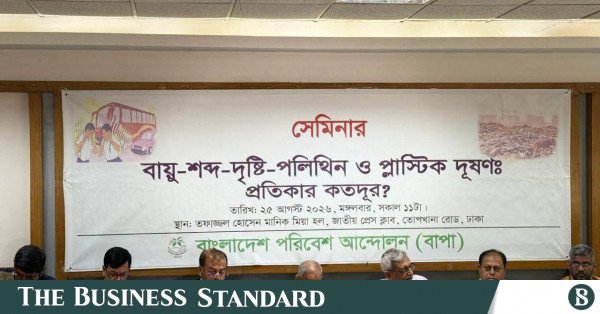
The demand was raised at a seminar titled “Air-Noise-Visual-Polythene and Plastic Pollution: How Far Has the Remedy Gone?” held today (25 August) at the Tofazzal Hossain Manik Mia Hall of the National Press Club.
Organised by BAPA, the seminar brought together environmentalists, academics, urban planners and leaders of environmental movements.

Speaking as chief guest, State Minister for Environment, Forest and Climate Change Sheikh Faridul Islam said that switching off billboard lights across the country after midnight would help reduce visual pollution as well as cut down on electricity wastage.
He said illegal brick kilns that burn wood to make bricks would be shut down after the monsoon season, and officials who approved such kilns would also face punishment. He added that the use of environment-friendly block bricks would be increased, unfit vehicles would be phased out, and the use of electric vehicles would gradually be promoted.
BAPA president Nur Mohammad Talukder said raising public awareness alone would not be enough to curb polythene and plastic pollution. He stressed the need to innovate and market eco-friendly alternative products and make them easily available to people.
Presenting the keynote paper, BAPA vice-president M. Feroz Ahmed said around 25,000 tonnes of solid waste is generated in the country every day, of which nearly 7,500 tonnes comes from Dhaka alone. He noted that per capita plastic use in urban areas has risen from 3kg in 2005 to around 9kg now, while in Dhaka it stands at about 22.25 kg per person.
He said the country generates around 800,000 tonnes of plastic waste annually, with 55% of total waste dumped haphazardly in open spaces. Polythene and plastic are blocking around 80% of the drainage system, he said, adding that this is having a long-term negative impact on rivers, wetlands, groundwater and ecosystems.
He called for the swift enforcement of the 3R (Reduce, Reuse, Recycle) law to control plastic and polythene pollution.
BAPA joint secretary Ahmed Kamruzzaman Majumder said air pollution is one of the biggest obstacles to Bangladesh’s environmental and economic progress, noting that it is reducing the average life expectancy of people in the country by about five and a half years.
He identified construction work and road digging, brick kilns and industrial factories, vehicles, smoke from household stoves, and waste burning as among the major sources of air pollution.
On noise pollution, he said sound levels exceed 60 decibels in 82% locations in Dhaka, with areas like Farmgate, Shahbagh and Gabtoli recording levels between 80 and 110 decibels.
He also pointed to rising visual pollution due to unplanned urbanisation, citing ESDO research showing the number of billboards in Dhaka rose 51% between 2019 and 2022, reaching 13,997.
Dhaka University Pro-Vice-Chancellor Abdus Salam said that despite long-standing efforts at various levels to protect the environment, desired results have not been achieved, noting that environmental considerations are often ignored in unplanned building construction. He called for proper enforcement of existing laws against polluters.
ESDO Secretary General Shahriar Hossain said people are inhaling large amounts of harmful particles through the air, leading to chronic coughing and various physical ailments, and he called for implementing a policy to recover compensation from polluters as well as strengthening regional cooperation to address transboundary pollution.
Architect Iqbal Habib said that alongside punishing polluters, incentives should be given, where necessary, to individuals and institutions playing an effective role in environmental protection. He urged young people to innovate alternatives to polythene.
BAPA Executive Member Ahsan Rony said Bangladesh is among the world’s top 20 countries contributing to plastic and polythene pollution. He also noted that an average family in Dhaka uses five polythene bags a day, with more than 25 million polythene bags discarded daily across the city, clogging drains and sewers.
BAPA General Secretary Md. Alamgir Kabir said it is necessary to investigate how a product banned in 2000 has again come into widespread use within a few years, adding that the responsibility lies not only with the public but also with the government and businesses.
10-Point Recommendations
The seminar put forward a 10-point set of recommendations to control air, noise, visual and plastic pollution.
These include regular mobile court drives against unfit vehicles emitting black smoke, including air quality and air pollution topics in the education curriculum, shutting down illegal brick kilns, making the use of block bricks mandatory in government construction work, introducing online air quality monitoring systems in industrial factories, strict enforcement of the Noise Pollution Rules 2025, regular noise testing of vehicles, controlling LED lights after 10pm, organising hanging electrical wires, increasing publicity around the 999 hotline and noise pollution control helplines, and automating the signal system.
Central leaders of BAPA were also present at the seminar.
About The Author