One of the key demands from investors was a reduction in borrowing costs under Bangladesh Bank’s Tk60,000 crore refinancing scheme for sick and closed industries.
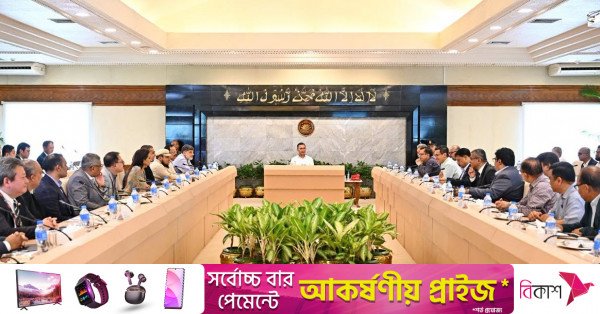
Prime Minister Tarique Rahman addressed investor business leaders at a roadshow organized for local and foreign investors at his office. Photo: PMO
“>

Prime Minister Tarique Rahman addressed investor business leaders at a roadshow organized for local and foreign investors at his office. Photo: PMO
Local and foreign investors have sought additional policy support, including cheaper financing and guaranteed gas supplies, to help revive 44 loss-making and shuttered state-owned industrial units.
The requests were raised at a meeting chaired by Prime Minister Tarique Rahman at his office today (20 June), where government officials presented investment opportunities in the factories and outlined plans for their revival through public-private partnerships (PPP), joint ventures, long-term leases and outright sales.
PM invites investment proposals

Assuring investors of the government’s support, the prime minister invited them to submit proposals for investing in the factories.
“Submit your proposals for investing in these factories through PPP arrangements, joint ventures or long-term leases. We will discuss what support you need and provide all necessary assistance,” Tarique was quoted as saying in a press release from the PMO.
One of the key demands from investors was a reduction in borrowing costs under Bangladesh Bank’s Tk60,000 crore refinancing scheme for sick and closed industries.
Bangladesh Bank Governor Mostaqur Rahman told the meeting that the central bank would examine proposals to lower interest rates under the facility.
Interest rate an issue
A business leader who attended the meeting told TBS on condition of anonymity that the governor said interest rates under the scheme currently range between 5% and 6%. While rates below 5% could make it difficult for banks to cover operating costs, Bangladesh Bank would consider reducing rates by another 1-2 percentage points for investors interested in reviving closed factories.
At the meeting, the government presented the current status of 44 factories under the industries ministry, highlighting their locations, land size, existing infrastructure, distance from seaports, investment incentives, transport connectivity and expansion potential.
Prime Minister’s Deputy Press Secretary Hasan Shiplu said the programme was jointly organised by the industries ministry, the textiles and jute ministry and Bangladesh Investment Development Authority (Bida).
Currently, 26% of the 107 factories under the industries ministry are loss-making, while 64% remain closed.
44 factories on revival plan
The government plans to revive 44 factories – including 12 under the Bangladesh Textile Mills Association, four under the Bangladesh Steel and Engineering Corporation, 10 under the Bangladesh Chemical Industries Corporation, 13 under the Bangladesh Sugar and Food Industries Corporation and five under the Bangladesh Jute Mills Corporation – through sales, long-term leases, PPP arrangements or joint investments.
Transcom Group CEO Simin Rahman sought clarification on the terms and conditions for reviving the factories and proposed additional financial incentives for investors.
One business leader expressed interest in cultivating sugar beet on land belonging to closed sugar mills and producing sugar locally.
Responding to the suggestions, the prime minister said: “As I have said before, move forward and we want to support you. You have raised a number of issues and suggested ways in which assistance can be provided quickly. We have already started working on some of these matters.”
Tarique Rahman added: “The primary responsibility of a political government is to remove obstacles and create pathways to overcome problems. Realistically, we cannot solve every issue at once, but we can address them gradually and systematically.”
Leading businesses attend
Participants included Meghna Group Chairman Mostafa Kamal, TK Group Director Mohammad Mostafa Haider, PRAN-RFL Group Chairman Ahsan Khan Chowdhury, ACI Managing Director Arif Dowla, Lal Teer Managing Director Mahbub Anam, Walton Hi-Tech Park Managing Director Mahbub Alam, Runner Group Chairman Hafizur Rahman Khan, Sayham Group Chairman Syed Sazzad Ahmed, Transcom Group CEO Simin Rahman, Nabil Group Managing Director Aminul Islam and senior executives from BRAC, Square, Akij and other major business groups.
Representatives from Japanese companies including Marubeni Corporation, Toyota Tsusho Corporation, Sumitomo Corporation, MUFG Bank, Mitsui & Co and Sojitz Corporation, along with officials from Jetro Bangladesh and the Japanese Embassy, also attended.
Government representatives included Finance and Planning Minister Amir Khosru Mahmud Chowdhury, Commerce, Industries and Textiles & Jute Minister Khandaker Abdul Muqtadir, prime minister’s Finance and Planning Adviser Rashed Al Mahmud Titumir, ICT and Science & Technology Adviser Rehan Asif Asad, Bangladesh Investment Development Authority (Bida) Executive Chairman Ashik Chowdhury, Bangladesh Bank Governor Mostaqur Rahman, Principal Secretary ABM Abdus Sattar and senior officials from relevant ministries.
About The Author