Some could not open businesses at all; others remain busy draining water.
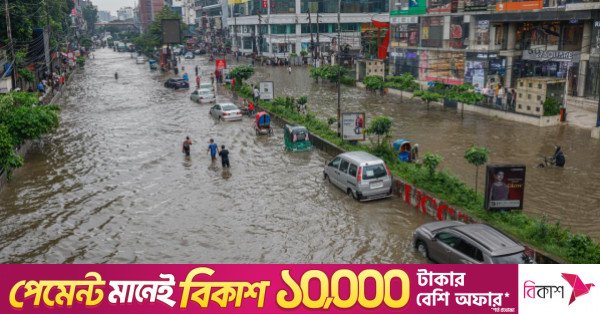
People wade through knee-deep water while vehicles struggle along a flooded road in Dhanmondi 27 of the capital after heavy rain triggered severe waterlogging across parts of the capital. Photo: TBS/Rajib Dhar
“>

People wade through knee-deep water while vehicles struggle along a flooded road in Dhanmondi 27 of the capital after heavy rain triggered severe waterlogging across parts of the capital. Photo: TBS/Rajib Dhar
Heavy overnight rainfall, followed by incessant showers today (12 July), left several of Dhaka’s major markets waterlogged, forcing shop closures, disrupting trade, and causing significant losses to businesses.
Commercial activity ground to a halt in some of the capital’s important trading centres, including New Market, Gausia Market, Chandrima Super Market, Noorjahan Market, Elephant Road and Karwan Bazar, as floodwater submerged roads, pavements and shops.
While some traders were unable to open their businesses at all, others spent much of the day draining water and shifting merchandise to safer locations.

A visit to the New Market area found knee-to-waist-deep water at the market entrances, on surrounding roads and footpaths, and inside ground-floor shops. Many shutters remained down, while traders and employees focused on draining water and protecting goods rather than serving customers. Water also entered several food outlets inside the market.
Nur Mohammad, a clothing trader at New Market, told TBS that he found his shop flooded when he arrived in the morning after the overnight rain, making it impossible to open for business.
Over the past week, he said, persistent rainfall had forced traders to open and close intermittently. “Even a single day of closure causes losses of more than Tk10,000, while expenses such as rent and staff salaries continue regardless.”
Another trader, Sajib Mia, said waterlogging had become a recurring problem every monsoon season, with no permanent solution in sight despite years of disruption.
“Every year, we witness the same situation. We cannot open our shops and have to bear losses. We only want a lasting drainage solution,” he said.
New Market remains closed
All shops at New Market remained closed from today morning because of waterlogging. Electricity supplies to the market were also temporarily disconnected for safety reasons, according to Firoz Ul Islam, office secretary of the New Market Traders’ Association.
He said a decision on reopening the market would be taken on Monday after reviewing the situation.
A similar picture emerged at Gausia Market, Chandrima Super Market and Noorjahan Market, where floodwater entered several ground-floor shops, soaking clothes and other merchandise.
Traders said that even those who managed to open their shops saw little business because customers stayed away. Although wet garments could be dried and sold later, they were unlikely to fetch their original prices.
The disruption also hit small businesses operating in the area. Most pavements around New Market remained largely deserted until the afternoon, with tea stalls, fruit vendors, snack sellers and cobblers among those forced to suspend operations.
Fruit seller Morshed said he had set out with his stock at dawn but was unable to arrange his stall because of the rain. By midday, he had not sold a single item.
Cobbler Ritwik Karmakar said the reduced number of people outdoors during rainy weather had left him without customers throughout the morning.
Sales slump at Karwan Bazar
Conditions were a little better at Karwan Bazar, where water had yet to recede fully by the afternoon. Waterlogging in several parts of the wholesale market forced customers and labourers to wade through muddy water, disrupting the transport of goods and hampering business operations.
Puddles remained in low-lying areas, while mud and stagnant water outside shops affected normal trading activity.
Mohammad Sohel, a wholesale vegetable trader, said sales between dawn and 10am normally amounted to between Tk50,000 and Tk60,000. Today, however, sales had failed to reach Tk15,000 by midday.
“Several sacks of spinach, coriander, red amaranth and green chillies have been soaked after floodwater entered the market. These products can no longer be sold at their previous prices, and some may have to be discarded,” he said.
Another trader, Abdur Latif, said rainwater entered the market shortly after produce had been unloaded from trucks early in the morning.
He estimated that tomatoes, aubergines, cucumbers and leafy vegetables worth between Tk20,000 and Tk25,000 were at risk of spoilage.
“Wet vegetables cannot be stored for long, so we will have to sell them at lower prices. Sales have fallen, while merchandise is also being damaged, leaving us to absorb losses on both fronts,” he said.
About The Author