He says there is little interest or initiative to comply with environmental laws, while a tendency has emerged to view them as obstacles to development.
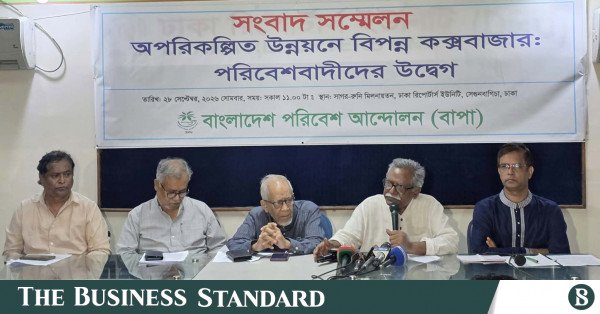
Economist Anu Muhammad (second from right) speaks at a press conference titled “Cox’s Bazar Endangered by Unplanned Development: Environmentalists’ Concern” organised by Bangladesh Poribesh Andolon (Bapa) at Dhaka Reporters Unity today, 28 September 2026. Photo: Collected
“>

Economist Anu Muhammad (second from right) speaks at a press conference titled “Cox’s Bazar Endangered by Unplanned Development: Environmentalists’ Concern” organised by Bangladesh Poribesh Andolon (Bapa) at Dhaka Reporters Unity today, 28 September 2026. Photo: Collected
Economist Anu Muhammad has alleged that efforts are underway within other ministries to render the Ministry of Environment, Forest and Climate Change ineffective, while development projects continue to disregard environmental laws and damage natural defences.
He said there is little interest or initiative to comply with environmental laws, while a tendency has emerged to view them as obstacles to development.
He made the remarks at a press conference titled “Cox’s Bazar Endangered by Unplanned Development: Environmentalists’ Concern” at Dhaka Reporters Unity today (28 September).

Bangladesh Poribesh Andolon (Bapa) organised the press conference against the backdrop of road construction on the sandy beach of Cox’s Bazar, a Local Government Engineering Department road project through the reserved forest in Moheshkhali, and the destruction of mangroves in Sonadia Island for shrimp enclosures.
Questioning the environment ministry’s role, Anu Muhammad said its effective involvement in enforcing environmental laws is not visible.
“It cannot be felt at all that there is a ministry called the ‘environment ministry’ in Bangladesh. There is indeed an environment ministry, but no interest, willingness, or initiative to abide by environmental laws is seen; rather, downright annoyance is visible among them,” he said.
He said environmental laws are intended to ensure that development is sustainable.
“Development that cannot create a better place for the future, for future generations, cannot be called development; it may be a project for a few people to make money, but not development,” he said.
Anu Muhammad said two tendencies are visible in government decision-making and project implementation – greed and a lack of thought.
“‘Foolishness and greed – when these two come together, the kind of danger that can occur is precisely what we are witnessing in Bangladesh,” he said.
He said the pattern of development projects had not changed despite the change in government.
“The main nature of the problems of the Hasina government for which the people of Bangladesh were aggrieved was undertaking various projects one after another to give business to certain groups, without thinking about the future of the people and the country, without thinking about life, nature, and the environment,” he said.
“The current government is an elected government. But looking at their attitude over these six to seven months, it feels as if they are speaking in the very language of autocracy,” he said.
He said ministers of an elected government must respect the law and protect the interests of the people.
“People voted for them; taking people’s votes cannot be used to protect the interests of certain groups,” he said. “This life, nature, and environment is a question of the people’s existence – it must be protected.”
Development projects worsening climate risks
Anu Muhammad said Bangladesh is highly vulnerable to climate change, with rising sea levels, increasing sea temperatures and saltwater intrusion threatening settlements, people and nature.
He said coastal protection should be strengthened to minimise the impact of these risks, but development projects from the Sundarbans to Cox’s Bazar and Banshkhali are instead damaging natural coastal defences.
Criticising road construction on the Cox’s Bazar beach, he said beaches and sand dunes absorb the force of waves and water flow and help prevent coastal erosion.
“Building a road on sand dunes – it is beyond imagination,” he said. “Basic common sense says that the sea beach keeps the seawater within a specific boundary.”
He said unplanned development is increasing erosion by obstructing the natural flow of water.
“Building a road across a sea beach – no one can even fathom how this thought could enter someone’s mind,” he said, adding that such a road would not last.
Referring to road construction through the hills of Moheshkhali, he said such projects were increasing rather than reducing climate risks.
“Building a road through the hills is not work aimed at countering climate change threats; it is work that increases the threat further,” he said.
He cited the destruction of the Chakaria Sundarbans as an example of how development can undermine natural protection against climate risks.
“The Chakaria Sundarbans was also a strong protective shield for that region. For what reason was it destroyed? It was destroyed precisely because of such development projects,” he said.
According to Anu Muhammad, the forest was gradually destroyed over two decades to establish shrimp enclosures, with World Bank loan money and the participation of Grameen Bank.
“Exactly the same thing is now being done in the Sonadia forest, and a road is being built through the Moheshkhali hills,” he said.
The press conference was chaired by Bapa President Professor Nur Mohammad Talukder. General Secretary Md Alamgir Kabir, Bapa Cox’s Bazar District Branch General Secretary Kalim Ullah and leaders from various levels of the organisation were also present.
About The Author