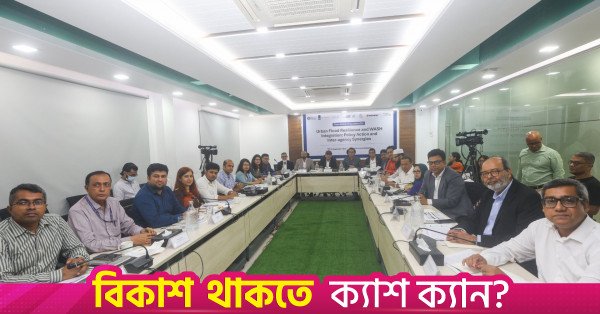
Bangladesh needs an integrated approach that combines flood management, solid and sewage waste management, water and sanitation, land use and urban planning to address its growing urban flooding and waterlogging, instead of a siloed approach, experts said at a roundtable.
They stressed that adopting the principles of the Bangladesh Delta Plan, especially long-term planning, adaptive management and partnerships with private and academia, is essential, allowing strategies to be regularly reviewed and adjusted based on changing conditions, uncertainties of climate change and development challenges.
The experts gave insights at the roundtable, “Urban Flood Resilience and WASH Integration: Policy Action and Inter-agency Synergies,” organised jointly by the Center for Environmental and Geographic Information Services (CEGIS), RedOrange and The Business Standard at the newspaper’s conference room today (10 September).

WASH integration combines water, sanitation and hygiene programs with sectors such as health, nutrition and environmental conservation to achieve sustainable outcomes.
Addressing the event as the chief guest, Dr Md Saimum Parvez, special assistant to the prime minister on environment, forestry and climate change, said the government’s long-term development vision considers the needs of future generations.
“Flooding is a permanent reality in Bangladesh. We need to plan to live with water, rather than fight against it,” he said, stressing the potential of nature-based solutions.
Referring to long-term knowledge of the Netherlands in Delta Management, he said they can adopt best practices locally and also learn from abroad.
He said the government has taken initiatives to re-excavate nearly 20,000 km of canals and restore rivers nationwide, including major rivers surrounding Dhaka, to revive natural drainage systems.
The special assistant also called for greater priority for poor and marginalised communities, who suffer disproportionately from urban waterlogging and WASH-related crises.
Presenting the keynote paper, Dr Mashfiqus Salehin, professor of the Institute of Water and Flood Management at Bangladesh University of Engineering and Technology, said drainage, stormwater, solid waste, sewage and WASH cannot be treated as separate issues.
“An integrated system-based approach is needed, with clear responsibilities and coordination among the relevant agencies,” he said.
Citing Dhaka and Chattogram’s waterlogging last July as an example, he said climate change could increase incidents of extremely heavy rainfall within short periods in the future.
“Without integrated management instead of fragmented initiatives, urban waterlogging will become more severe,” he said.
Professor Salehin said 141 waterlogging hotspots have already been identified in Dhaka, while untreated sewage and faecal waste entering water bodies are worsening both drainage and public health problems.
He stressed that authorities must focus not only on infrastructure construction but also on operation and maintenance, regular monitoring and coordinated action before, during and after disasters.
The expert said long-term plans should set clear targets for where Bangladesh wants to be in 20 or 30 years, while allowing the strategies to reach those targets to change with circumstances.
“The Delta Plan 2100 can be updated but the principles like adaptive approach, private sector engagement and long-term visioning should be continued,” he said.
Senior Policy Adviser at the Embassy of the Kingdom of the Netherlands in Dhaka Dr Md Shibly Sadik said Bangladesh’s WASH and water-management challenges are complex and have no single solution.
He said the Delta Plan 2100 should not simply be viewed as a “100-year plan”. Rather, its key objective is to establish a framework for developing and implementing long-term plans that can adapt over time.
Dr SM Zobaidul Kabir, joint chief of the General Economics Division at the Bangladesh Planning Commission, said eight studies, including six hotspot-based and one urban-focused study, have been conducted under the Delta Plan to determine regional investment priorities.
He said development projects are now screened through the Delta Appraisal Framework to assess their compatibility with Adaptive Delta Management and their contribution to the goals of the Delta Plan.
Md Motaleb Hossain Sarker, executive director (acting) of CEGIS, said the Delta Plan 2100 is not a fixed 100-year blueprint but a “dynamic and adaptive document”.
Dr Md Akter Mahmud, professor of Urban and Regional Planning Department at Jahangirnagar University, noted that Rajdhani Unnayan Kartripakkha, the Urban Development Directorate (UDD) and city corporations are preparing separate master plans, but a lack of coordination is preventing many projects from delivering expected results.
Dr Uday Sankar Das, senior planner of the UDD, said “UDD is responsible for making master plans at district and upazila Level. However, implementation of plans is to be ensured.”
Dr Farhana Ahmed, adaptive delta management expert and principal specialist at CEGIS, said integrating urban flood resilience and WASH management remains a major challenge.
“An integrated planning framework linked with spatial planning strategies as suggested in the Delta Management Strategies is needed instead of fragmented plans, for dealing with uncertainties of climate change and socio-economic development,” she said.
Farhana stressed the need for continuous post-project monitoring from districts and upazilas to grassroots levels engaging the local community.
Arnob Chakrabarty, founder and managing director of RedOrange Limited, said Bangladesh’s WASH challenges are complex and unstructured, requiring a long-term, integrated and adaptive approach rather than fragmented interventions.
Monowar-ul Haq, associate specialist at the Water Resources Management Division of CEGIS, shared his experience about the case study of Chattogram and the coordination gap leading to recurring flood hazards and its impact on WASH.
Naeema Jahan Zinia, co-founder and director of Business Development and Operations at Environmental Management Solutions, moderated the discussion.
About The Author