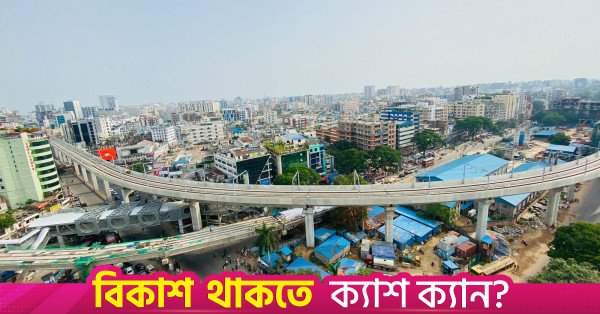
The revised cost estimates of Dhaka’s Metro Rail Line-1 and Line-5 Northern projects are set to be reduced by at least Tk4,800 crore at the initial stage as the government moves to rationalise their sharply increased budgets.
An inter-ministerial committee has also been formed to review and rationalise the revised proposals. The committee, headed by Planning Commission Additional Secretary Md Ali Reza Siddiquee, will begin work from today.
The decisions were taken at a Project Evaluation Committee (PEC) meeting yesterday (30 August) to review the revised proposals for Line-1, connecting Dhaka airport and Kamalapur, and Line-5 Northern, connecting Hemayetpur and Bhatara, according to planning officials.

The two projects, for which implementation began in 2019, were originally estimated to cost Tk93,799.98 crore. The first revised proposals submitted to the Planning Commission earlier this month sought to raise their combined cost to Tk2,13,989 crore.
The proposed increase triggered scrutiny by the Planning Commission, which reviewed the costs of different packages under the two projects at the PEC meeting.
Planning officials said the PEC reviewed various project packages and decided to cut about Tk4,000 crore from the revised cost of Line-1 and Tk800 crore from Line-5 Northern. Further cuts could be made following detailed scrutiny by the inter-ministerial committee.
Implementation of the two projects had remained largely stalled for about a year and a half after bidders quoted significantly higher prices than the estimates for several packages.
The delays occurred during the interim government and continued afterwards, prompting the authorities to reassess the project costs and implementation plans.
Planning Commission and Dhaka Mass Transit Company Limited (DMTCL) officials said the government wants to proceed with both projects and expedite their approval so the current government can start at least some parts of the two projects before within its tenure.
MRT-1 cost proposed to rise 130%
The MRT Line-1 was approved in October 2019 at an estimated cost of Tk52,561.43 crore. The project was scheduled for completion between September 2019 and December 2026.
However, the DMTCL earlier this month proposed raising the cost of the project by 129.82% to Tk120,794 crore. It also proposed completing the project by December 2035.
The revised proposal attributes much of the cost increase to changes made during detailed design, exchange-rate depreciation, and higher bids submitted by contractors.
The proposal said the approved project was based on a 2018 preliminary design, while detailed site investigations later led to structural changes that increased civil works costs.
For example, the maximum thickness of diaphragm walls was increased from 1 metre to 1.5 metres, while station boxes were deepened from 3 metres to at least 5.5 metres.
Besides, station lengths have been increased, exit and entry ventilation shafts relocated, and nearly 20km of detour roads and 3.99km of additional track have been added.
The proposal also cited the depreciation of the taka. The dollar exchange rate was Tk85.80 when the project was approved in 2019, compared with about Tk123 now.
The depreciation has increased costs under the supervision consultancy component by Tk2,042.70 crore. The supervision consultancy allocation was originally Tk1,390 crore for 22,671 person-months. The requirement has since increased by 5,929 person-months.
The revised proposal says contractors added risk premiums to their bids to cover geological risks, potential damage to buildings foundations in densely populated Dhaka. Spending on outsourced staff has also been increased to about Tk25 crore.
As of July, the project had achieved 7.30% physical progress, while cumulative financial progress stood at Tk3,905.68 crore, or 3.24% of the proposed revised cost.
The 31.241km line comprises 19.872km airport route, which will be entirely underground, and the 11.369km Purbachal Route, which will be partly underground and partly elevated.
MRT-5 cost proposed to rise 126%
The MRT Line-5 Northern project was approved in 2019 at a cost of Tk41,238.54 crore. The revised proposal seeks a 125.98% increase, raising the cost to Tk93,190.96 crore.
The 20km route was originally targeted for completion by 2028. The revised proposal pushes the completion deadline to 2034. DMTCL plans to begin passenger services in January 2033.
The revised proposal attributes the higher costs to the exchange rate, inflation, rising labour costs, design changes, depot expansion, and higher imported equipment and service costs.
The proposal said the higher dollar rate has raised the cost of imported rolling stock, electromechanical systems, railway technology and foreign consultancy services.
It said inflation was estimated at 4.7% when the original DPP was prepared in 2018, but has remained close to 10% in recent years. Labour costs increased by around 50-55%, raising construction, underground works, utility relocation and depot development costs.
Changes to the detailed design have also increased costs. In particular, Gulshan-2 and Natun Bazar stations were deepened by around 15 metres and 7 metres respectively. The depth and length of most stations were also increased, raising project costs by up to 40%.
Besides, the proposed depot area has been expanded from 22 hectares to 39 hectares, increasing costs for land development, drainage, roads and other infrastructure.
Additional costs have also been included to address risks associated with underground construction in densely populated areas, including potential damage to nearby structures.
Upgrades to rolling stock and railway systems have further increased the estimate. Land acquisition, resettlement and utility relocation have become more expensive because of the time and coordination required in densely populated areas.
According to DMTCL, 13.50km of the 20km route will be underground and 6.50km elevated. The line will have 14 stations, including nine underground and five elevated stations.
As of July 2026, cumulative financial progress stood at Tk3,901.77 crore, or 9.46% of the original project cost, while physical progress reached 10.2%.
About The Author