At the centre of the dispute is a key question: who authorised the event and under what terms.
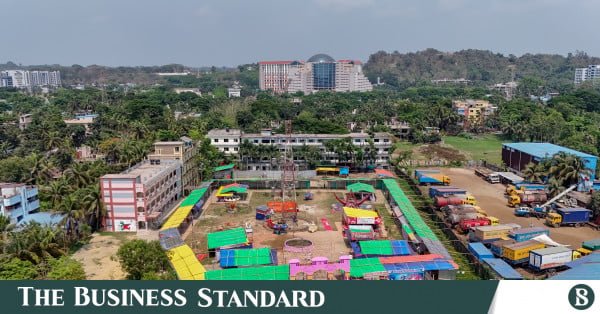
Construction work for a month-long fair was seen in full swing across the college field beside the highway, with pavilions and structures being set up despite government restrictions on non-educational use of school grounds. Locals said the fair began on Tuesday, raising concerns among students and guardians over the use of the playground. Photo: TBS
“>

Construction work for a month-long fair was seen in full swing across the college field beside the highway, with pavilions and structures being set up despite government restrictions on non-educational use of school grounds. Locals said the fair began on Tuesday, raising concerns among students and guardians over the use of the playground. Photo: TBS
A month-long rural small and cottage industry fair at Bijoy Smarani University College field in Sitakunda upazila of Chattogram has triggered controversy over alleged violations of government rules on the use of educational institution playgrounds, administrative oversight, and conflicting claims over permission.
At the centre of the dispute is a key question: who authorised the event and under what terms.
The issue escalated after The Business Standard began inquiries into the fair, prompting administrative intervention. Officials subsequently shut it down, even though preparations had been completed and the event had already begun operating on the college grounds.

Upazila Nirbahi Officer (UNO) and Chairman of the college’s governing body, Md Fakhrul Islam, told TBS the fair was shut down immediately as it had no approval, and further action is under review.
He said the college administration failed to inform the governing body and that the principal would be held accountable after assessment and consultation with higher authorities.
College Principal Shib Shankar Shil told TBS, “Our classes run until around 3-4pm, and the fair starts afterwards. I am not aware of any permission. Local and political individuals are organising the fair; any approval for it is a matter that falls under the responsibility of the administration.”
As official explanations emerged, competing claims surfaced from political and local actors, each presenting a different version of how the fair proceeded.
Sitalakunda Samaj Kalyan Federation President Lion Md Gias Uddin alleged that preparations had been ongoing for nearly a month and suggested political involvement.
He further argued that since the UNO also serves as the chairman of the governing body, the event could not have taken place without administrative knowledge or approval.
Teachers of the college alleged that a syndicate involving administrative figures facilitated the fair for financial gain.
They claimed a similar event last year generated around Tk60 lakh and that the same group had again taken control of the field.
Sitalakunda Upazila BNP Member Secretary Md Morsalin claimed that the fair initially had institutional backing.
“We were invited during the inauguration and attended. Later, considering electricity savings, it was shut down from the Deputy Commissioner’s office,” he said.
Fair organiser Helal Uddin Babar maintained that the deputy commissioner had initially given verbal approval but later withdrew it.
“The DC sir had verbally allowed it, but later he prohibited it even after traders had prepared all arrangements. If written permission is given, the fair will be organised,” he said.
However, Chattogram Deputy Commissioner Md Jahidul Islam Miah rejected the claim outright.
“At least I have not approved any such fair. Upon receiving information, I sent the Assistant Commissioner (Land) and shut it down. Nothing runs from the DC office without written permission,” he said.
He added that no fair can operate on informal consent and warned that action would be taken if such events continue.
The controversy is rooted in a clear policy framework. A 30 March directive from the Secondary and Higher Education Division instructed that school and college playgrounds must be preserved for students’ physical and mental development and remain free from non-educational use.
Officials and education stakeholders noted that preparing and dismantling such fairs typically takes around two months in total, during which playgrounds remain unavailable for students, affecting sports and extracurricular activities.
Overall, questions have been raised as to how, despite clear government directives, a school or college playground was taken over for a fair, and why the administration was unaware of it.
On the ground, it was seen that construction of pavilions and structures for a month-long fair was seen underway at the college field beside a highway, which locals said began Tuesday (21 April) despite rules banning non-educational use of school grounds.
The field, the only major space for student activities, has been damaged and may remain unusable for months.
Locals alleged that similar fairs have been held in other educational grounds as well, including Shahid Shahjahan field beside Pahartali Railway School.
Concerns have also been raised as SSC examination centres are located near some of these fair venues, raising fears of disruption and security risks for examinees.
About The Author