As tidal waters rise, the sound of erosion echoes along river and canal banks across Bangladesh’s coast. In some places, rivers swallow homesteads; elsewhere, the soil of newly formed chars disappears within a single monsoon.
Now, in these areas that have battled erosion and salinity for years, a new initiative aims to heal nature’s wounds with nature itself.
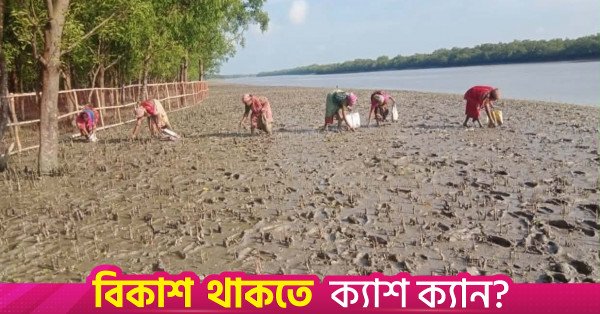
A local community-led initiative has been launched to restore mangroves on erosion-hit chars along rivers and canals near the Sundarbans. Initially, afforestation will cover 11 kilometres of the Sundarbans-adjacent coastal area.

Jagrata Juba Sangha (JJS), a Khulna-based NGO, will implement the initiative under a project titled “Community-Based Mangrove Micro-Restoration for Climate Resilience in the Sundarbans”.
Talking to The Business Standard, JJS Executive Director ATM Zakir Hossain said the programme is not simply about planting trees.
“The goal is to restore mangrove habitats on a small scale while using local people’s knowledge, labour, and participation to make the coast more resilient to the impacts of climate change,” he said.
Dr Mominul Islam Nahid, senior research officer at the Mangrove Silviculture Division of the Bangladesh Forest Research Institute (BFRI) and a consultant in this project, said mangroves serve multiple functions along the coast.
They provide habitats for biodiversity, breeding grounds for fish and aquatic life, store carbon, and form part of a natural system linked to the livelihoods of the locals, he said.
“Restoring mangroves outside the Sundarbans could positively affect coastal land and water systems while strengthening the livelihoods of people dependent on fish, crabs, honey, and other natural resources,” he added.
Nahid said the Sundarbans, the world’s largest single block of natural mangrove forest spanning Khulna, Bagerhat, and Satkhira, has long provided natural protection to coastal communities from cyclones, storm surges, and tidal impacts.
Expanding mangrove cover on river and canal chars, newly formed sedimentary land, and eroding coastal areas outside the Sundarbans could extend that natural protection further, he said.
The project places particular emphasis on involving local communities throughout the process, from site selection and seedling production to planting, maintenance, and monitoring.
Zakir said local communities must be treated as partners rather than merely project workers if such initiatives are to be sustainable. “They will be made partners in decision-making.”
Another project consultant, Md Abdullah Al-Mamun Palash, a lecturer at Khulna University’s Forestry and Wood Technology Discipline, said the success of a mangrove restoration project largely depends on local participation.
“Because locals have long experience of where and when tides come in, where sediment accumulates, which areas suffer more erosion, and which plants can survive in the local environment,” he told TBS.
Based on this approach, he said, a phased framework for community-based mangrove micro-restoration has been developed. The process will begin with selecting potential sites, consulting union parishads, site visits, and holding community meetings.
This will be followed by forming project implementation committees, planning assisted natural regeneration (ANR) and plantation activities, preparing worker lists, implementing cash-for-work programmes, planting, and regular monitoring, Palash said.
“Most importantly, arrangements are also being made so that local committees can continue the work even after plantation is completed,” he added.
Khulna Circle Conservator of Forests Imran Ahmed said an erosion-hit coastal char may initially appear to be nothing more than a stretch of sediment, mud, and saline water. “But once mangrove roots spread across it, that char can eventually become a refuge for fish, a habitat for birds, and a natural protective belt for people,” he said.
He said tangible results of such initiatives have already been seen in several areas near the Sundarbans. Mangrove vegetation expanded visibly after assisted natural regeneration activities took place in East Kalinagar of Shyamnagar Upazila in Satkhira.
Similar results have also been observed in Shailkhali and Kaikhali areas, he added.
However, as the impacts of climate change intensify in coastal areas, so do the risks of river erosion, salinity, and tidal surges, Imran added.
Against this backdrop, such initiatives are highlighting the growing importance of nature-based solutions alongside infrastructure in protecting vulnerable coastal communities, he said.
About The Author