State Minister for Civil Aviation and Tourism Rashiduzzaman Millat recently told the media that reopening closed airports is being considered on a priority basis.
Infographics: TBS
“>

Infographics: TBS
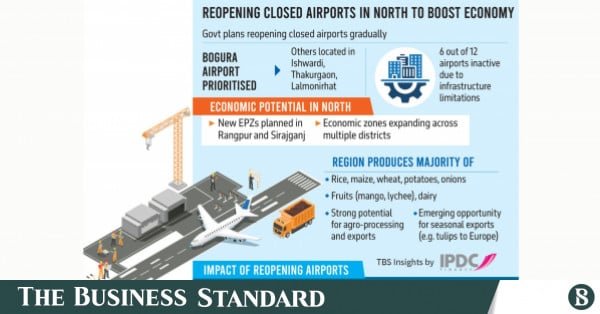
The government has taken an initiative to gradually reactivate closed domestic airports in northern districts to boost regional economic activity through improved connectivity.
Bogura Airport tops the Civil Aviation Authority of Bangladesh (Caab)’s priority list followed by Ishwardi, Thakurgaon and Lalmonirhat as part of a broader plan to revitalise underutilised aviation infrastructure in the north.
State Minister for Civil Aviation and Tourism Rashiduzzaman Millat recently told the media that reopening closed airports is being considered on a priority basis.
The move aligns with the BNP’s election manifesto, which emphasises reducing regional disparities by accelerating industrialisation in northern Bangladesh. To advance this goal, Prime Minister Tarique Rahman recently held a meeting this month to woo leading agro-processors to explore potentials in northern districts rich with farm output.

Rashed Al Mahmud Titumir, adviser to the prime minister on finance and planning, recently highlighted the region’s unique export opportunities.
“Northern Bangladesh produces surplus crops, specifically fruit and milk. There is a significant opportunity to export Tulips grown there. When Tulip production ceases in Europe during certain seasons, they are in full bloom in Northern Bangladesh, creating a prime window for the European market,” he said.
Officials said the Bangladesh Export Processing Zones Authority plans to establish new export processing zones in Rangpur and Sirajganj, while several economic zones are already approved or under development across the region, including near the Jamuna Bridge and in Kurigram.
Local businesspeople believe improved air connectivity will revitalise the northern economy through large-scale industrial initiatives.
Four of six closed airports located in North
Six of the country’s 12 airports have remained inactive for years. Four of them are located in the North and two others in Cumilla and Moulvibazar’s Shamshernagar.
Most of these airfields were originally constructed during the British era and some were operational during the Pakistan period.
Caab has already conducted a preliminary assessment regarding their reopening.
Air Commodore Nur-e-Alam, member of Air Traffic Management at Caab, told The Business Standard that the initiative is in its early stages, as detailed feasibility studies are yet to be finalised, nor any definitive cost estimates have been made.
Caab has planned to float tenders to appoint external consultancy firms to analyse infrastructure requirements, market demand, land acquisition needs, and project costs.
The Caab official initial efforts are focused on Bogura Airport.
“The development of an airport in any region stimulates economic activity, and northern Bangladesh will be no exception,” he said.
Currently, domestic airports in Cox’s Bazar, Rajshahi, Jashore, Saidpur, Sylhet, and Barisal remain operational. National flag carrier Biman Bangladesh Airlines, alongside private carriers such as NovoAir, US-Bangla Airlines, and Air Astra, continue to operate regular flights connecting these regions to Dhaka.
Why focus on northern airports
Significant industrial developments are underway across Northern Bangladesh. A major economic zone is being established near the Jamuna Bridge in Sirajganj, while a dedicated special economic zone is being set up in Kurigram for Bhutan. Additional projects are also progressing in Rajshahi, Rangpur, Natore, Panchagarh, Dinajpur, and Gaibandha.
Analysts believe that reopening of abandoned airports – starting with Bogura – will help unlock the full economic potential of the northern region, which has already got two EPZs. Several economic zones are also planned there. An EPZ will be built on 450 acres of land of Rangpur Sugar Mills, which will create one lakh jobs.
Established in 2001, Ishwardi EPZ gained global fame in 2012 when Vintage Denim Studio became the country’s first LEED Platinum-certified green factory. Today, the zone facilitates over $2.21 billion in exports and employs more than 21,000 workers.
Bangladesh Export Processing Zones Authority (BEPZA) Executive Chairman Major General Mohammad Moazzem Hossain said, “EPZs in Rangpur and Sirajganj are in the planning stages. Once these projects are complete, the geographical footprint of Bangladesh’s industrialisation will expand significantly.”
Despite being built to international standards in the early 1990s and completed in 2000, Bogura Airport remains unused. A new government initiative proposes acquiring 550 acres of additional land to facilitate its reopening. Last year, a high-level delegation, including the Chief of Air Staff and the Caab chairman, visited the site to assess its readiness.
Stakeholders have emphasised Bogura’s strategic importance, noting its proximity to the historic Mahasthangarh and its robust industrial base, which includes major facilities such as Essential Drugs Company Limited and Uttara Motors.
Kamrul Islam, spokesperson for US-Bangla Airlines, highlighted the viability of these routes: “We have long urged the reopening of domestic airports. Small aircraft with 17-18 seats could be deployed on routes like Dhaka-Bogura and Dhaka-Thakurgaon; these operations would be viable even with as few as 10-11 passengers.”
He also stressed the urgency of reopening Ishwardi Airport, citing its proximity to the Rooppur Nuclear Power Plant and the high-performing Ishwardi EPZ.
Originally built during the British era, Ishwardi Airport saw regular commercial flights from 1962 to 1989. After a 17-year hiatus, it briefly resumed operations in 2013, only to close again in 2014. Airlines attribute these closures to insufficient runway length, inadequate fire safety facilities and weak air traffic management systems.
BNP focuses on agricultural industrialisation in North
In BNP’s manifesto, agro-based industrialisation has been given a top priority for employment and balanced development in the northern region, which grows the bulk of the country’s supply of rice, maize, wheat, potatoes, and onions. The region is a leading supplier of fruits – particularly mangoes and lychees – as well as flowers and dairy products.
The government will provide comprehensive support to 10 major industrial groups that have expressed interest and possess the necessary funds to invest in the North, Rashed Titumir said.
Chowdhury Ashik Mahmud Bin Harun, executive chairman of both the Bangladesh Investment Development Authority (BIDA), told TBS that efforts are underway to integrate Northern Bangladesh with neighbouring nations, specifically Bhutan and Nepal, to bolster cross-border trade.
The region’s underutilised state-owned industrial units can be revived through Public-Private Partnership (PPP) models, he said, stating his agency’s plan to develop district-based industrial clusters and engage with automotive manufacturers to explore new investment opportunities there.
The investment promotion agency chief said districts like Bogura have strong prospects in light engineering, while Rangpur shows promise in agro-processing.
Local businesses see opportunities
Bogura is one of the country’s key hubs for foundry industries, machinery, and sanitary product manufacturing. However, businesses are facing setbacks because of logistical challenges and inefficient transportation.
Given Bogura’s central location in the northern region, reopening its airport would benefit several nearby districts, including Naogaon, Gaibandha, and Sirajganj, local businesspeople said.
“Currently, it takes 8 to 10 hours to travel from Bogura to Dhaka by road. If the airport is open, travel time could be reduced to just one to two hours,” said Abu Mottaleb Manik, general secretary of the Yamaha Dealers Association in Bogura and a member of the Bogura Chamber.
“Due to the absence of an airport, many corporate and foreign visitors are reluctant to come to Bogura,” he said, hoping that making the airport operational would encourage investment.
He also noted it is also essential to operationalise Ishwardi Airport, considering the Rooppur Nuclear Power Plant, the EPZ, and the region’s agricultural potential.
Businesspeople further said that a large volume of vegetables is supplied daily from northern districts to Dhaka. However, due to traffic congestion, goods often fail to reach markets on time, resulting in losses for farmers and traders. The poultry sector faces similar challenges, as transportation delays lead to increased losses.
Experts urge assessing viability
Aviation experts have emphasised the need for a thorough assessment of both commercial and strategic viability before reopening closed or inactive airports in the country.
Many small airports were established in the past due to limited connectivity, but the context has changed significantly with the country’s infrastructural development, said Air Vice Marshal (retd) M Mafidur Rahman, former chairman of Caab.
“Therefore, only those airports that are commercially viable for regular flight operations should be prioritised,” he said.
“Some airports may be kept operational for strategic national interests, but in such cases, a clear plan and timeline must be set,” he added.
According to Mafidur, building infrastructure alone is not enough – its effective utilisation must be ensured; otherwise, it will lead to financial losses. Decisions should be made based on input from all stakeholders, including the government, airline operators, and passengers.
Regarding Bogura Airport, he noted that the presence of an Air Force training unit means that, with proper infrastructure development, it could also be used for civilian operations.
About The Author