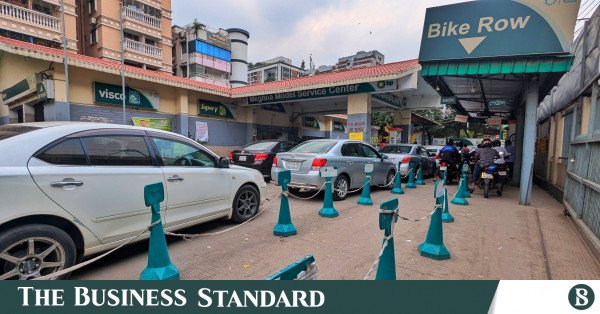
Based on March global prices and the current exchange rate, the import cost of octane is Tk105.73 per litre. After the latest price hike – driven by supply constraints and rising global prices – it is being sold at Tk140 per litre at pumps.
This means consumers are paying Tk34.27 more than the import cost per litre. Of this, Tk27.57 goes to the government as import duty, VAT, development surcharge, transport costs, and margins for state-owned distributors.
When local transport costs and dealers’ commissions are included, the total cost reaches Tk151.61 per litre – Tk11.61 higher than the retail price. The government counts this difference as a subsidy.

This creates a paradox: the government collects Tk27.57 per litre in taxes and charges, while also providing a subsidy of Tk11.61 per litre.
“This raises a valid question as to whether the government is truly subsidising octane,” economist Selim Raihan, executive director of the South Asian Network on Economic Modeling (Sanem), told The Business Standard.
The same is true for petrol, which is usually priced Tk4 lower than octane.
However, the situation differs markedly for diesel, the most widely used fuel in public and goods transport, irrigation, inland water transport, and fishing.
Rising global prices have pushed the import cost of diesel to Tk148.06 per litre, which increases to Tk203.84 after adding duties, taxes, and operational and marketing costs. However, the government has fixed the retail price at Tk115 per litre – even after a Tk15 increase – effectively subsidising more than Tk88.84 per litre. This figure still includes over Tk55.78 (or 37%) in taxes and other costs.
Speaking to this newspaper, analysts and consumer rights groups say this “subsidy” exists only because of the fuel oil tax burden, as fuel oil remains among the major revenue sources for the government. They argue that if taxes were reduced or waived temporarily, and only distribution costs were added to the import price, octane could be sold at a much lower price than it is now, requiring no subsidy.
Major economies in the region, including India and Pakistan, slashed fuel oil taxes to lower price shocks on the people. India marginally increased the price of premium-grade oil, but kept the prices of the most-consumed diesel and petrol unchanged.
Though Pakistan raised oil prices, it exempted or slashed taxes for diesel and petrol. The country also introduced free bus services in cities, cash subsidies for bikers and farmers.
The EU is planning to cut electricity taxes and provide consumers with targeted and temporary support. The USA offers tax breaks to lessen the impact of gasoline price hikes and politicians there are calling for the federal tax to be exempted – 18.4 cents per gallon.
Price hikes in Bangladesh, effective from 19 April, were not backed by any such measures.
Maintaining existing VAT and tax rates while raising retail prices in line with international trends amounts to an “extortionist approach,” where revenue generation appears to take precedence over public welfare, said Shamsul Alam, energy adviser at the Consumers Association of Bangladesh (Cab).
‘No hike’ means Tk2,764cr in monthly subsidy
If the government had followed the automatic pricing formula to set fuel prices in April, following the rise in international market rates after the Iran war, the price of diesel would have been Tk155.46 per litre, octane Tk148.93, and petrol Tk144.93.
Following the conditions of a loan taken from the International Monetary Fund in 2023, the government began adjusting prices monthly through an automatic system from the following year. However, the government did not increase fuel prices on 31 March.
Under the method, the current month’s price is determined by the average “Platts-based” market price from the 21st of the month before last to the 20th of the following month. This formula is used to set the prices for diesel and octane, while the price of petrol is always fixed at Tk4 less than that of octane.
According to a briefing by the energy ministry prepared ahead of the latest price hike on 18 April, the government had been providing subsidies of nearly Tk45 per litre for diesel and Tk29 per litre for octane prior to the adjustment.
Energy Division estimates suggest that following the rise in international market prices after the Iran war, the government would have had to provide Tk2,764 crore in subsidies every month based on average demand if domestic prices remained unchanged. Of this amount, Tk2,452 crore would have been allocated to diesel and Tk145 crore to octane, with the remainder subsidising petrol and kerosene.
However, as a result of the government’s decision to increase fuel prices on 18 April, the monthly subsidy burden will be reduced by approximately Tk800 crore. This means that even after the price hike, the government will still provide nearly Tk2,000 crore in fuel subsidies each month.
Despite the subsidy for octane being significantly lower than the vast amount spent on diesel, the Energy Division justified the steeper price increase for octane as a means of ensuring social and economic balance.
The ministry noted that diesel is directly linked to agricultural activities, the transport sector, freight movement, manufacturing, and the livelihoods of the general public. In contrast, octane consumption is relatively limited and primarily concentrated among higher-income groups.
Therefore, when adjusting prices, the Energy Division considered it a logical and policy-acceptable approach to place a comparatively lower burden on diesel while implementing a higher adjustment for octane, given the potential impact on public life and overall economic activity.
There are options
In the wake of the Iran war and the subsequent rise in fuel prices, several countries across Europe and Asia have attempted to keep prices manageable by reducing fuel duties. Pakistan, a fellow South Asian nation, has also slashed taxes on fuel. However, as Bangladesh has opted not to follow suit, consumers are forced to purchase fuel at much higher prices.
Selim Raihan said that the immediate hike in transport fares and commodity prices following the adjustment of fuel prices has had a direct impact on the general public.
He continued, “A portion of the revenue from fuel sales is transferred by the Bangladesh Petroleum Corporation (BPC) into their development fund, money essentially collected from the consumers. Temporarily suspending these transfers could have mitigated some of the pressure from the price hike.
“Similarly, while the commission rate for petrol pump owners remains unchanged, their total commission has increased significantly due to the higher sales value; a cap or adjustment could have been introduced here. Furthermore, a temporary waiver in the tax structure, similar to measures taken by neighbouring countries, could have been considered.
“In my view, by considering these three steps together – reducing taxes, pausing transfers to the BPC development fund, and implementing effective controls on commissions – the government could have achieved a more tolerable price adjustment.
“While this might have placed some pressure on revenue management, it would have lessened the direct impact on ordinary citizens. In the current situation, a transparent and balanced pricing policy is essential, prioritising consumer interests while moving towards long-term sustainable solutions.”
Shamsul Alam, Cab’s energy adviser, said reducing VAT and taxes on fuel is an accepted global practice to stabilise markets, cushion the impact of price spirals, and provide relief to consumers.
“Despite rising global oil price, our actual import costs remain significantly lower than what is being presented by the government,” he pointed out.
At a time when the government is struggling to ensure adequate fuel supply to meet demand, such pricing policies effectively deprive citizens of their right to fair pricing, he believed.
Treating the fuel sector primarily as a profit-making entity reflects a disregard for the hardships faced by consumers, Shamsul said.
Bangladesh is not unique to global shocks, but it lags behind regional countries in managing the crisis judiciously, analysts say.
Cab Vice-President SM Nazer Hossain said the government, instead of raising fuel prices amid consumers’ hardship, could have temporarily exempted duties.
“Though Bangladesh’s recent fuel price change is a response to global pressures, the policy choices have raised some valid concerns,” said Fahmida Khatun, executive director, Centre for Policy Dialogue.
The economist referred to the immediate effects of oil price hikes translated into increased transportation costs, hitting low- and middle-income households hardest.
Instead, she said, the government could have taken some practical steps to reduce the impact of rising fuel prices. “For example, the government could have temporarily reduced fuel taxes, restrained dealer commissions for now, and avoided tapping into the Bangladesh Petroleum Corporation development fund unless absolutely essential.”
While these actions would not eliminate the price hike completely, they could have relieved the burden on ordinary people, Fahmida added.
Understandably, she said, the government’s limited fiscal capacity means it cannot afford large subsidies for long. “But the adjustment could have been managed more carefully, with the burden shared more fairly across stakeholders, which would also improve public confidence.”
There should be a balanced approach in light of high inflation and the hardships faced by common people, Fahmida said, suggesting that targeted support for the poor should be provided through fiscal adjustments and improved energy-sector efficiency.
How countries are responding to oil shocks
Regional economies such as India and Pakistan opted to lower fuel taxes to keep pressure on people lower. Excepting marginal increase in premium-grade fuel – Rs2 per litre, India remains among a few countries like Madagascar that have not hiked fuel prices since the Middle East war began. Pump prices of petrol and diesel in India remain at levels seen four years ago.
Rather, in March, ahead of elections in some states, India’s finance ministry reduced the excise duty on petrol from Rs13 to Rs3 per litre. Similarly, the duty on diesel was slashed from Rs10 to zero.
It is unofficially estimated that this decision could result in an annual revenue loss of approximately Rs1.55 trillion.
Indian Oil Minister Hardeep Singh Puri wrote on X that oil companies were facing losses of around Rs24 per litre on petrol and Rs30 on diesel due to high prices in the international market. To mitigate those losses, the government has provided a significant waiver in revenue income, he said.
Reducing the duty at current prices will help decrease the annual losses of oil marketing companies by 30% to 40%, Puri said.
On the other hand, to limit exports and support the exporting companies, which include the private firms, the Indian finance ministry earlier this month increased the tax on diesel exports to Rs55.5 per litre from Rs21.5 per litre.
Though the world’s third-largest fuel oil importer, India also exports refined oil to a number of countries, including Bangladesh. The export tax hike will affect Bangladesh’s diesel import from India through the pipeline.
Pakistan raised domestic fuel oil prices much earlier than Bangladesh, but drastically slashed the petroleum levy to zero for diesel. The tax cut brought down the petrol price by Rs80 per litre.
Apart from adjusting fuel prices, Pakistan introduced free bus services in major cities and targeted subsidies for bikers, farmers and transport operators to cushion the public from the 55% hike in oil prices.
Registered motorcyclists in Sindh will get Rs2,000 each a month – the equivalent of a Rs100 subsidy per litre for 20 litres of fuel.
Farmers will receive Rs1,500 per acre to cover diesel costs, while heavy transport operators will receive fixed subsidies on the condition that bus and truck fares are not increased.
Registered bus and truck owners in Punjab will receive up to Rs1,00,000 in subsidies to prevent them from passing the increased fuel costs on to passengers and consumers.
About The Author