According to official data, Dhaka South alone cleared 32,662 tonnes of waste, while Dhaka North removed 18,344 tonnes.
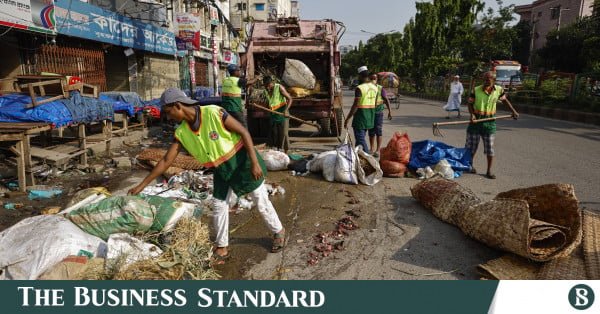
City corporation cleaners collect and clear sacrificial animal waste on Eid-ul-Adha afternoon along Mirpur Road in Dhaka. Photo: Rajib Dhar
“>

City corporation cleaners collect and clear sacrificial animal waste on Eid-ul-Adha afternoon along Mirpur Road in Dhaka. Photo: Rajib Dhar
In an intense three-day cleanup following Eid-ul-Adha, the combined efforts of Dhaka South and Dhaka North city corporations removed more than 51,000 tonnes of sacrificial waste from the capital.
To handle the waste load several times higher than normal, they deployed nearly 24,000 permanent as well as outsourced workers and several thousand vehicles.
According to official data, Dhaka South alone cleared 32,662 tonnes of waste, while Dhaka North removed 18,344 tonnes.

While officials hailed the rapid clearance as a major success, the exercise also revealed a deep dependence on outsourced and informal workers – raising questions about the cities’ long-term capacity to manage surging urban waste during peak periods.
Massive workforce mobilised for Eid cleanup
Dhaka South, which has 4,950 permanent sanitation workers, mobilised more than 13,000 workers during Eid, including around 8,000 outsourced, household-service and informal workers. The corporation also deployed 2,117 vehicles for the cleanup.
In Dhaka North, around 11,000 workers were engaged in waste removal operations. Since it has around only 2,500 permanent sanitation workers, most of the workforce during Eid came from outsourced labourers and workers associated with hired vehicles.
Dhaka North deployed about 700 vehicles, including nearly 400 hired pickup trucks in addition to its own fleet of around 350.
Waste volume spikes far above normal levels
Under normal conditions, Dhaka South generates and removes about 3,200 to 3,500 tonnes of waste daily. Officials said the Eid waste load on the first day alone was more than four times the usual volume.
Despite the large-scale mobilisation, analysis of the operations shows both city corporations remain heavily dependent on outsourced labour and privately managed collection systems.
Dhaka North Additional Waste Management Officer Arifur Rahman said preparations began one and a half to two months before Eid. “We had sufficient capacity and advance planning for waste removal. However, the challenges were also significant,” he said.
He added that recruiting workers during Eid holidays was difficult and that livestock markets expanding beyond designated areas added pressure.
He also noted that door-to-door waste collection van services are not directly controlled by the city corporation, contributing to waste accumulation in some areas.
Call for long-term waste management reforms
Dhaka South’s Chief Waste Management Officer Mahbub Rahman said manpower shortages were a major constraint. “Many workers engaged in other activities instead of their regular duties during Eid. As a result, there was a shortage of around 6,000 workers,” he said.
Mahbub also claimed this was the first time both sacrificial and cattle market waste were cleared within three days. “Earlier, it used to take seven to eight days to remove waste from cattle markets alone,” he said.
A total of 23 permanent and temporary cattle markets operated across the two city corporations this year, while illegal and unauthorised markets further increased pressure on the system.
Urban planning experts warned that rising population and increasing numbers of sacrificial animals will continue to intensify waste pressure.
Urban planner Adilur Rahman Khan said long-term solutions require increased dedicated manpower, modern equipment and stronger transfer stations.
He also stressed technology-driven monitoring and citizen participation, including CCTV surveillance, satellite tracking of dumping hotspots, and local community committees to report irregularities.
About The Author