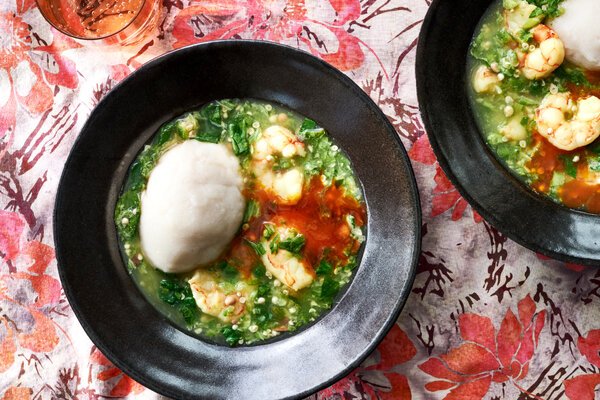
The ingredients I love all share one thing: They stir my desire to experience them in every form. Okra, a plant from the mallow family found across the tropical parts of Africa, Southeast Asia and North America, falls right in that category.
When okra appears at the farmers’ market each spring, I am reminded of its many joys. If you’ve come across the plant, you’ll notice its thick stems studded with flowering buds and large, broad leaves. The flowers, striking and beautiful, range from pale yellow to shades of pink and bloom only for a single day, then fall off to reveal nodes that sprout into the finger length, star-shaped fruit we’ve come to know and love.

Part of the mallow family, okra can be enjoyed in many ways.Credit…Kelly Marshall for The New York Times. Food Stylist: Roscoe Betsill. Prop Stylist: Paige Hicks.
I find myself craving it, roasted in a hot oven until crispy and brown in spots; spread in a skillet in an even layer over a hot flame until seared and lightly charred; and bathed in hot oil to fry into shatteringly crunchy nibbles. But my favorite preparation — and okra’s simplest form — is in a soup, specifically a draw soup.
In West and Central Africa, many soups and stews are built on vegetables, fruits or seeds that add an elemental viscosity, an incredible (and sometimes startling) stretchiness described as “draw.” Éwèdu soup, for example, uses a leafy green vegetable with a sublime pull. There’s ogbono soup, which uses àpọ̀n, a type of ground wild mango seed with a similar heft, and ìlà àlàsèpò, which uses the okra fruit and means “okra cooked together.” All possess this magnificent quality.
Growing up in Lagos, I knew okra as just ìlá, its name in Yorùbá, which can also refer to any soup from southwest Nigeria where okra is the star ingredient. For this take on draw soup, I let okra lead. With that in mind, you’ll want to find the freshest okra, which is essential to this dish’s success. But if you can’t find it — or don’t have time to get the plump, ripened pods from farm stand to pot before they start turning woody — then frozen will do just fine.
The dish begins with okra pods, chopped into confetti-like bits and releasing their fragrant grassy notes with every cut. They’re then brought to a simmer over low heat. Whole bean írù or dawadawa powder (both fermented locust beans) and dried crayfish season the broth with a robust umami.

A starchy swallow is a perfect accompaniment to this soup.Credit…Kelly Marshall for The New York Times. Food Stylist: Roscoe Betsill. Prop Stylist: Paige Hicks.
Of course, okra loves balance, and here, plump, saline shrimp accentuate its heft. Fresh chopped spinach leaves wilt lovingly into the soup when added. A finish of red palm oil melts, slicking and coating all in its path of its gentle flow, compliments okra’s springy bounce. It’s also essential for adding a creamlike richness to the soup. This recipe guides you toward an essential balance of textures and a layering of flavors that are evident within each spoonful. When served with a starchy swallow or a simple steamed grain, the soup is a delight, a full meal to ease you into the next moment in your day.
Your ìlá can be yours to define. Add meat, tripe, smoked fish or roasted mushrooms. Your goal is to understand okra’s flexibility, to grasp what it can or can’t do. Whether okra is new to you or a staple of your spring and summer soups, with this recipe it’s yours to discover multiple times over.
Follow New York Times Cooking on Instagram, Facebook, YouTube, TikTok and Pinterest. Get regular updates from New York Times Cooking, with recipe suggestions, cooking tips and shopping advice.
About The Author