The five containers, declared to contain a combined 1,21,000kg of goods, had been entered into the customs automated software ASYCUDA World as an export consignment.
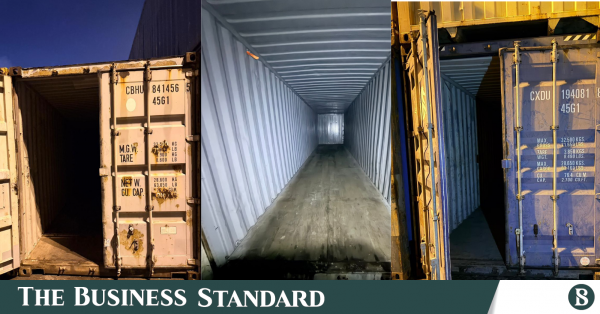
Five containers allegedly carrying no export goods are seen at the port after customs intelligence officers stop the shipment, preventing a suspected fake export on 7 September 2026. Photo: TBS
“>

Five containers allegedly carrying no export goods are seen at the port after customs intelligence officers stop the shipment, preventing a suspected fake export on 7 September 2026. Photo: TBS
Highlights:
- Five containers carrying no export goods intercepted
- Shipment linked to Valmont Fashions Limited
- Consignment cleared customs
- Investigation underway
Five containers carrying no export goods were allegedly cleared through customs formalities and were about to be loaded onto a vessel when customs intelligence officers stopped the shipment, preventing a suspected fake export worth $4,38,000, or around Tk5.5 crore.
The five containers, declared to contain a combined 1,21,000kg of goods, had been entered into the customs automated software ASYCUDA World as an export consignment.

The shipment was linked to Valmont Fashions Limited, a garment exporter.
According to a statement from the National Board of Revenue (NBR), the suspicious consignments were detected on 3 September while customs intelligence officials were reviewing export declarations in the ASYCUDA World system.
Customs intelligence officials subsequently visited the depot and instructed the authorities to present the goods for physical inspection.
However, neither the depot authorities nor the clearing and forwarding (C&F) agent concerned could produce any goods for inspection.
Instead, they told the officials that the goods declared for export had never entered the depot.
More surprisingly, customs formalities for the five containers — carrying a declared total weight of 1,21,000kg — had already been completed.
The containers were subsequently examined based on intelligence information just before they were scheduled to be loaded onto a vessel, and officials found that none of the five containers contained the declared export goods.
How did the shipment clear customs?
Under the normal export process, goods are brought into the relevant inland container depot, where they undergo necessary customs formalities before being exported.
The incident has raised questions about how the customs formalities were completed despite the goods never entering the depot and whether anyone within the process was involved.
A senior official of the Customs Intelligence and Investigation Directorate (CIID), who was involved in the operation, told The Business Standard on condition of anonymity, “We are also investigating this matter.”
He declined to provide further details.
In its statement, the NBR said, “The Customs Intelligence and Investigation Directorate’s investigation is continuing to determine how the customs formalities for the export were completed without the goods entering the depot and who was involved in the process.”
Another official of the same department told TBS that the government has instructed customs authorities to ensure that export consignments are not unnecessarily held up.
“For this reason, customs procedures have to be completed even before the goods arrive at the depot,” he said.
He added that normally 5-10% of export consignments undergo physical examination.
“Perhaps the people involved in the irregularities took advantage of this,” he said.
The official said the department had long been urging senior authorities to give greater importance to 100% verification of export consignments, particularly because the process is more vulnerable to abuse than the verification conducted when raw materials are imported under bonded facilities.
Officials said the alleged fake export could have facilitated several forms of financial crime including inflow of illicit funds through trade misinvoicing, selling imported bonded raw materials on the local market, and claiming export incentives without actually exporting the goods.
TBS contacted Valmont Fashions Director Azizul Hasan Bazmi for comments on the allegations, but he did not answer the phone.
An email was also sent to him outlining the issues, but no immediate response was received.
How customs intelligence detected the fake export
Officials said several factors raised suspicion about the five consignments.
The destinations declared for the five consignments were the United Arab Emirates and the Philippines, which is unusual for RMG exports.
Another significant red flag was the unusually high volume of export goods declared by the bonded exporter compared with the quantity of raw materials it had imported over the previous year.
About The Author