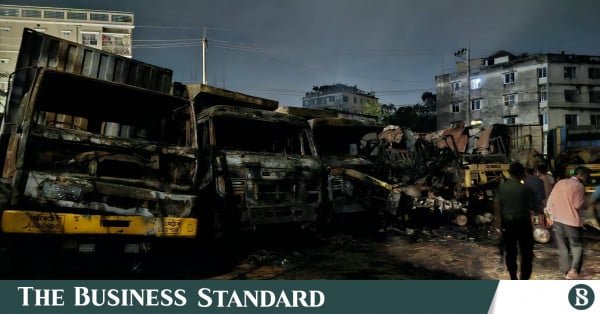
The gas transportation and use system at Pretty Composite Textile Ltd in Ashulia, where six people were killed in a fire yesterday (20 September), was completely illegal and unsafe, officials from the Fire Service and the Department of Explosives have said.
The factory, owned by Pretty Group and certified LEED Platinum by the US Green Building Council, was using specially installed CNG cylinders inside covered vans to transport gas before supplying it to a gas chamber inside the factory for boiler operations, according to officials.
Muhammad Mehedi Islam Khan, assistant inspector of explosives (Dhaka) at the Department of Explosives, told The Business Standard that the method was extremely risky and not permitted under any law or provision in the country.

“This method of gas usage is extremely risky. LPG cylinders are low pressure, whereas these cylinders are very high pressure. Furthermore, this is not permitted under any law or provision of the country.”
He said the Department of Explosives regularly conducts drives at CNG stations to stop such practices, particularly in the Dhaka and Chattogram belts.
“Having conducted numerous such drives in Chattogram, many covered vans were seized and handed over to Karnaphuli Gas Distribution Company. In the case of Dhaka as well, we have issued show-cause notices to many institutions, and the licenses of some have been cancelled. Most recently, the license of a CNG station named Cabex in Jatrabari was cancelled,” he said.
The official said a shortage of manpower and logistics, along with the department’s lack of magisterial powers and district-level offices, limits its ability to conduct drives on a wider scale.
“However, even amidst this, we are regularly trying our best, and steps such as conducting drives, issuing fines, and cancelling licenses are being taken,” he added.
Hafizur Rahman, deputy assistant director (Zone-04) of the Fire Service and Civil Defence Department, who led the firefighting effort following Sunday’s incident, said factory employees told firefighters that 12 covered vans at the compound had been fitted with cylinders for transporting gas.
“Each of these vehicles contained around 90 gas cylinders, which is extremely risky. From what we could gather immediately, gas was transported in the covered vans and then taken to a gas chamber inside the factory to be used in boiler operations,” he told TBS.
A probe committee may be formed regarding the incident, he said, adding that details would likely be known after the investigation.
The practice of installing gas cylinders in covered vans and using the gas in industrial facilities is not new, according to relevant sources. Such gas has long been transported and used in industries across various industrial belts, including Savar and Ashulia in Dhaka.
The sources said some factory owners collect gas through such unsafe and illegal methods under the pretext of a gas crisis and use it for factory operations.
The issue came to light after six people were killed and at least 24 injured when gas cylinders exploded inside a covered van at the factory compound yesterday (20 September).
The fire broke out around 6:45pm and was brought under control around 8pm by four units from the DEPZ and Zirabo fire stations.
About The Author