Farmers and activists report higher losses as floods intensify
Photo: UNB
“>

Photo: UNB
Highlights:
- Most rice gets produced in boro season; haor contribute 20%
- 88,000 hectares classified as low-lying high-risk; 28,000 hectares submerged
- Crops unhervested: Habiganj 45%, Kishoreganj 47%, Sunamganj 38%, Netrokona 35%
- Waterlogging renders harvesters unusable; hervested paddy faces spoilage risk
- Severe labour shortage persists despite double wages
With 37% of the boro crop still unharvested, as the Department of Agricultural Extension (DAE) reports, farmers in Bangladesh’s haor region face mounting losses as upstream rainfall and hill runoff push river levels higher. Despite a brief easing of local rain, they dispute the figures, saying the true share still standing is significantly higher.
Most of Bangladesh’s rice is produced in the boro season, with about 20% coming from seven haor-dominated districts. This year, DAE set a target of 22.7 million tonnes from 5 million hectares. Cultivation covered 963,000 hectares across Sunamganj, Sylhet, Habiganj, Moulvibazar, Netrokona, Kishoreganj and Brahmanbaria, of which 455,000 hectares lie in haor areas.

As of yesterday, 63% of the haor harvest had been completed, leaving 37% still standing. Within this, 45% in Habiganj, 47% in Kishoreganj, 38% in Sunamganj and 35% in Netrokona remain unharvested. Of the remaining fields, 88,000 hectares are low-lying and high-risk, while 28,000 hectares are already submerged. In the Sylhet division, 13,541 hectares are underwater.
Waterlogged fields have rendered harvesters unusable, while cut paddy is increasingly at risk of spoilage due to drying difficulties. Labour shortages persist despite offers of double wages, further slowing harvesting and post-harvest work during a critical window.
Farmers and local organisations say the situation is far worse than official estimates. They assess that around 40,000 hectares in the Sylhet Haor alone have been damaged by flooding and hill runoff, with losses nearing Tk3,000 crore. Haor environmental activist Kasmir Reza said official figures underestimate losses and that only 35-38% of the crop has been harvested. He alleged agricultural offices overstate progress and understate damage, adding, “The real picture is much worse.”
Farmers also dispute the data, saying authorities only count submerged fields while ignoring harvested paddy rotting due to a lack of sunlight for drying. Rathindra Chandra Sarkar from Shaillar Haor in Shalla upazila said he harvested less than one-third of his land, while the rest remains submerged. He added that the cut paddy is now sprouting and unusable.
Additional Director of DAE Sylhet, Md Mosharraf Hossain, said damage is not yet final as losses may rise if water levels increase, though some crops could survive if floodwaters recede quickly. He said there is no artificial drying system for such volumes, leaving farmers dependent on weather, and noted delays in mill procurement have added to losses.
Infographics: TBS
“>

Infographics: TBS
Labour crisis deepening harvest losses
Labour shortages are worsening losses as farmers struggle to harvest and dry boro rice amid rising floodwaters. Traditionally, labourers are paid in cash or kind, usually one-sixth to one-seventh of the harvested paddy.
During floods, payment can rise to half the crop under “noyonbhaga,” but even this has failed to attract workers. In Shonir Haor of Tahirpur, farmer Ramen Biswas said offering half the harvest still brought no labourers.
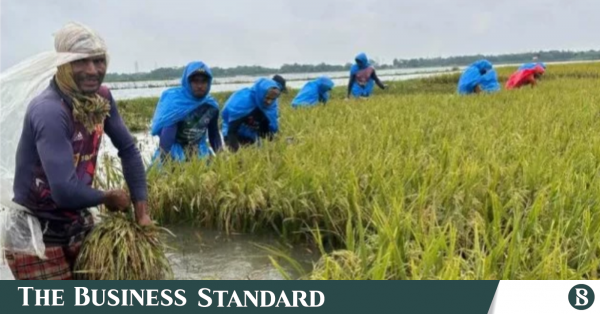
In Karcha Haor of Bishwambharpur, farmers and women were seen drying paddy during a brief break in the rain, with children helping. Farmer Hosna Begum said repeated rainfall had already caused the cut paddy to rot. “Even though the rain has stopped, we cannot find labourers, so the whole family is working,” she said.
Farmer Manjur Ahmed said only 0.54 acres of his 1.89-acre land remains above water. He offered up to Tk1,500 daily – far above the usual Tk700-800 – but found no workers. “If water keeps rising, even what remains will be submerged in two days,” he said.
Md Mosharraf Hossain of DAE said harvesting has become machine-based, but early and continuous rainfall has disrupted operations. “Harvesters cannot enter fields, and labourers are not available at once,” he said, adding that reliance on machinery has reduced the inflow of seasonal workers from other districts.
Rising rivers and expanding flood risk
Upstream rainfall and hill runoff have raised river levels, increasing flood pressure across the region.
The Flood Forecasting and Warning Centre of Bangladesh Water Development Board (BWDB) said five stations on four rivers in Netrokona and Habiganj are above pre-monsoon danger levels. At Jariajanjail on the Bhugai-Kangsa, water is nearly 100 cm above danger. Other affected points include Someshwari, Magra and Sutang rivers.
Moderate to heavy upstream rainfall has also raised the Surma-Kushiyara and Dhanu-Baulai rivers, still below danger levels. BWDB warned that heavy to very heavy rain in the next three days could push Kushiyara, Baulai, Juri, Manu and Khowai above danger levels, worsening flooding across Sylhet, Sunamganj, Netrokona, Kishoreganj, Moulvibazar and Habiganj.
Its seven-day outlook (30 April-7 May) forecasts 150-350mm rainfall in the northeast, keeping river levels high early in the week with possible improvement later if rain eases. Officials cited upstream rainfall in Cherrapunji and Mawsynram and continuous hill runoff as drivers of rising inflows.
The Meteorological Department expects rain until 3-4 May with slow drainage. Economists warned of a 10-15% fall in boro output (around 2 million tonnes), urging labour deployment and procurement of wet paddy to avoid inflation from imports.
The Agriculture Ministry said emergency measures include deploying harvesters, reapers, drying equipment and manpower for manual harvesting where machines cannot operate.
About The Author