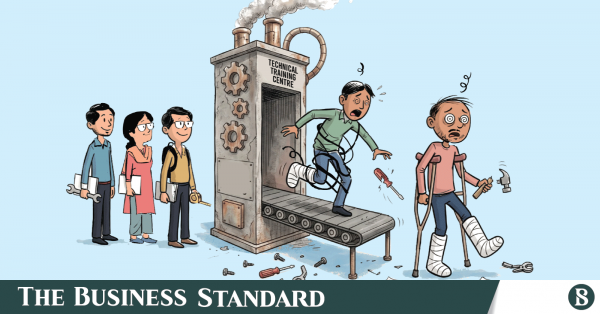
Govt orders detailed assessment of all TTCs
TBS Illustration
“>

TBS Illustration
Highlights:
- Costly CNC machines idle due to faults, lack operators
- Nationwide TTCs face unused equipment, vacancies, limited training output
- Rapid expansion risks worsening inefficiencies without structural reforms
- Skilled migration demand rising, Bangladesh workforce remains mostly low-skilled
- Severe funding gaps hinder maintenance, equipment repair, effective training
- Staffing shortages leave centres inactive despite infrastructure and demand
At the Feni Technical Training Centre, three computer numerical control (CNC) machines were installed in 2018 at a cost of Tk20-30 lakh each to train workers for modern industry.
But the systems, which control machine tools for precise cutting and shaping, have remained largely idle for years due to technical faults and a shortage of qualified operators.

“These machines are meant for engineering training, but they haven’t been operational for years,” said acting principal Md Jasim Uddin. “We are trying to restore them, but budget constraints are slowing the process.”
The Feni centre reflects a broader crisis across Bangladesh’s government-run Technical Training Centres (TTCs), where expensive equipment often lies unused, instructor posts remain vacant, and some newly built centres are yet to train a single student except conducting a few project based temporary courses.
Infograph: TBS
“>

Infograph: TBS
The crisis comes at a time when the government is pushing ahead with expanding training infrastructure, as overseas labour markets increasingly demand skilled workers.
Marina Sultana, director (programme) at the Refugee and Migratory Movements Research Unit (RMMRU), has visited at least 15 TTCs for professional and research work over the past decade.
“I have observed that there is a significant capacity shortage in government courses during my visits,” she told The Business Standard.
There are some project-based courses with adequate teachers and facilities for a limited period, she added. “But once the project ends, those resources are no longer available.”
Recognising these concerns, Expatriates’ Welfare and Overseas Employment Minister Ariful Haque Chowdhury told TBS, “I have directed that a detailed assessment be made of the real conditions of all TTCs. Based on that, necessary measures will be taken.”
Experts questioned whether the training network is expanding too quickly without fixing deep-rooted structural weaknesses, warning that further expansion could scale up inefficiencies rather than improve skills outcomes.
TTCs in Bangladesh
According to BMET, Bangladesh currently operates 110 Technical Training Centres (TTCs) and six Institutes of Marine Technology, offering training across 55 trades.
The earliest institution, currently the Bangladesh-Korea Technical Training Centre, was established in 1942. Four more centres were set up during the East Pakistan period.
After independence, additional TTCs were gradually added through the 1990s. Expansion accelerated in the 2000s, with 26 centres established between 2001 and 2006, followed by 27 more between 2011 and 2017.
Between 2016 and 2026, 40 new centres were set up at a cost of over Tk1,667 crore. A further Tk3,751 crore project has already been approved to establish 50 additional upazila-level TTCs.
Skills push meets system stress
Countries in the Gulf and other destinations are increasingly favouring skilled migration, while Bangladesh still sends a workforce dominated by semi-skilled and low-skilled workers.
Data from RMMRU shows only around 20-22% of Bangladeshi migrants are skilled, while 70-74% fall into semi-skilled or low-skilled categories. The mismatch reduces earning potential abroad and often raises migration costs at home.
“Most destination countries are moving towards skill-based labour recruitment,” said Mohammad Jalal Uddin Sikder, a migration expert and faculty member at North South University told TBS “This is a crucial call for Bangladesh to produce a more skilled workforce.”
Yet despite more than 12.7 lakh people receiving some form of training, including three-day pre-departure orientation through TTCs in FY25.
Though BMET does not have specific data on how many trainees secured jobs abroad after completing their courses, various TTC sources indicate that, on average, the percentage is around 25-30%. The rate is higher for courses such as electrical work, plumbing, and welding.
Equipment without instructors
Feni TTC currently offers seven trades, including electrical work, computer operation, dress design, mobile servicing, driving, auto mechanics, and machine shop training. Most of these are short-term courses lasting three to four months.
While visiting the centre on 27 March this year, it was found that two trades – machine shop and automobile servicing- have not been activated for training over the years due to lack of trainers and dysfunctional equipment. After assuming office by the new principle in October last year, these labs have started short courses.
“We have equipment, but much of it is used only for demonstration,” said Shakil Ahmed, a guest instructor in the automobile lab. “Students can identify parts, but full hands-on work like engine overhauling is not possible.”
As a result, many trainees acquire only basic skills, while higher-level competencies remain out of reach, added Shakil.
Government officials said funding constraints are a key barrier, with equipment repairs often delayed or left undone when major machinery breaks down.
BMET Director (Training) Salah Uddin Ahmed explained that annual maintenance allocations fall far short of requirements.
“For equipment maintenance, we receive only Tk4 crore annually for all 110 TTCs. One TTC may require around Tk1.5 crore, but we can allocate only around Tk1.5 lakh each,” he said.
Recognition matters, too
Finance Minister Amir Khosru Mahmud Chowdhury, while stressing the importance of vocational training, pointed out that a major shortcoming in skill training in Bangladesh is that training centres mostly lack accreditation and standard certification. “As a result, the certificates provided by those institutions do not come to any use.”
The government, he added, will introduce such vocational curriculums which will have global accreditation and certification.
“Our goal is to ensure that an expatriate Bangladeshi, who now earns $500 a month, will gain enough skills to earn $2,000.”
In many countries, students are directed to different trades of vocational learning just at the school level, the minister said at a pre-budget discussion with economic journalists on Saturday.
Staffing crisis equally severe
Feni TTC has only two permanent instructors against a requirement of at least 16.
At Fenchuganj TTC in Sylhet, one of the 40 newly built centres, the situation is worse. Construction finished in December 2022, but it is still not fully operational.
“We have the building and equipment, but no staff,” said principal Mohammad Abdur Rahim. “Currently only one security guard is present and none of the 85 approved posts has been filled.”
Demand exists, but capacity lags
At the Bangladesh-German Technical Training Centre in Mirpur, one of the country’s oldest institutions, established in 1965, applications often exceed available capacity.
“There is strong demand for courses like driving, computer training and languages, but we cannot accommodate everyone,” said principal Fowzia Islam.
She also highlighted a newer bottleneck: the requirement for national ID cards for enrolment has excluded many 16–18-year-olds, a key age for skills development.
“This is the age when skill development is most crucial,” she said.
Where centres function effectively, outcomes are strong. The German TTC reports that over 90% of its graduates secure employment at home or abroad.
Mohammad Ashraful Rahman Chowdhury, who completed auto mechanics training in 2025, is now preparing for work in Japan. “This training allows us to work in automobile workshops. I have already started learning Japanese.”
Expansion or overhaul?
Migration expert Tasneem Siddiqui described the state of many centres as troubling.
“Many TTCs still lack basic infrastructure, modern equipment and adequate instructors,” she said. “In some places trainees are even asked to clean facilities because support staff are absent. This is not skill development.”
A principal of a Dhaka-based TTC said Bangladesh risks training workers for yesterday’s industries. “In developed countries, training centres are linked with industries and use modern equipment. Here students often train on outdated or non-functional machines.”
Several experts said the government should prioritise upgrading a smaller number of centres to international standards rather than continuing broad expansion without reform.
“Instead of building TTCs everywhere, upgrade 10 to 15 centres to global standards first,” one principal said. “Fix the teacher shortage, reduce project-based staffing dependency and establish industry linkages.”
BMET Additional Director General Ashraf Hosain said efforts are under way to address capacity limitations and align training with industry needs.
“Yes, we have capacity limitations,” he admitted. “But we are trying to mitigate the gaps in line with industry requirements.”
About The Author