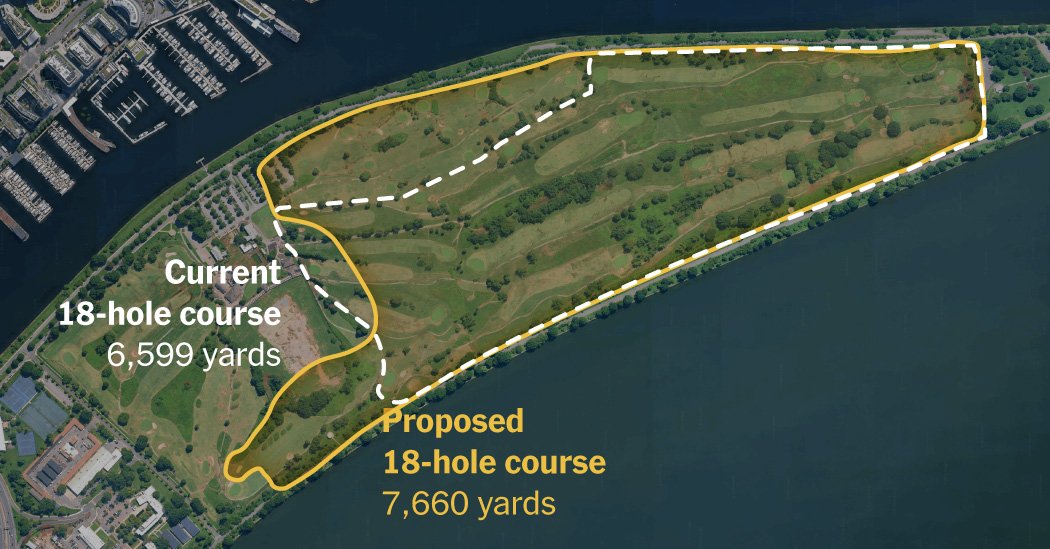
Most would agree that East Potomac Golf Links is in need of a makeover. It has been prone to flooding since first opening to golfers in the 1920s. Age and a limited maintenance budget have taken their toll over the years.
In 2020, the National Links Trust, a nonprofit, took over operations, began improvements and made its own renovation plans. But the Trump administration is now pushing for an overhaul with a blueprint by Tom Fazio, who has designed several of the president’s golf courses. The project’s cost is not known and it’s unclear who would pay for it.
Mr. Trump has ambitions to model East Potomac after other notable public courses like Bethpage Black and Torrey Pines, which have hosted major professional tournaments. Some locals said the removal of a nine-hole course and the increased difficulty of the 18-hole course would reduce their options and nudge them out.
There are other challenges, too. Fixing the property’s flooding and drainage issues could be expensive, and East Potomac’s limited space on the small peninsula could make for a logistical headache.
Community concern
The affinity that local players have for the place is clear. They play around the drainage issues and have little interest in watching the pros take over.
“The vibe’s incredible,” said Rob Stokes, 33, who had given up golf for several years before discovering East Potomac. “Everyone is having fun. I consider this to be my home course.”
A spokesperson for the Department of the Interior — which would oversee the renovation — said that the course would remain affordable and accessible for the Washington community.
Players like Mr. Stokes worry, however, that eliminating an entire nine-hole course would reduce the number of people who could play at East Potomac Golf Links. Under the initial plan, there would be 25 percent fewer holes, leading to fewer available tee times.
The lengthening of the 18-hole course could exclude even more golfers. Most golf courses have three to five tee boxes, with the longest ones being farthest from the hole and reserved for the most advanced players.
In the proposed design, the total yardage when played from the longest tees is 7,600 yards, compared with the current 6,599 yards. Even the distance from the shortest tees would be 1,100 yards longer on the new course, at 5,740 yards, making the game harder for many.
Richard Mandell, a golf course architect who has renovated dozens of private and public courses, said that “maybe the top 2 percent would ever use” the longest tee boxes and suggested adding even shorter ones to accommodate a wider range of players.
When asked about the plan, the Interior spokesperson said that players could tee off “halfway down the fairway” if they wanted. (Official rules of golf generally prohibit this.)
Mikhail Westelius and Suli Ajmeri, both 18, recently played at East Potomac Golf Links after their high school graduation.
“A lot of other courses I’ve played are more difficult, and we play with our other friends who are just beginners,” Mr. Ajmeri said.
Chronic flooding
Modern championship courses need to drain thoroughly and rapidly, in part so tournaments can fit 72 holes into their four-day windows even when it rains, and because the fairways and greens need to stay at a consistent level of firmness.
At the moment, a combination of high tides, a high water table and aging drainage infrastructure makes flooding and standing water a significant issue that will have to be addressed.
The current water problems are exacerbated by a broken seawall along the property’s perimeter.
Repairs have been discussed for decades, but they would cost hundreds of millions of dollars. Recently, similar repairs to the seawall of the nearby Tidal Basin cost $112 million. The peninsula’s seawall is about three times as long.
A possible solution to keep the course dry would be to substantially raise the fairways by adding many tons of dirt to the course.
“The only way to have good-quality turf grass is to have a high and dry playing surface,” Mr. Fazio recently told Golf.com. “You have to make the water flow off and move off in order to get quality turf. So that’s what we’re analyzing now.”
Mr. Fazio did not respond to requests for comment for this article.
Soil and debris from the East Wing demolition has already been dumped on the site. At the time the work began in October, the National Park Service said it would use the dirt for “contour correction, drainage improvement and turf establishment.”
The DC Preservation League, a nonprofit, as well as two local residents sued the administration over concerns that the dirt was contaminated, and that major renovations would make the course less accessible. The fill has tested positive for toxic metals.
In response, a federal court told the administration that any major construction could not proceed until the suit was resolved.
Mr. Mandell, the golf course architect, pointed out that raising fairways was not uncommon, but that it came with some costs. “You’re going to lose trees if you raise golf holes,” he said.
While tree removal is often a part of course restoration, certain trees will be hard to replace.
The ancient cottonwood in the corner of the White Course appears to be replaced by a new maintenance facility in the Fazio rendering.
Washington’s oldest grove of cherry trees — a gift from Japan in 1910 — currently sits between the fourth and the ninth holes on the White Course. In the Fazio plan, the grove is shown in the middle of the practice range. Its fate is uncertain.
Limited space
Typically, professional tournaments use acres of open space for concessions, security, grandstands and bathrooms.
“I look at this and think, Where are you going to put all that stuff?” said Jonathan Temme, regional manager for South Australia at iEDM, an Australian engineering firm that plans the logistics for LIV Golf Adelaide, Australia’s largest golf tournament.
“If they are talking about a major, you need big areas — there’s a lot of infrastructure that needs to come in,” he said. “In an area like this, which is fairly water-locked, it just limits a lot of that ability.”
The U.S. Open, held last weekend at Shinnecock Hills Golf Club in Southampton, N.Y., dedicated over 45 acres of land to grandstands, concessions, broadcast, security and logistics, according to a New York Times analysis of satellite imagery.
Major golf tournaments need a lot of open space
The new design at East Potomac Golf Links would seem to leave little room for that infrastructure on its tight 220 acres.
Transportation in and out of East Potomac Golf Links would also be challenging.
At large tournaments, fans and those running the event ordinarily use separate roads and entrances to reach the grounds, and fan shuttles normally have their own dedicated drop-off areas. At Shinnecock Hills last weekend, there were at least six entrances.
At East Potomac Golf Links, there is one two-lane road in and out of the grounds.
Limited access to East Potomac Golf Links
A few surface roads come off heavily congested bridges.
If Mr. Trump’s plans go forward, transportation, drainage and logistical issues will be up to Mr. Fazio and the Department of Interior to figure out. But that’s not what’s on the mind of Mr. Stokes, the local golfer.
“I just want to make sure that it stays what it is, which is a great resource to the community,” he said. “And that it doesn’t become something that some people are shut out of.”
About The Author