Bangladesh paid Tk7.58 per unit for electricity imported from NVVN, including transmission charges, making Adani’s tariff almost 96% higher.
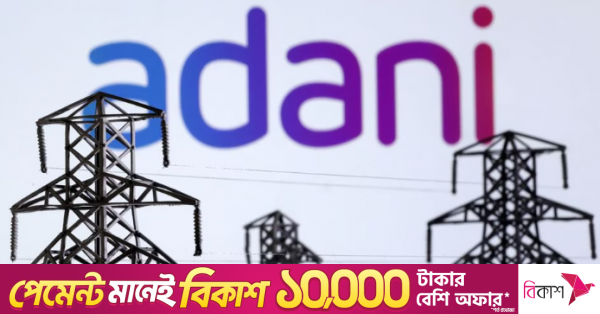
Electric power transmission pylon miniatures and Adani Green Energy logo are seen in this illustration taken, on 9 December 2022. Photo: Reuters
“>

Electric power transmission pylon miniatures and Adani Green Energy logo are seen in this illustration taken, on 9 December 2022. Photo: Reuters
Electricity imported from India’s Adani Power remained significantly more expensive than power sourced from Bangladesh’s other cross-border suppliers in FY2024-25, primarily because of the pricing structure in its power purchase agreement rather than transmission costs.
An analysis of the Bangladesh Power Development Board’s (BPDB) annual report and the Power Division’s financial statements shows Bangladesh paid an average of Tk14.86 per kilowatt-hour (kWh) for electricity imported from Adani’s Jharkhand power plant during the fiscal year.
In contrast, the combined weighted average tariff of electricity imported from three other Indian suppliers stood at Tk9.33 per unit.

The difference means Adani’s electricity cost Bangladesh nearly 59% more than the weighted average tariff charged by NTPC Vidyut Vyapar Nigam Limited (NVVN), Power Trading Corporation of India (PTC India) and Sembcorp Energy India.
The gap becomes even more pronounced when suppliers are compared individually.
Bangladesh paid Tk7.58 per unit for electricity imported from NVVN, including transmission charges, making Adani’s tariff almost 96% higher.
Electricity purchased from PTC India cost Tk10.20 per unit, while imports from Sembcorp averaged Tk10.22 per unit – around 45-46% cheaper than Adani’s supply.
Even electricity imported from Nepal under Bangladesh’s first hydropower agreement cost Tk8.35 per unit, nearly 78% lower than Adani’s tariff.
No transmission charge advantage
Unlike the NVVN agreements, where Bangladesh pays wheeling charges separately to India’s grid operator, Adani’s tariff already reflects the agreed contract price.
Transmission costs therefore do not explain the large difference in overall import prices.
In fact, transmission charges through the Indian grid declined during FY25. Bangladesh paid Tk211.71 crore in wheeling charges for electricity imported through NVVN corridors, bringing the average transmission cost down to Tk0.437 per kWh, compared with Tk0.527 a year earlier.
Despite this decline, Adani remained by far the most expensive import source.
Adani imports remain stable
Bangladesh imported 8,030 million kWh of electricity from Adani in FY25 at a total cost of Tk11,933.44 crore, with the average tariff virtually unchanged from Tk14.87 per unit in FY24.
By comparison, Bangladesh imported:
- 4,840 million kWh from NVVN at an average cost of Tk7.58 per unit (including wheeling charges);
- 1,620 million kWh from PTC India at Tk10.20 per unit; and
- 1,920 million kWh from Sembcorp at Tk10.22 per unit.
- Overall power purchase costs rise
The BPDB purchased 101,187.17 million kWh of electricity from domestic and imported sources during FY25 at a total cost of Tk121,420.16 crore.
As a result, Bangladesh’s average power purchase cost increased to Tk12.1 per unit, up from Tk11.35 in FY24.
Bangladesh currently has agreements to import 2,656MW of electricity from India and 40MW from Nepal.
While cross-border electricity remains an important component of the country’s energy mix, the data show that power imported from Adani continues to carry the highest price among all foreign suppliers.
About The Author