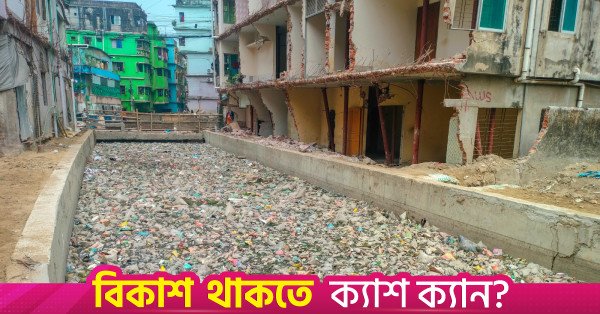
Once vital for drainage, canals such as the Jamal Khan canal are now nearly dysfunctional due to years of unplanned waste disposal.
A portion of the Jamal Khan canal is seen filled with plastic bottles, polyethylene waste, and other objects, which ultimately obstruct the water body from flowing smoothly in any season. The photo was taken from Hem Sen Lane of the Jamal Khan area in the port city of Chattogram on Saturday. Photo: TBS
“>

A portion of the Jamal Khan canal is seen filled with plastic bottles, polyethylene waste, and other objects, which ultimately obstruct the water body from flowing smoothly in any season. The photo was taken from Hem Sen Lane of the Jamal Khan area in the port city of Chattogram on Saturday. Photo: TBS
Highlights:
- A large portion of daily waste remains uncollected, ending up in canals, drains
- Stagnant water in blocked canals creates breeding grounds for mosquitoes
- Residents report frequent flooding even after light rainfall
- Several canal renovation programmes underway
- Experts warn infrastructure upgrades alone will not provide a lasting solution to waterlogging
Years of plastic and polythene waste dumping have left Chattogram’s canals increasingly clogged, aggravating serious concerns over waterlogging and public health, even as several restoration projects remain underway to revive the port city’s drainage network.
Chattogram, a city of over 60 lakh residents, faces varying degrees of waterlogging every year despite several initiatives, including a Tk50 billion mega project by the Chattogram Development Authority, that were taken earlier.

Once vital for drainage, canals such as the Jamal Khan canal are now nearly dysfunctional due to years of unplanned waste disposal.
The Jamal Khan canal, which originates from the Kazir Dewri area and flows through Jamal Khan, Hem Sen Lane, Rahman Ganj, and Dewan Bazar before merging with the Chaktai canal, has become a case study in environmental neglect.
Its natural flow is obstructed by accumulated plastic and polythene, creating stagnant water zones that serve as breeding grounds for mosquitoes and pathogens. This has significantly increased the risk of dengue, other mosquito-borne diseases and waterborne infections.
Hem Sen Lane resident Md Mohiuddin described daily hardships, saying that stagnant water often floods the ground floor of his house due to blocked drains.
Another resident Suman Das noted that even light rainfall inundates the area, sometimes forcing people to use boats for movement.
Fish vendor Abul Khayer recalled that soil excavated during canal dredging was left within the canal itself, accelerating the accumulation of plastic waste and further reducing water flow.
They questioned when all the canals would flow again.
Contacted, Ershad Ullah, Chattogram-8 MP and convenor of the city unit BNP, told The Business Standard yesterday (18 April), “We have considered two aspects in the canal excavation programme: drainage and irrigation to support crop cultivation or supply water to fallow land. A large-scale canal excavation is not feasible in Chattogram city. Instead, the Chattogram Development Authority and the city corporation have undertaken several projects focused on the renovation and reconstruction of existing canals.”
Captain Ikhtiar Uddin Ahmed Chowdhury, chief conservancy officer of the Chattogram City Corporation, told TBS that renovation work on 36 canals is ongoing and expected to be completed by November this year.
Plans are also in place to recover and re-excavate 29 more canals, he said, hoping that these initiatives will improve drainage, reduce health risks and restore biodiversity.
A large-scale drainage improvement project, approved in 2017, includes excavation and renovation of canals, construction of 163 kilometres of retaining walls, over a hundred bridges and culverts, silt traps, regulators, and modern drainage systems and works of the project are still underway.
While these developments signal progress, experts warn that infrastructure alone cannot solve the crisis.
Historically, Chattogram had 118 canals but many have disappeared due to encroachment and neglect. Currently, only 57 canals remain, many of which are under threat.
Environmentalists argue that recovering at least 21 encroached canals and integrating them into the drainage system could significantly improve the situation.
Imtiaz Ahmed, Chattogram divisional head of Poribesh Bachao Andolon, told TBS that the condition of the Jamal Khan canal reflects systemic failures in waste management.
He emphasised that unless waste is controlled at its source, dredging efforts will offer only temporary relief. Planned drainage systems, stricter regulation of plastic use, and public awareness are essential to prevent recurring problems.
The city generates nearly 3,200 metric tonnes of waste daily but only 2,500 metric tonnes are collected. The remaining waste often ends up in drains and canals, worsening waterlogging and creating serious health hazards.
Experts stress that without effective waste management, law enforcement, and sustained public engagement, the port city cannot achieve long-term resilience against flooding and disease.
Even as projects near completion, concerns remain about maintenance. After the project ends, responsibility will fall on the city corporation, which reportedly faces shortages in budget and manpower.
About The Author