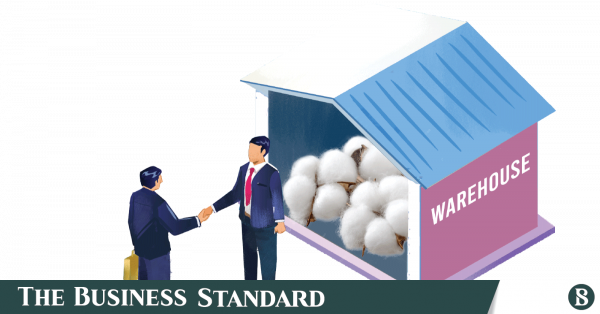
Formal launch scheduled for 18 November
TBS Illustration
“>

TBS Illustration
Bangladeshi textile businesses will be able to buy American cotton locally from November through the country’s first privately operated US cotton warehouse, a move expected to significantly reduce import lead times and lower reliance on intermediaries.
Infographic: TBS
“>

Infographic: TBS
The facility, established in Anwara, Chattogram, near the government-designated Free Trade Zone, will allow mills to purchase stock locally on demand rather than waiting months for individual shipments.
AmeriBangla Corporation, led by Bangladeshi-American cotton trader Aswar Rahman, is setting up the facility following slow progress on a previous government-led initiative.

“We are planning to launch operations on 18 November. Around 100 tonnes of cotton have already left a US port for Bangladesh,” Aswar, Chief Executive Officer of AmeriBangla, told The Business Standard. He added that the initiative is being run jointly with a local partner and will scale up inventory as demand rises.
“This will help entrepreneurs shorten lead times and access cotton at competitive prices, benefiting spinning mills and factories with smaller capital capacities,” Aswar said.
A major boost for local textile mills
Spinning and textile mills represent Bangladesh’s primary cotton consumers. Showkat Aziz Russell, President of the Bangladesh Textile Mills Association (BTMA), welcomed the venture.
“Importing cotton after placing an order usually takes nearly 90 days,” Russell noted. “A local warehouse slashes that waiting time, gives us a major lead-time advantage, and reduces price volatility.”
Russell added that while the BTMA had previously lobbied the government to expedite a bonded warehouse in the Free Trade Zone, private enterprise offers an immediate solution. “If someone establishes this privately, we will actively support and lobby on their behalf.”
Although US cotton carries a slight price premium over other sources, industry leaders note that its higher quality, lower waste rate, and reduced processing losses offset the initial cost.
According to BTMA data, Bangladesh imported $346 million worth of US cotton in FY25, up from $278 million in FY24, accounting for roughly 10% of total cotton imports. Apparel leaders estimate that imports could eventually scale to $2 billion if strategic trade advantages align.
Direct sourcing to lower prices
Aswar highlighted that purchasing from the warehouse could prove cheaper than conventional import channels. By sourcing directly from US farmers and ginners, AmeriBangla aims to undercut prevailing spot market prices.
Currently, US cotton imported through traditional channels costs around 85 cents per pound delivered to Chattogram, typically carrying a 16-cent premium over standard market alternatives. Under the warehouse model, AmeriBangla plans to supply stock at roughly 10 cents less per pound than prevailing rates.
An official at Envoy Textile, a prominent cotton importer, confirmed the company had already tested small trial imports through AmeriBangla. “Direct sourcing enables competitive pricing. If they can supply larger volumes reliably, they could become a primary supplier,” the official stated.
Potential duty relief under scrutiny
The development carries added weight following discussions around bilateral trade terms between Dhaka and Washington, under which garments made with US fiber may receive tariff concessions when entering the US market.
Mahmud Hassan Khan Babu, President of the Bangladesh Garment Manufacturers and Exporters Association (BGMEA), stated that apparel exporters are keenly awaiting official implementation guidelines from US authorities.
“The US Embassy indicated that procedures for obtaining tariff-related benefits for garments made with US cotton should be clarified by September,” Babu said, adding that the association will follow up with officials in Dhaka.
Aswar outlined the prospective advantages for end-buyers: “The benefits for buyers importing finished garments could include a 10–19% reduction in import duties, alongside an 18% transferable tax credit on the raw American cotton value.”
To enforce compliance, the proposed verification model is expected to combine industry self-reporting with third-party physical audits and isotopic origin testing by US state universities.
In FY25, Bangladesh’s exports to the United States reached $8.69 billion, including $4.95 billion in woven garments and $2.60 billion in knitwear. Exporters hope local availability of US fiber will strengthen Bangladesh’s competitive edge in its largest export market.
About The Author