Over 33,000 tons of plastic waste – comprising 70% single-use plastic and 30% hard plastic – have been collected in Chattogram between June 2022 and April 2026 under a joint initiative by Unilever Bangladesh Limited (UBL), Chattogram City Corporation (CCC), and Young Power in Social Action (YPSA).
This recovered waste is supplied to roughly 180 recycling facilities monthly to build a circular economy, with a target to recover an additional 8,000 tons in 2026.
The program actively supports the value chain by providing financial incentives for gathering single-use plastics alongside critical collection equipment across all 41 wards of the city.

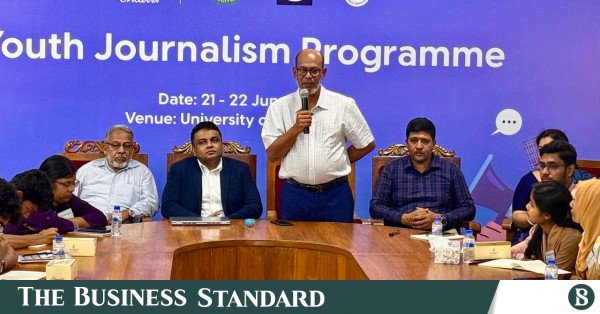
The comprehensive data of this integrated plastic waste management project, along with the sustainability achievements of Unilever’s historic Kalurghat Factory, were presented today (21 June) during a two-day Youth Journalism Program at the University of Chittagong.
SM Faysal, Public Relations and Project Manager at Unilever, shared the findings at the workshop, which was inaugurated by the university’s Proctor, Professor Dr Hossain Shahid Sarwardi, alongside YPSA representative Apurba Dev.
The initiative has trained around 3,000 waste workers on health and safety, including 500 under the CCC. Safety gear was distributed to 2,000 collectors, and 220 scrap buyers received business training. These efforts yielded livelihood improvements for 70% of participating workers.
Furthermore, a social protection scheme launched in 2025 has brought 1,827 participants under group health insurance, offering up to Tk1,50,000 for permanent disability or death. To date, 6 death and 14 accident claims have been settled.
Efforts to formalise the sector resulted in 50% of participating scrap buyers securing trade licenses and 100% opening active bank accounts. On the community front, awareness drives reached over 25,000 households, with 40% practicing waste segregation.
The project plans to expand to an additional 10,000 households this year, complementing the three-colour bin systems deployed in 41 residential colonies, 10 markets, and 111 schools. Additionally, a youth volunteer network of 410 members has engaged over 10,000 students across 80 schools.
This comes as CCC records indicate nearly one-fourth of the city’s waste remains uncollected, causing drainage blockages and waterlogging.
The event also highlighted Unilever’s deep-rooted connection to Chattogram, where it began its journey in 1964 via the Kalurghat Factory. Following independence in 1973, the Government of Bangladesh acquired a 39.25% ownership stake.
Today, with 9 out of 10 Bangladeshi households using at least one Unilever product, the Kalurghat Factory has transformed into a benchmark for industrial environmental performance.
Since 2010, the factory has systematically reduced its environmental footprint through target-driven technological upgrades. It has achieved a 31% reduction in energy consumption (saving 1.61 million gigajoules) and avoided 90.56 kilotons of carbon emissions.
Water consumption was slashed by 33% (saving 2,763 million litres), while total waste generation dropped by 30% against the 2010 baseline.
Key interventions include replacing steam-driven systems with dry vacuum pumps, utilising magnetic bearing chillers, and capturing generator exhaust heat for steam production. Transitioning toward clean energy, the factory uses International Renewable Energy Certificate (I-REC) matching for grid electricity and has expanded its rooftop solar capacity to nearly 1 megawatt (890 kWp).
Water management relies on advanced filtration. A BDT 4 million investment to upgrade Reverse Osmosis (RO) and Ultrafiltration (UF) membranes boosted water reuse capacity by 60%.
Additionally, transitioning homogeniser seal cooling to a recirculation loop saves 3,000 cubic meters of water annually, alongside expanded rainwater harvesting across 8,000 square meters of roof area.
In waste management, the facility upgraded its Effluent Treatment Plant (ETP), doubling its chemical oxygen demand (COD) management capacity to 12,000 ppm. ETP-generated sludge is diverted from landfills and co-processed as fuel in cement factories. Currently, one out of every four units of waste generated at the Kalurghat facility is successfully recycled.
The youth journalism workshop, which ends tomorrow, is the third iteration of Unilever’s environmental journalism initiative at the campus.
A total of 23 students from various departments are participating in this year’s session, building on the 80 student journalists trained during the previous two years.
Following the inaugural session on Sunday, the participating students were taken on a field visit to inspect the various operational stages of the local plastic waste management project.
About The Author