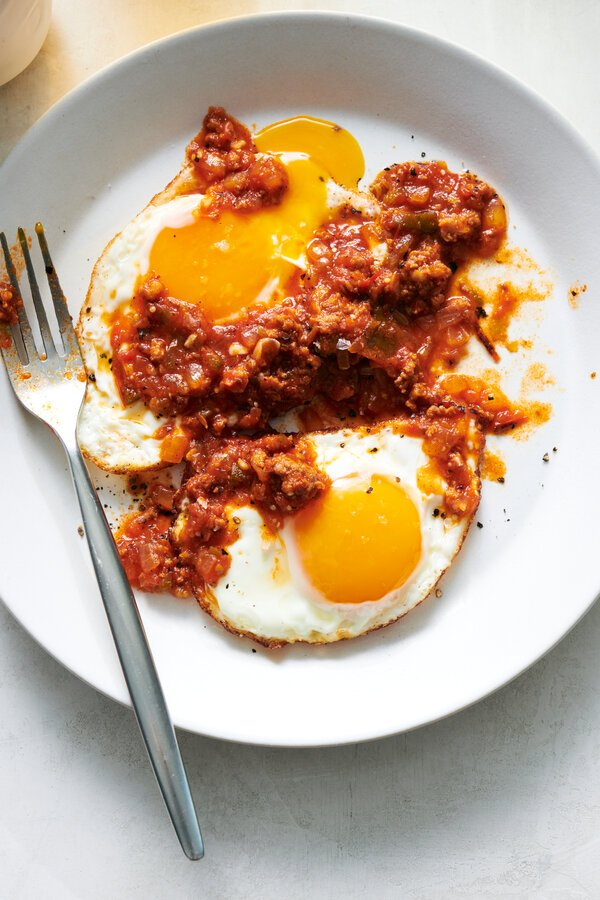
In the sun-washed kitchen of Hacienda San Lorenzo at Casa Madero Winery in Parras, Mexico, Mari Medina places two eggs in an oil-slicked pan and turns the heat on low. As the whites slowly set, she ladles a chunky, brick-red sauce that smells of roasted tomatoes, toasted chiles and its rich, smoky main ingredient: chorizo.
Ms. Medina, who has cooked at the hacienda in the state of Coahuila for more than 18 years, and whose family has lived in Coahuila for six generations, said that guests travel great distances. They’ll have the salsa de chorizo for the first time and request it again the next morning.
Coahuila, the vast Mexican state that stretches from the Texas border to deep into the Sierra Madre, is one of Mexico’s underrepresented culinary regions. Its most famous dish, nachos, was invented in the border city of Piedras Negras in the 1940s and went on to conquer the world. Salsa de chorizo, on the other hand, has been nourishing Coahuila for generations — Ms. Medina learned to make it from her mother, who learned from hers, who learned from hers — but almost no one outside the state knows its name.

Mari Medina has cooked at Casa Madero for more than 18 years.Credit…Raúl Salazar
Whether you call it salsa de chorizo or caldillo de chorizo, which is technically soupier, the idea is the same: chorizo as the base of a stellar sauce, scooped with torn pieces of warm corn or flour tortilla. Though it’s often served alongside eggs or a small bowl of frijoles de olla, the dish began as a meal on its own.
Coahuila is an arid place, settled by miners and ranchers who needed food that was nutritious, would not spoil and, above all, rendidor, a word that means yielding, or able to feed many from a little. Cooking the chorizo into a salsa meant that a family could eat well from only a modest amount of meat.
The chorizo that cooks in Coahuila seek out above any other comes from a town tucked into a remote corner of the state: Ciudad Melchor Múzquiz.
Múzquiz, as everyone there calls it, was founded in 1739 by Basque soldiers looking for silver and gold, and it was shaped by those mining and ranching families.
Yolanda Elizondo Maltos, the city’s official historian and chronicler, who was born there and traces her roots to the first Spanish settlers who arrived in Coahuila about 450 years ago, describes the town as “un rincón en el mapa de Coahuila.” A nook on the map of Coahuila. That isolation, she said, further necessitated smart ways to preserve food.
“The chorizo has been made here for centuries because it is a way to conserve meat,” Ms. Elizondo Maltos said. “With the spices and the vinegar, it holds for long periods without refrigeration.”
Families in Múzquiz follow closely guarded recipes. There’s no one single way to make chorizo, but the common denominators are quality pork butt, as well as dried chiles that are toasted, rehydrated and puréed with fresh garlic, oregano, cumin, black pepper and vinegar. The mixture is then oreada, left to air under a fine cloth to marinate deeply before being packed into casings. People buy their chorizo from the same butcher their entire lives, the one their mothers and grandmothers used. When they cook it, it tastes like home.
The chorizo of Múzquiz is so prized that chefs and restaurants across northern Mexico are starting to call it out on their menus.
“Rather than make our own chorizo at our butcher shops, I realized it was better to source it from a place that really knows how to make it,” said Anuar Yutani Morales, the owner of Super Carnes Coahuila in the neighboring town of Sabinas, who runs the state’s Festival de la Carne Asada. “The artisanship is incomparable.”
In 2019, Múzquiz held its first Festival del Chorizo, which brought together about 30 chorizo-making families. Ms. Elizondo Maltos, who helped organize the event, wants to bring it back.
“It marks the city as unique,” she said.

Guests will have the salsa de chorizo for the first time and request it again the next morning, Ms. Medina said.Credit…Raúl Salazar
At the hacienda, Ms. Medina makes her salsa with chorizo, tomatoes, onion, garlic and jalapeño. She roasts everything until deeply charred. That is, she said, the secret.
“It is very homey food,” she said.
Once salsa de chorizo enters a kitchen, it tends to stay. Pair it with sunny-side-up eggs, or scramble the eggs directly into the salsa. Poach it like a smokier and meatier shakshuka. Use it to sauce crispy tacos and tacos sudados, filled with mashed potato or shredded beef. Pair it with quesadillas, rice and beans. With potatoes, it becomes an even more filling guisado. Or, pair two of the region’s classic dishes and use it to top nachos.
Asked what it would mean if salsa de chorizo were to reach the fame of nachos, Ms. Elizondo Maltos did not hesitate.
“Nuestra identidad reconocida,” she said. Our identity, finally recognized.
After a pause, almost teary-eyed, she said: “Mucho orgullo.” A lot of pride.
Follow New York Times Cooking on Instagram, Facebook, YouTube, TikTok and Pinterest. Get regular updates from New York Times Cooking, with recipe suggestions, cooking tips and shopping advice.
About The Author