Every Tk1 invested in nutrition could generate more than Tk23 in long-term economic returns.
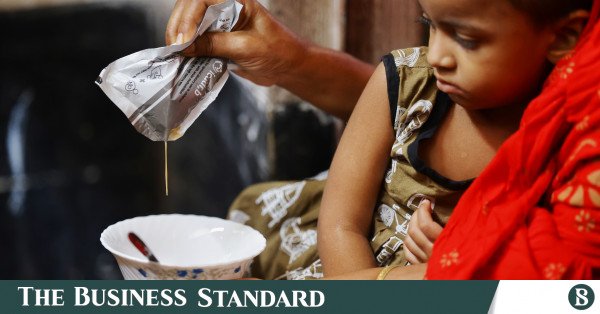
The sachet contains a nutrient-rich paste of chickpeas, soy, peanuts, green bananas, oil, sugar, and essential micronutrients. Photo: Mehedi Hasan.
“>

The sachet contains a nutrient-rich paste of chickpeas, soy, peanuts, green bananas, oil, sugar, and essential micronutrients. Photo: Mehedi Hasan.
Bangladesh is now confronting a “triple burden” of malnutrition, with undernutrition, micronutrient deficiencies, and a rapidly growing prevalence of obesity posing a major public health challenge, experts warned yesterday (3 August).
They said malnutrition is reducing economic growth by 8% annually, but every Tk1 invested in nutrition could generate more than Tk23 in long-term economic returns, underscoring the need for stronger public-private partnerships to improve nutrition services.
Infographics: TBS
“>

Infographics: TBS
The observations came at a roundtable titled “Integration of Nutrition Action in Primary Healthcare System through Public-Private Platforms in Bangladesh,” organised by Max Foundation Bangladesh. The Business Standard was the media partner of the event.
Poor diets, maternal malnutrition fuel crisis

Presenting the keynote paper, Saiqa Siraj, public health nutrition specialist, said nearly 70% of Bangladeshis still depend on cereal-based diets despite years of awareness campaigns, while nutrition services remain inadequate in marginalised areas, including chars, haor regions and urban slums.
She said the nutritional needs of child brides, garment workers, persons with disabilities and older people continue to receive insufficient attention, calling for stronger public-private partnerships and coordinated initiatives involving local entrepreneurs.
Dr Tahmeed Ahmed, executive director of icddr,b, said one in four Bangladeshi children under five remains stunted. New research shows stunting begins in the womb rather than after six months of age, with maternal malnutrition – particularly during adolescence – being a major contributor.
Unsafe water, poor sanitation and inadequate hygiene, which lead to environmental enteric damage, are also driving childhood stunting, he said, adding that increasing public health spending from the current 1% of GDP to 3-5% could reduce the stunting rate from 24% to 12%.
He also said around 4 lakh children are suffering from severe acute malnutrition, although only 6-7% require hospitalisation, with the remainder able to recover through community-based care.
Govt plans preventive healthcare overhaul
Professor Dr Pravath Chandra Biswas, director general of the DGHS, said Bangladesh has yet to achieve its nutrition goals despite launching the National Nutrition Programme in 1974.
He said 60-70% of Bangladeshis rely on private providers for primary healthcare, while child wasting stands at 13%. Anaemia affects 53% of pregnant women and 55.5% of women of reproductive age, and malnutrition and micronutrient deficiencies are contributing to the growing burden of non-communicable diseases, which now account for about 70% of all diseases in the country.
To strengthen preventive healthcare, the government plans to introduce artificial intelligence-based support into the healthcare system, Dr Pravath said.
Dr Mohammad Eunus Ali, director of the Institute of Public Health, said the institute continues to implement the Vitamin A Plus Campaign and enforce the Breast-milk Substitutes Act.
He also proposed integrating data on children suffering from severe acute malnutrition into the government’s central database through NGOs and Upazila Health Complexes to eliminate duplicate records and improve service delivery.
Dr SM Ziauddin Hyder, special assistant to the prime minister on health affairs, said Bangladesh has never developed a sustained national commitment to nutrition despite multiple initiatives since the National Nutrition Council was established in 1974.
He said policy decisions have often been driven by development partners rather than strong government ownership, limiting long-term progress.
Dr Ziauddin said the government is shifting from a treatment-oriented healthcare model to preventive care by establishing Primary Healthcare Units in every union and urban ward.
The government will recruit an additional 100,000 health workers, expanding the existing workforce of 43,000. Every citizen will receive a digital health card to reduce unnecessary hospital visits and out-of-pocket healthcare costs.
He added that the government would propose establishing a National Nutrition Commission.
Dr ATM Tariqul Islam, country director of Max Foundation Bangladesh, said the organisation is working to bring together the government, private sector and civil society to scale up successful pilot initiatives.
Dr Rudaba Khondker, Country Director of GAIN Bangladesh, said Bangladesh’s health and food systems continue to operate in parallel despite the country’s heavy climate burden, with weak linkages between the two.
She said transforming the food system would be impossible without the private sector, which produces most of the country’s food. Yet there is no reliable data on private sector investment, making effective public-private partnerships difficult to design.
Market-based solutions, she added, must be aligned with government systems and bring the private sector within a clear regulatory framework.
Iqbal Kabir, a public health nutrition specialist, said integrating nutrition into primary healthcare is not a new concept. However, achieving Universal Health Coverage now requires strengthening that integration through effective public-private partnerships.
Prof Kaosar Afsana, head of the Humanitarian Hub at the BRAC James P Grant School of Public Health, said nutrition, health, agriculture, the environment and food systems are closely interconnected, requiring a coordinated, multi-sectoral approach.
Improving nutrition cannot be left to the health sector alone, she said, stressing the need for coordinated action by ministries responsible for agriculture, food and related sectors. Ensuring healthy diets also depends on strengthening the entire food system.
Prof Afsana said policy alone is not enough. Effective action requires active participation from the private sector, development partners and community organisations. She also stressed the need to strengthen the science-policy interface so researchers can engage policymakers from the outset, helping translate evidence into effective policies and action.
Dr Rawshan Zahan Akhter Alo, deputy director of the Institute of Public Health Nutrition (IPHN); Dr Santhia Ireen, deputy director at the BRAC James P Grant School of Public Health; Prof Kaosar Afsana, head of the Humanitarian Hub at the BRAC James P Grant School of Public Health; Mohammad Solaiman Rasel, CTO and CBO of Grameen Health Tech Ltd (Shukhee); Dr Rudaba Khondker, country director of GAIN; and ASM Shahidul Alam attended from SMC, also spoke.
About The Author