Highlights:
- The government has shelved its Tk71,850 crore six-lane highway expansion plan
- Authorities now favour a PPP-based elevated expressway along the 232km corridor
- The RHD is assessing three options, from fully to partially elevated structures
- The expressway could cut Dhaka-Chattogram travel time from 8-10 hours to four
- Traffic is projected to reach 119,000 vehicles daily by 2040
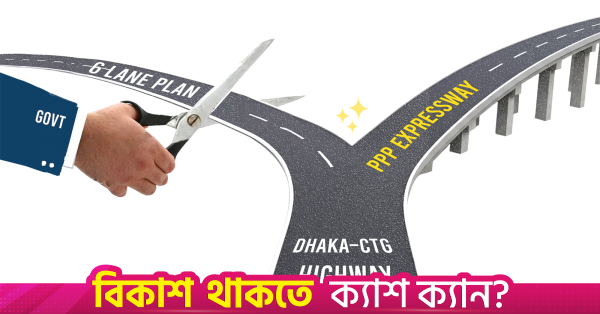
The government has shelved a Tk71,850 crore plan to expand the 232-kilometre Dhaka-Chattogram Highway to six lanes using foreign loans, shifting focus instead to constructing an access-controlled, fully or partly elevated expressway under a public-private partnership (PPP) model.
The decision comes as authorities prioritise a high-speed, grade-separated transport corridor along the nation’s main economic lifeline, where mounting congestion, monsoon flooding, and severe travel delays increasingly disrupt trade and supply chains.
The six-lane expansion project –- which relied on Tk55,080 crore in external borrowing –- was returned by the Foreign Assistance Search Committee on 8 October following in-principle approval from the Planning Commission. Official meeting minutes confirm the proposal was sent back specifically due to the revised plan to build an elevated expressway along the same route.
Officials from the Economic Relations Division (ERD) and the Roads and Highways Department (RHD) said the government is now prioritising the PPP elevated model over ground-level expansion, citing the corridor’s high traffic density and strong commercial viability for private investors.

The RHD is evaluating three structural formats: a fully elevated expressway along the entire 232km route, an elevated structure covering one-third of the corridor, or elevated sections restricted to high-congestion bottlenecks.
A review report outlining these options has been prepared by the RHD for submission to the Prime Minister through the Road Transport and Highways Division. The Prime Minister will make the final decision on the expressway’s scope and financial framework.
“If the Prime Minister approves the PPP model, the RHD will formally engage Invest Bangladesh to target domestic and foreign investors. Otherwise, we will reopen funding talks with the Asian Development Bank and other development partners,” a senior RHD official said.
Another RHD official, speaking on condition of anonymity, noted that the route offers exceptional financial returns.
“The journey currently takes eight to 10 hours. An expressway could cut travel time down to four hours, delivering huge savings in fuel, logistics, and operational costs. A portion of those economic gains can easily be captured through tolls, making the project highly attractive to private funding,” the official said, adding that commercial trucks and covered vans would provide a stable, long-term revenue stream.
‘A wider highway alone will not work’
Experts have welcomed the move, emphasising that simply widening the existing surface road would fail to address the core bottleneck.
Md Shamsul Hoque, Professor of Civil Engineering at the Bangladesh University of Engineering and Technology (Buet), argued that ground-level roads suffer from a lack of access control, roadside markets, and local vehicle interference.
“Widening the road to six, eight, or even 10 lanes will not resolve congestion. Recent maintenance issues and monsoon floods caused 30 to 40-kilometre tailbacks, stranding export cargo, delaying flight passengers, and blocking emergency medical transport,” Prof Hoque said. “The priority must be service quality, speed, and reliability—not merely lane count.”
Prof Hoque advocated for a fully elevated, interchange-based expressway. He noted that an elevated design optimises the existing right-of-way, minimises land acquisition delays, and provides climate resilience against recurring floods.
He also stressed that a PPP model ensures long-term maintenance standards often lacking in government-funded projects.
“Under PPP arrangements, private operators are contractually bound to maintain the road throughout the concession period. Government-built roads often deteriorate within a few years due to poor upkeep,” he said. “Work on a PPP-based elevated expressway should begin immediately. Every day of delay puts further strain on the current road and hurts the economy.”
Surging commercial traffic pressure
More than 90% of Bangladesh’s import-export trade relies on the Dhaka-Chattogram corridor. Current traffic stands at roughly 30,000 vehicles daily, with heavy goods transport accounting for 30% to 40% of the volume. Traffic projections indicate this figure will reach 66,000 vehicles per day by 2030 and surpass 119,000 by 2040.
Business bodies have long demanded a predictable, high-speed corridor enabling freight movement between the capital and Chattogram port within three to four hours. They point to the Dhaka-Mawa Expressway as an operational benchmark, noting that the country’s prime industrial corridor urgently requires similar high-speed connectivity.
A decade of indecision
RHD officials recalled that Buet first recommended an elevated expressway for the Dhaka-Chattogram route around 2015. However, inter-agency disagreements and delayed decision-making stalled the initiative for over a decade.
Officials warned that further delays could dramatically inflate project costs. Unplanned commercial development along the existing highway is rapidly consuming land, which will make securing land for expressway interchanges increasingly complex and expensive in the near future.
About The Author