Highlights:
- Bangladesh scraps Gazipur-Airport BRT after 14 years of troubled construction
- Over Tk2,811 crore spent, but the specialised bus service never operated
- Buet experts found the corridor unsuitable for a dedicated BRT system
- Fatal design flaws and repeated warnings failed to stop construction
Imagine taking a piece of cloth to a tailor, selecting a design, and paying for a custom coat, only to discover upon delivery that the garment is completely unwearable because the pattern itself was fundamentally flawed. The money is gone, the time is lost, and you are left holding a costly mistake.
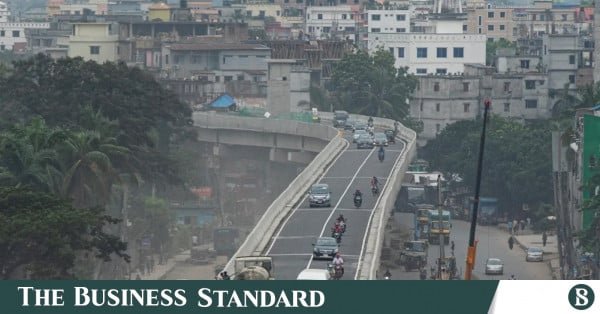
That is precisely the reality of the Gazipur-Airport Bus Rapid Transit (BRT) project. After 14 years of disruptive construction, escalating budgets, and immense public suffering, the ambitious project has been abandoned. Over Tk2,811 crore has already been spent, with another Tk1,000 crore outstanding in unpaid bills, yet the specialised bus service never carried a single passenger.

The failure is exceptionally severe because this was no isolated site. The 20.5km corridor runs along the primary arterial route connecting Dhaka with Gazipur and the northern districts. Transforming this vital corridor required utility relocations, property demolitions, and daily upheaval for hundreds of thousands of commuters.
The human cost was horrific: five members of a family were crushed to death when a concrete girder fell onto their car during construction. Countless others endured years of severe gridlock in anticipation of a transit solution that never materialised.
Despite claims that over 77% of physical work had been completed by May 2025, the government officially scrapped the BRT concept, electing to convert the corridor into a conventional six-lane highway. The cabinet decision, chaired by Prime Minister Tarique Rahman on 18 October, also ordered the winding up of Dhaka Bus Rapid Transit PLC.
While halting the project stops further financial bleeding, abandoning the infrastructure must mark the beginning of institutional accountability, not its conclusion.
Who answers for the billions wasted?
The decision to scrap the BRT followed an expert review commissioned after the interim government refused further cost escalations and deadline extensions. A panel from the Bangladesh University of Engineering and Technology (Buet) concluded that the narrow Gazipur-Airport corridor could never safely sustain a dedicated BRT system. They recommended repurposing the partially built infrastructure into an improved highway for long-distance and higher-speed traffic.
Converting the road salvages minimal utility, but it leaves an uncomfortable question: how did a major urban transit project advance so far despite fatal design flaws?
The shortcomings were no secret. As early as 2020, the planning ministry’s Implementation Monitoring and Evaluation Division (IMED) warned of severe design defects, poor contractor performance, and weak oversight. Former planning minister MA Mannan publicly noted that agencies routinely attached “substandard feasibility studies” merely to secure project approval. In October 2022, former road transport minister Obaidul Quader acknowledged widespread construction disorder yet ordered the agency to finish the project “at any cost”.
Driven by political insistence, a flawed blueprint was pushed forward, turning an early error into a catastrophic sunk cost. Initially budgeted at Tk2,135 crore for completion in 2016, repeated revisions pushed the projected cost to Tk6,598 crore and the timeline out to 2029 before the project was finally pulled back.
Shared burden: The role of development partners
The Buet evaluation also raises critical questions about the Asian Development Bank (ADB) and the international consultants who prepared the original feasibility and engineering designs.
Originating as an ADB-backed initiative before being transferred to the Roads and Highways Department (RHD), the project suffered from fundamental spatial constraints that should have been flagged during early appraisals. Firms including Advanced Logistics Group (ALG), BETS-TMB JV, SMEC International, SYSTRA, and ACE Consultants were central to the feasibility and design phases.
The ADB had declined to comment on the findings when contacted by The Business Standard. The ALG, meanwhile, said its study had been conducted many years ago and had been extensively discussed with public institutions, multilateral development banks and other stakeholders.
While development partners provide crucial technical expertise and concessionary funding, technical influence must come with institutional responsibility. Approval by a host government should not shield international lenders or private consultants from scrutiny when their fundamental recommendations prove unviable.
A lender’s involvement does not absolve the then government of its duty to scrutinise a project. Equally, a government’s approval should not automatically shield the lender and consultants from questions about the soundness of their recommendations.
Accountability must follow the evidence. The government should establish which decisions were flawed, who made them and whether the parties involved discharged their professional and institutional responsibilities.
A cautionary tale for public investment
The concept first entered national planning via the 2005 Strategic Transport Plan (STP), prepared by the Louis Berger Group and funded by the World Bank. The ADB later financed the primary feasibility study for Line-3 under the Greater Dhaka Sustainable Urban Transport Project, projecting travel times of 20 minutes between Gazipur and the airport for 20,000 passengers per hour.
The then government eventually took up the project, with the Road Transport and Highways Division sponsoring it and the Roads and Highways Department (RHD) responsible for implementation. The project was initially approved at Tk2,135 crore, with the government bearing about two-thirds of the cost and the ADB pledging Tk707 crore.
Reality diverged sharply from those projections. The then planning adviser Wahiduddin Mahmud later described the scheme as “monstrous and ill-planned”. The current government acted correctly in stopping further investment, resisting the classic trap of throwing good money after bad.
Taxpayers are now left to finance the conversion of the corridor while servicing millions in foreign loans including over $256 million disbursed by the ADB and the Agence Française de Développement.
To prevent similar failures, the government must institute a formal, independent inquiry spanning the entire lifecycle of the project: initial approval, feasibility validation, contractor selection, and the repeated granting of extensions despite known flaws.
Every major public infrastructure project must be judged on its delivered public benefit – not on expenditure volume or physical progress metrics. The Gazipur-Airport BRT collapsed under the weight of its own flawed assumptions; ensuring those responsible for answering is the only way to safeguard future public funds.
Otherwise, the lesson is a grim one: projects may be abandoned, infrastructure may be rebuilt and official plans may be rewritten, but those responsible for failure can still escape accountability while the public pays the price.
About The Author