When the Barbadian chef Paul Carmichael was reluctant to share a recipe with me, I could relate. I’m also hesitant to share ideas, to brag about my own food, to have to explain what makes my cooking unique.
But I also like to nerd out with other cooks. I love nothing more than getting to the bottom of what makes a dish work.
It was late last summer when Emily Weinstein, my friend and the editor in chief of New York Times Cooking and Food, and I went to Mr. Carmichael’s Kabawa, in the East Village. We’d been whisked by a host to its cozy dining room and seated by the entrance, in front of a large window. (I’d made a note in the reservation announcing my food allergies, and that I was in a wheelchair, and they were accommodating.)
I took in the beautiful space, the carefully placed Tiffany-style lamps, the (wedged or sliced) fruit garnishing the drinks.
As the playlist blared loudly — thrilling! — I glanced through the menu. Pepper shrimp, hibiscus, cassava, coconut, goat meat, plentiful dips in patterned condiment vessels. There was sourness from tamarind pods, sweetness from dark sorghum or molasses, and heat from Scotch bonnets or jalapeños, who cares? I took every nibble as an invitation to play and engage with the meal.
I felt I was home — if my home were a Caribbean Frank Lloyd Wright.
Mr. Carmichael would at times come to our table. It was the first time he and I were meeting in person — I’d been following his work for years — and our conversation flowed easily. Occasionally, while eating the braised goat, I would shake my head, stare wide-eyed with suspicion and surprise, or smile, taking in the intensity and tangibility of the sensations.
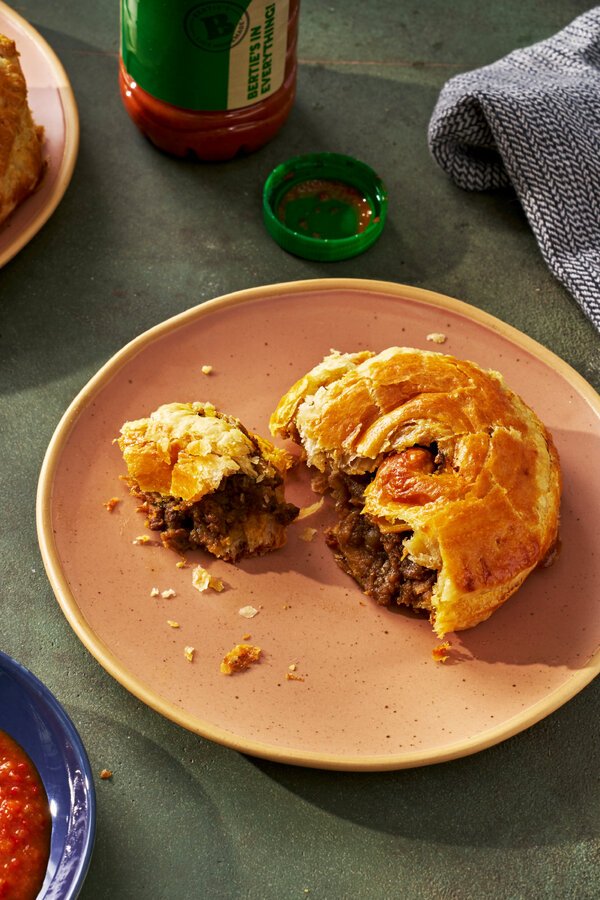
He walked next door to his sister restaurant, Bar Kabawa, to get us beef patties, still piping hot, delicate with a buttery crust that shattered with each bite. When cut, they unveiled an abundant meat or vegetable filling, a mix of earthy cumin-coated minced goat or creamy fried chunks of eggplant. I first nibbled, then bit into the patty with reckless abandon as the crumbs scattered across my chin to my scarf and napkin.
“Do you use puff pastry?” I asked him.
“No,” he said. “Who’s got time for that?” We both laughed.
Over eight months, I spoke reverently about those beef patties to my husband. When I returned to Kabawa in January with him for a late-night meal of braised goat meat and cocktails, I could finally share the cooking I had been raving about. Again, Mr. Carmichael would return to our table.
When our server presented us with a shallow bowl of cassava dumplings over a Creole sauce, I giggled quietly, recognizing the starchy root’s soft, supple and chewy nature. Here, my friend, cassava’s starch had been pulled and stretched — as when making mochi — making it the ideal vehicle to the savory tomato-pepper sauce spread on the plate. I pressed Mr. Carmichael, gently, about the dumplings. Or so I thought: I actually blurted out different ways to ask the same question. And then I asked him what I’d really been wanting to know.
“What is in the beef patty dough? Break it down, to ingredient level? To the elements?”
He smiled and said, simply: Flour, water, salt.
My mind was blown. You mean no yeast? No leavener?
Finally, I asked, “Is there any butter?” “Yes,” he admitted, “there is butter.”
Weeks later, I called Mr. Carmichael early on a weekday. Prep had begun for the next day’s service, and his team was starting to roll out the beef patty dough. He explained that he uses an in-house ground goat (a mix of meat, tendon and fat from leg and shoulder) for the filling. The dough uses a well-honed technique. He turned on video calling and held up the phone to show me the cooks’ work station and their process. Yan Torres, the junior sous-chef of pastry, expertly pulled two different doughs into shape.
Readers, please believe me when I say his process is brilliant, innovative, clever! And it works so well. I never could have guessed such a process could be applied to a four-ingredient dough.
But I cannot share every step. What I can share is my version of his recipe.
I liken it to love. I have love in my life that I can’t always readily share widely. It is mine, and I think that’s what makes it so special. It can be guarded and protected, personal or let loose. We are all selective about how much to open the door of our hearts to others.
As Mr. Carmichael put it, when talking about layering spices in the patty’s filling: “I know when something is right, and it makes sense to me. The way my palate works, I just love balance.”
He cracked the door to his passion, ever so slightly, and I have flung my recipe’s door wide open.
It is easy for any level of cook, and almost as good as his. It can be made with store-bought frozen or homemade puff pastry and ground lamb or beef. The potatoes, which are absent from Bar Kabawa’s patties, are crushed with the reserved cooking liquid, which helps maintain the fillings’ supple sauciness.

The dough is rolled into a log, then sliced into individual pieces.Credit…Andrew Bui for The New York Times. Food Stylist: Barrett Washburne.

The rounds are then rolled out and filled.Credit…Andrew Bui for The New York Times. Food Stylist: Barrett Washburne.
To form the patties, scatter a handful of flour across a work surface. Gently unravel the sheet with conviction, and it will glide while maintaining its composure. Stretch the dough into a rectangle. If it begins to tear, you’ve gone too far. (Don’t worry. It’s endlessly fixable: Trim the edge to press the scraps into any tears.) Brush the sheet lightly with a prepared egg wash, roll it into a spiral and cut it into smaller pieces as you would a slice-and-bake cookie. Roll each round a into circle, then fill, seal and repeat.

A second round tops the filling and is crimped to close the patty.Credit…Andrew Bui for The New York Times. Food Stylist: Barrett Washburne.

An egg wash mixed with turmeric helps give the patties their golden hue.Credit…Andrew Bui for The New York Times. Food Stylist: Barrett Washburne.
The process is technical but simple. You do have to go back and forth between the work surface and your refrigerator to keep the disks cool. But when done, you can breathe a sigh of relief and give yourself a pat on the back. Enjoy the patties hot or warm, alongside pepper sauce, pikliz and cilantro-mint chutney, as a snack anytime of day or a bite to whet your palate before a larger meal. You can even freeze them for a few months, reheating them whenever you need to feel like sharing a moment with a loved one.
But if this all piques your curiosity, too, and if you’re left wondering how good these patties and Mr. Carmichael’s cooking can truly be, you may just want to go to his restaurants to find out.
Follow New York Times Cooking on Instagram, Facebook, YouTube, TikTok and Pinterest. Get regular updates from New York Times Cooking, with recipe suggestions, cooking tips and shopping advice.
About The Author