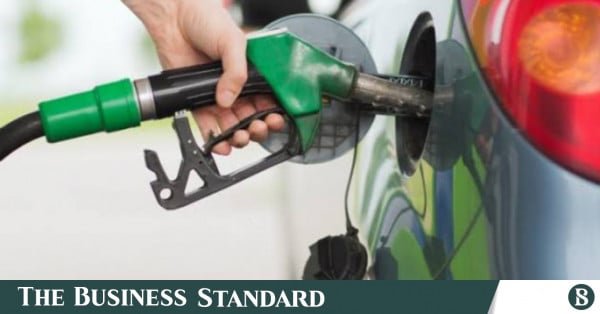
Bangladesh’s delayed fuel price adjustment is being treated as the start of the shock. For millions, the inflation arrived weeks earlier—through queues, shortages, and an expanding “open” market, where scarcity becomes a game of privilege, and the real price is paid long before the official one moves.
Images from recent weeks capture this reality: motorbikes coiled around petrol pumps like a serpent, engines switched off to conserve the last few drops, riders slumped over handlebars in the afternoon heat. Bangladesh may have waited over six weeks to adjust fuel prices, but the market did not—it adjusted on its own, quietly and outside official statistics.
The government’s decision to raise administered prices is being debated as the start of the shock. In truth, it marks when the shock becomes visible on paper. For most consumers, inflation had already arrived. What followed was not a delay, but a different form of adjustment.

When the price is suppressed, the market adjusts
The global backdrop leaves little room for ambiguity. Since late February, when tensions around the Strait of Hormuz disrupted tanker traffic, energy markets have been under strain. Oil prices surged, freight costs climbed, and war-risk premia rose. Even without real-time access to Mean of Platts Arab Gulf (MoPAG) benchmarks used in BPC’s pricing formula, the direction is clear: import costs for gasoline, diesel, and kerosene have moved broadly in line with Brent.
BPC’s automatic pricing formula, introduced in 2023 and applied monthly through 2025, would have tracked the rise had it been used as intended. Instead, it was paused. Once paused, the gap between import costs and domestic prices widened. On paper, this looked like stability. In practice, it was an invitation to arbitrage.
What followed was predictable.
When administered prices are held below market-clearing levels during a supply shock, the price no longer allocates supply. Time takes its place. The queue becomes the price.
Eight to ten hours spent waiting under a punishing sun became the real surcharge on fuel. Those with the least flexible time—delivery riders, small transport operators, day laborers—paid the highest share. Where price cannot adjust, access becomes the currency.
Scarcity does not produce a single queue; it produces a hierarchy. As lines lengthened, a quieter choreography emerged: vehicles entering through side gates, some customers bypassing the wait, informal “lists” at the margins. The pattern is familiar enough to need little documentation. Where access becomes more valuable than the good itself, privilege finds a way in.
For ordinary citizens, the contrast is stark. Hours lost in line mean lost income, higher costs, and mounting uncertainty. Meanwhile, those with connections navigate the system differently. The queue becomes more than an inconvenience—it reflects a political economy of scarcity, where time is extracted from the many while access is reserved for the few.
As queues lengthened, a parallel market took shape. Farmers reported paying Tk 125–135 per litre when the official diesel price was Tk 100. Riders found that queuing, filling, and reselling fuel could be more profitable than using it. The filling station became, in effect, a wholesale point. The official price remained on paper—only for those able to reach it.
Because much of this activity is informal, little appears in the consumer price index. Yet the inflation is real. By the time the government adjusted administered prices in mid-April, much of the global price shock had already filtered through the economy—hidden in queues, informal transactions, and risk premia rather than in official data.
Distortions multiply: from queues to smuggling
But the distortion did not stop at the queue. As uncertainty deepened, households and dealers began to hoard. When future access is uncertain, the incentive is to store more today—in tanks, drums, and jerrycans. Dealers also have reason to hold back supply or divert it to higher-paying buyers. The result is reduced effective supply at the pump, reinforcing the shortages that triggered the behavior.
Smuggling added another layer. Fuel imported at global prices but sold domestically at subsidized rates became, in effect, an exportable commodity. Selling across the border below world prices but above Bangladesh’s administered price quickly became profitable. The result was a quiet leakage of subsidy beyond national borders—unintended, but predictable once a large gap opens between domestic and international prices.
The narrative that “no price increase means no inflation” has not survived contact with reality. When farmers pay above the official price, their costs rise. When transporters secure fuel at a premium, fares follow. When uncertainty dominates, traders widen margins as a hedge. Inflation does not wait for official price changes—it moves through shortages, expectations, and informal markets.
Recognition, not relief
Seen in this light, the recent price adjustment is not a new shock but partly a recognition effect. Official prices are catching up to what many consumers have already been paying. The adjustment narrows arbitrage margins, reduces incentives for resale and smuggling, and slows BPC’s losses—easing fiscal pressure when public resources are already stretched.
The deeper lesson is about rules and credibility. Bangladesh did the technical work of designing an automatic pricing formula linked to international benchmarks. The problem is not the design but the discretion to suspend it when prices become politically inconvenient. A rule that operates only in benign conditions is not a rule; it is a suggestion.
Avoiding a repeat of recent weeks requires allowing the rule to function even when it is uncomfortable. Transparency is equally critical. Publishing benchmarks, premiums, and price build-up in a simple, regular format would help anchor expectations and reduce uncertainty. Rather than subsidizing every litre for every consumer—including those engaged in arbitrage, hoarding, or smuggling—public resources would be better used to support vulnerable households through targeted measures.
Queues at filling stations are not merely a logistical problem; they are a macroeconomic signal. They show that the price system has been asked to do something it cannot: deliver artificially cheap fuel during a global supply shock without shortages, rationing, or fiscal cost. No administrative mechanism can sustain that balance.
Flexible, rules-based pricing does not resolve the global shock. It does not reopen shipping routes or lower international benchmarks. What it does is ensure that the cost of adjustment is transmitted in a way that is visible, predictable, and economically coherent—rather than hidden in queues, informal markets, and unequal access.
About The Author