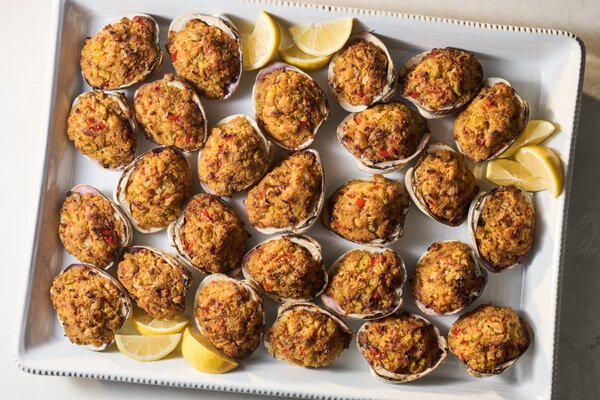
Extravagant buttered lobster rolls and briny oysters top the gustatory bucket lists of most summer visitors to New England’s shore. But among many denizens of the sandy precincts stretching from Cape Cod through southern Massachusetts and Rhode Island, a humbler bite is equally beloved: the stuffed quahog — or “stuffie,” in local parlance.
A species of hard-shelled Atlantic clams (Mercenaria mercenaria) that can grow as fat as a fist, quahogs prefer the mild estuaries of southern New England to the frigid, saline open waters up north. The tidal shallows around Narragansett Bay are especially hospitable, a quirk of ecology that’s fostered a particular passion for the dish among Rhode Islanders. (In 2023, a cadre of seven-foot-tall stuffie statues were deployed around the country as the centerpiece of a state tourism campaign.)
Though cousins to clams casino and clams oreganata, stuffies reflect a diversity of influences unique to this watery corner of the country. The Wampanoag and other Algonquian peoples had been harvesting quahogs for millenniums before the arrival of Europeans. But modern stuffie recipes are characterized by both a “make-do and use-it-up” spirit of Yankee thrift and ingredients like chouriço and linguiça sausage that arrived in the 1800s with the Portuguese, Azorean and Cape Verdean migrants who built communities around the region’s marine industries and textile mills.
When Marcey Bartnicki was growing up in the South Coast town of Acushnet, Mass., in the 1980s, pit stops at takeout clam shacks were a fundamental part of the rhythm of summer. “Clam cakes, stuffies, I thought everybody knew what those were,” she said. After moving inland to Nashua, N.H., however, she was dismayed to find herself in a stuffie desert. To satisfy cravings, she realized she’d need to make her own.

Cousins to clams casino and clams oreganata, stuffies reflect a diversity of influences.Credit…Joe Lingeman for The New York Times. Food Stylist: Barrett Washburne.
Happily, stuffies are not only suited to home cooking but, once prepped, freeze exceptionally well, souvenirs of the shore that can be socked away for colder, darker days.
Die-hards may insist on digging their own clams. But should you lack will or proximity, many grocery stores and well-stocked fish markets supply clams year-round, or they can get them for you if you call ahead. (Ms. Bartnicki buys her fixings at Market Basket.) When fresh isn’t an option, seek out containers of chopped raw sea clams, another large species that fishmongers often sell frozen. (Though don’t forget: You’ll need to get your hands on some clamshells, too.)
Quahog clams are sometimes better known by names they are assigned according to size, which include petite littlenecks, midsize topnecks and hefty cherrystones. The largest ones are also called quahogs, or sometimes chowder clams. You want the big boys for this.
Mac Hay, founder of Mac’s Seafood, which operates markets and restaurants across Cape Cod, started making stuffies alongside his grandfather during childhood summers at the family home in Truro, Mass. Back then, Mr. Hay said, they used whatever the tide provided — quahogs or sea clams. After steaming, chopping and reserving the stock, the rest of the formula was elemental: diced onion, celery and a bit of pork fat (usually Portuguese linguiça sausage or bacon), bound with bread crumbs, mounded into a shell and baked until golden.

Mac Hay, the founder of Mac’s seafood, started making stuffies as a child.Credit…Vanessa Leroy for The New York Times
Mr. Hay’s methods have grown a bit more sophisticated since. Nowadays, he adds white wine, garlic, fresh herbs, crushed crackers (often gluten-free) instead of plain bread crumbs and, to really punch it up, a finishing hit of sherry, a trick from Howard Mitcham, a colorful local artist and chef who was an early guru for Anthony Bourdain. One element that hasn’t altered: Portuguese sausage. “If you tried to make a stuffie without linguiça in Provincetown,” Mr. Hay said, “they’d probably shoot you.”
In her kitchen, Ms. Bartnicki follows a slightly different blueprint, folding in bits of sweet red pepper and forgoing garlic and wine. For a binder, she typically reaches for stale Portuguese rolls or leftover sweet bread — though, on this point, there is abundant flexibility. Other cooks cite crushed Ritz crackers or Pepperidge Farm stuffing mix as go-tos. Toasted cornbread cubes lend an especially appealing edge of sweetness.
But taking a rigid approach to ingredients runs counter to the spirit of the dish. “Stuffies are tavern food,” Mr. Hay said. “They’re easy to prepare, hard to mess up and a good source of protein, too” — ideal fortification alongside a few beers or a bottle of Vinho Verde.
Both agree that, to preserve their tenderness, quahogs ought to be steamed briefly, just until opening and finely chopped. For the fullest flavor of the sea, the stuffing should be deeply moistened with clam cooking broth and then generously scooped (but not tightly packed) into cleaned shells. Topping each one with a knob of butter before baking lends a final layer of richness and crunch. Besides the aforementioned beverages, lemon wedges and a bottle of vinegary hot sauce are all the accompaniments needed.
In other words: Avoid fuss, and feel free to follow the spirit of summer where it moves you. “Stuffies are kind of like grandma’s Sunday gravy,” Mr. Hay said. “Everyone’s got their own angle.”
Follow New York Times Cooking on Instagram, Facebook, YouTube, TikTok and Pinterest. Get regular updates from New York Times Cooking, with recipe suggestions, cooking tips and shopping advice.
About The Author