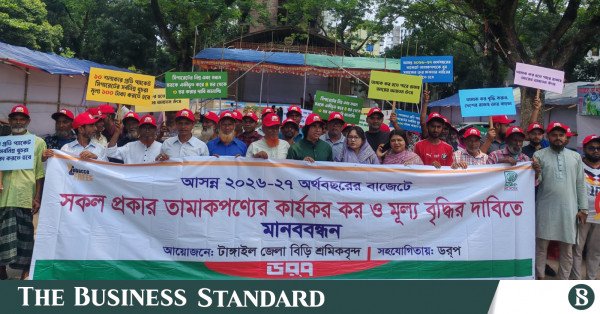
Workers and anti-tobacco activists in Tangail have demanded increased taxation and higher retail prices for all tiers of tobacco products in the upcoming national budget for fiscal year 2026–27.
The demand was raised during a rally held today (4 May) in front of the Tangail District Press Club, organised by the Development Organisation of the Rural Poor (DORP).
The programme brought together participants from various professions, anti-tobacco campaigners, journalists, civil society members, and leaders of bidi workers’ associations.

Speaking at the event, Zeba Afroza, programme coordinator of DORP’s Tobacco Control Project, said Bangladesh’s cigarette market is divided into four tiers—low, medium, high, and premium—with around 90% of sales concentrated in the low and medium segments. She said this makes tobacco products easily accessible and contributes to rising addiction, particularly among young people.
She proposed merging the low and medium tiers and setting new minimum retail prices at Tk100 per 10-stick pack for the combined category, Tk150 for high-tier cigarettes, and Tk200 for premium brands. She also recommended maintaining a 67% supplementary duty across all tiers and introducing a specific tax of Tk4 per pack.
According to her proposal, these measures could discourage more than 3,72,000 young people from starting smoking and help prevent over 185,000 premature deaths in the long term.
Speakers at the programme, including Nazmul Haque, president of the Tangail Regional Bidi Workers’ Association; Shah Alam Mia, general secretary; Zaynab Bibi, a member; and journalist Borhan Talukdar, highlighted the public health and economic impacts of tobacco use.
They said Bangladesh has the highest tobacco consumption rate in South Asia at 35.3%, describing it as a major public health concern. Tobacco-related illnesses, they noted, cause nearly 2 lakh premature deaths each year, while economic losses from health and environmental impacts reached about Tk87,000 crore in 2024—more than double the revenue generated from the sector.
The speakers stressed that tobacco should be addressed through stronger taxation policies aimed at increasing prices rather than treating it primarily as a revenue source.
Bidi workers at the event also expressed concern that while prices of essential goods such as rice, lentils, oil, and salt have risen, tobacco prices have remained relatively low, making them more accessible to low-income groups and young people.
They added that many workers do not wish to continue in the sector and urged the government to increase tobacco prices while ensuring alternative employment opportunities for bidi workers.
About The Author