A syndicate has allegedly been importing high-value luxury cars from Japan by declaring them as used motor vehicle spare parts to bypass customs controls and evade duties and taxes, according to the Customs Intelligence and Investigation Directorate.
Sagar Sen, joint director of the Customs Intelligence and Investigation Directorate, disclosed the findings at a press briefing at Patenga Container Terminal this afternoon (1 September).
“An organised group has been importing complete luxury vehicles by cutting or dismantling them and declaring them as used spare parts. We have found evidence of this practice in the latest Chattogram consignment,” he said.

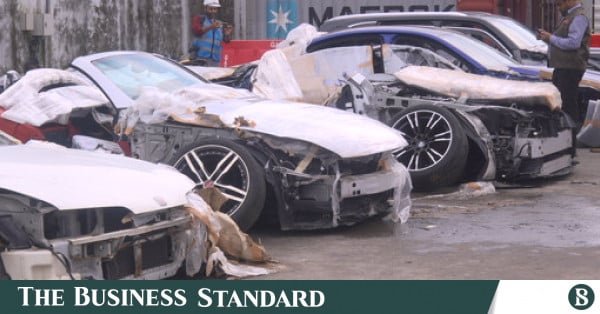
The latest consignment, intercepted at the Patenga Container Terminal of Chattogram Port, contained major components of several high-end vehicles, including a Lexus LX 600, Lexus SC 430 and BMW M5, as well as a Honda B18C Type R engine and two vehicle front-half sections.
The consignment arrived in a single container carrying 167 packages weighing 8,018kg. Customs officials estimated the equivalent value of three complete vehicles and the engine at Tk9.5 crore to Tk12 crore, although the final customs value will be determined after a detailed physical examination.
According to Sen, the importer, Crown Automobile Services, has been involved in such imports since 2018 and expanded the practice from 2021.
The customs intelligence agency said it had received confidential information that the consignment contained vehicles and major components inconsistent with the declared description.
A preventive team led by Sen inspected the container on 31 August and stopped an attempt to clear the goods through an auction process.
The shipment arrived at Chattogram Port from Yokohama, Japan, aboard the MV Maersk Mongla on 10 July. Mahi Car Port in Japan was listed as the exporter, while Crown Automobile Services was the importer.
The goods were declared as “used spare parts of motor vehicles and used/second-hand petrol engine fitted with gear box of motor vehicles”.
Customs officials, however, found components that could potentially be reconstructed into complete or nearly complete vehicles.
Sen said the same importer had previously brought four such vehicles through Mongla Port. Customs authorities are now reviewing its previous consignments to determine the scale of the alleged practice.
“We are investigating how many consignments this company has imported through different ports and whether similar declarations were used in those shipments,” he said.
Officials are also examining whether the imported components belonged to the same vehicles and whether they had been deliberately dismantled before shipment.
The inspection found that some vehicle bodies had been positioned in a way that made them difficult to identify through routine scanning.
“In one case, the vehicle was suspended in such a manner that it was not possible to identify it as a vehicle even after scanning. Only the four wheels could be identified clearly,” Sen said.
The consignment also contained engines, suspension and other major components, tyres and two front-half sections.
Investigators will examine the VIN or chassis numbers, engine numbers, gearbox details and part numbers to determine whether the components came from the same vehicles.
They will also assess whether the parts can be reassembled into complete vehicles.
Authorities suspect the method may allow importers to circumvent restrictions and reduce customs liabilities compared with importing complete vehicles.
Customs officials also suspect that the group may be exploiting damaged or scrapped vehicles from abroad.
Sen said vehicles damaged, burned or otherwise rendered unusable overseas could be dismantled and brought into Bangladesh as parts. The group may then use number plates associated with damaged vehicles to sell reconstructed vehicles in the local market.
“If a vehicle has a market value of around Tk5 crore, reconstructed vehicles can sometimes be sold Tk1 crore to Tk1.5 crore cheaper,” he said.
Customs officials said the latest shipment had remained at the port without a bill of entry for around a month. The importer had submitted the bill of lading but had not filed the bill of entry required for customs clearance.
The agency is now conducting a 100% physical examination and preparing a detailed inventory of the goods.
Officials will determine the actual customs or assessable value of the vehicles and parts, applicable duties and taxes, and whether any duty evasion took place or was attempted.
The Customs Intelligence and Investigation Directorate is also examining possible violations of the Customs Act 2023 and other relevant laws. Possible money laundering aspects will also be investigated, officials said.
Sen said the latest interception might not be an isolated case.
“We believe another consignment may arrive through the same route or using a similar declaration. That is why we are examining the importer’s previous and upcoming shipments closely,” he said.
The investigation will determine whether the imports constitute genuine used spare parts or deliberately dismantled luxury vehicles imported as parts to circumvent regulations.
Customs officials said no final conclusion had yet been reached on the exact value or extent of duty evasion. Those findings will depend on the completion of the physical examination, technical assessment and verification of vehicle identification numbers.
The agency said legal action would be taken against those responsible once the investigation establishes the facts and identifies violations.
About The Author