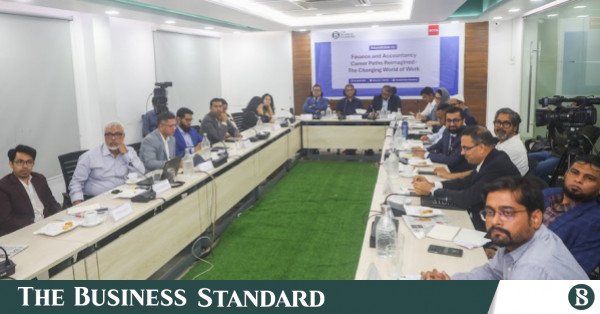
The success in accountancy and finance careers in future will depend on adaptability, continuous learning, and the ability to combine technical expertise with human-centred skills, experts have said.
The future of work is undeniably uncertain, but it is teeming with opportunity for those willing to adapt, they said in a roundtable discussion held at The Business Standard conference room yesterday.
Titled “Finance and Accountancy Career Paths Reimagined – The Changing World of Work”, the discussion was organised by ACCA Bangladesh, moderated by TBS Senior Executive Editor Sharier Khan.

Clive Webb, head of Business Management at ACCA Global, presenting the keynote, said there has been a fundamental change in career structures driven by the interconnected forces of demography, climate change, and technology.
He suggested that the role of the profession is shifting from being the “owner of knowledge” to the “provider of trust and integrity”.
Webb described a transition from a traditional “pyramid” organisational structure to a “diamond” model, where fewer entry-level roles exist and the focus shifts to interpretation, human verification, and value-driven insight.
In his presentation, he further said the future of work in accountancy and finance is dynamic, uncertain, and full of opportunity.
“Success will depend on adaptability, continuous learning, and the ability to combine technical expertise with human-centric skills. By embracing flexibility and aligning with emerging trends – technology, sustainability, and purpose – professionals can thrive in a world where career paths are reimagined and accountancy is redefined,” he said.
Prawma Tapashi Khan, country manager at ACCA Bangladesh, said that while concerns about job cuts due to AI are valid, the reality is that many new roles will emerge as the nature of work is redefined.
She added that technology itself will not replace human professionals, but those who fail to utilise technology effectively will be replaced by those who do.
Sajjad Hossain Bhuiyan, chairman of the Financial Reporting Council (FRC) Bangladesh, revealed that while 150,000 companies are registered with the RJSCF, only 35,000 submit tax returns. He challenged the accounting community to locate these missing 115,000 entities and bring them into the formal fold.
The FRC chairman addressed the need for a professional Valuation Code and the formal recognition of ACCA graduates under the Financial Reporting Act, acknowledging that their international expertise is vital for better economic governance.
ASM Amanullah, vice-chancellor of National University, Bangladesh, pointed out a stark disconnect: the country produces 10 lakh graduates annually, yet 3 lakh stay unemployed.
He attributed this to a lack of industry-academia linkage. To address this, the National University has launched 26 reform initiatives, including an MoU with ACCA to integrate professional certifications into the curriculum.
He advocated increasing education spending to 3% of GDP, stressing that a one-dollar investment in human development today can yield a 300% return within a decade.
Professor Tapan Mahmud, head of Business Administration in Accounting and Information Systems at the Bangladesh University of Professionals, said modern “outcome-based education” must be more than a paperwork exercise for accreditation.
He warned that over-reliance on digital tools is eroding students’ decision-making abilities, urging a return to “dialogic teaching” that develops the capacity to handle complex and ambiguous scenarios beyond number-crunching.
Shanshil Ahmed Shibly, technology director at Grameenphone, said the first wave of AI has already passed and the era of “Agent AI” has begun, with “Robotic AI” expected to handle basic tasks by 2028.
He added companies are transforming workforces not just for profit but for survival, and that data sovereignty must be a national priority.
Imam Al Razi, director at Monstarlab Enterprise Solutions, said the challenge often lies in the mindset of business owners who fear automation or lack the capacity to implement ERP systems. He called on universities to introduce these technologies early so students remain relevant in a world where repetitive tasks are rapidly being transferred to AI.
Tanaka Islam, head of HR at Maersk (Bangladesh and Sri Lanka), observed that the era of preferring select institutions is over, with focus now firmly on mindset and self-awareness.
She urged academics to move beyond ceremonial collaborations and engage in meaningful mentorship that prepares students for the corporate environment.
Seezan M Choudhury, partner at ACE Advisory, added that while managing “Gen Z” can be challenging due to their preference for flexibility over certainty, they also present an opportunity.
He suggested that AI-driven automation at the “bottom of the pyramid” allows mid-level managers to produce high-quality reports that previously required large technical teams, enabling Bangladesh to “leapfrog” traditional accounting methods.
Jakir Hossain, group CFO at Asiatic 3Sixty, described the transition of finance leaders from “historians” to “architects” of business.
He shared how re-engineering a company’s financing structure saved hundreds of crores, proving that strategic integration is more valuable than technical bookkeeping alone.
Snehasish Barua, managing director of SMAC Advisory Services, noted a critical shortage of forensic accountants – a field that accounts for eight out of ten client requests – and urged institutions to develop specialists in this high-demand area.
Mohsena Khanom Munna, founder of De Tempete, said accounting business process outsourcing (BPO) is a major export sector for Bangladesh but suffers from a gap in “job-ready” skills and the high cost of training interns who often leave for different time zones. She proposed embedding technical courses during university education.
Marzana F Chowdhury, managing director at RSM Bangladesh, said finance professionals must now act as “co-pilots” to management, using data insights to drive strategy rather than simply reporting the past.
Mohammod Rashedul Alam Chowdhury, financial management officer at the Asian Development Bank, stressed the need for specialised finance cadres in the public sector.
Sarwar Alam, executive partner at KZK Advisory, said Bangladesh’s 78 lakh SMEs represent a vast job market if accountants can offer affordable, AI-assisted services.
Mohammad Rokibul Kabir, dean of the Faculty of Business and Entrepreneurship at Daffodil International University, showcased successful “Pathway to ACCA” programmes that allow students to work while studying.
Shah Waliul Manzoor, senior business development manager of ACCA Bangladesh, said a significant part of this journey involves the continuous evolution of qualifications.
He said integration of artificial intelligence into the curriculum by 2027 is a key part of ACCA’s strategic direction, supported by research and “Professional Insights” resources.
Labio Bala, financial specialist at UNOPS, said that while degrees are essential, competency and the confidence to add value are the ultimate benchmarks.
He said participants agreed that by embracing flexibility and aligning with technology and sustainability trends, the reimagined finance professional will not only survive but lead the coming transformation, where career paths are defined by the ability to evolve.
About The Author