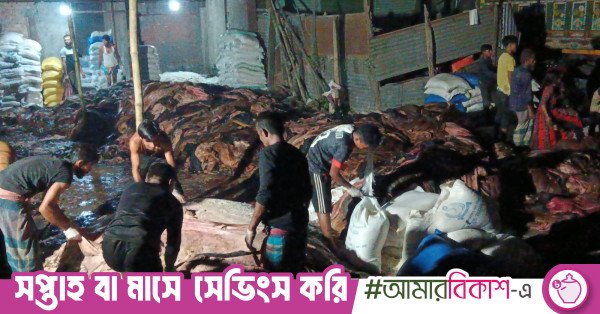
Faced with a complete absence of wholesale buyers, a large majority of people donated their sacrificial hides to local orphanages and madrassahs
A visit to North Tehmuni area in Lakshmipur town on Eid afternoon showed traders purchasing medium to large hides for between Tk100 and Tk150 each. Photo: TBS
“>

A visit to North Tehmuni area in Lakshmipur town on Eid afternoon showed traders purchasing medium to large hides for between Tk100 and Tk150 each. Photo: TBS
The government-fixed rates for sacrificial animal hides have failed to take effect in Lakshmipur, leaving local sellers in severe financial distress as raw rawhide prices crashed on Eid day.
While some individuals managed to sell large hides from cattle worth Tk1,50,000 to Tk2,50,000 for a nominal Tk100 to Tk200, many found no buyers at all after waiting hours past noon. Faced with a complete absence of wholesale buyers, a large majority of people donated their sacrificial hides to local orphanages and madrassahs, though these institutions subsequently struggled to find merchants willing to purchase their stockpiles.
According to the latest government rates, salted cowhide prices in Dhaka have been fixed at Tk62 to Tk67 per square foot this year, compared with Tk60 to Tk65 last year. Outside Dhaka, the rate has been set at Tk57 to Tk62 per square foot.

For goatskins, salted hides of male goats have been priced at Tk25 to Tk30 per square foot, while female goatskins have been fixed at Tk22 to Tk25.
A visit to North Tehmuni area in Lakshmipur town on Eid afternoon showed traders purchasing medium to large hides for between Tk100 and Tk150 each.
Many donors said they were left with no option but to hand over the hides to local madrassahs and orphanages after being unable to find buyers.
Madrassas struggle to dispose of hides
Maulana Maksudul Haque, a teacher at North Char Lawrence Madinatul Madrassah in Kamalnagar upazila, told TBS that the institution had collected around 300 hides on Eid day and spent the entire day contacting traders.
He said a buyer eventually purchased the hides in the evening at Tk340 each.
Referring to several other madrassahs, he said many smaller institutions were unable to sell their collected hides at all.
Authorities at a madrassah in Ward No 11 of Lakshmipur municipality also faced difficulties after collecting around 30 hides. According to madrassah officials, a local warehouse owner at Islam Market had initially agreed to buy the hides at Tk420 each and arrange transport by pick-up vehicle.
However, the trader later informed them in the evening that he would not purchase the hides, leaving the madrassah unable to sell them elsewhere.
Traders blame tannery crisis and labour shortages
Mohammad Box Ali, a hide warehouse owner in Lakshmipur town, said he had stopped purchasing hides due to a shortage of processing workers and difficulties selling collected hides to tanneries.
He said hides that previously sold for Tk800 to Tk900 were now fetching only Tk400 to Tk500, while the prices of preservation chemicals had also increased significantly.
Ali said he had initially planned to purchase 10,000 hides this Eid but abandoned the target because of labour shortages and weak demand from tanneries.
He also alleged that although the government supplied salt to madrassahs for hide preservation, many institutions did not use it properly. Instead, he claimed, some sold the salt outside and kept untreated raw hides for extended periods in hopes of securing higher prices, resulting in decomposition and deterioration in quality.
A similar view was expressed by Mohammad Harun, another hide trader from North Tehmuni.
He said madrassahs often failed to apply salt to the hides in time, causing quality deterioration and reducing market value.
Harun also criticised the lack of government support for small warehouse owners, saying traders were unable to find buyers after purchasing hides and often faced delayed payments from tanneries.
He claimed that some tannery owners had yet to clear payments for hides supplied last year.
According to Harun, preservation costs have continued to rise due to higher labour wages, increased transport expenses and rising salt prices, while hide prices have continued to decline each year.
Harun said each worker now costs between Tk3,000 and Tk3,500 during the Eid season, while a sack of salt priced at Tk600 before Eid rose to Tk700 during the festival period.
“The increase in fuel prices has also pushed up transportation costs, leaving traders to incur losses year after year instead of making profits from the hide business,” he said.
About The Author