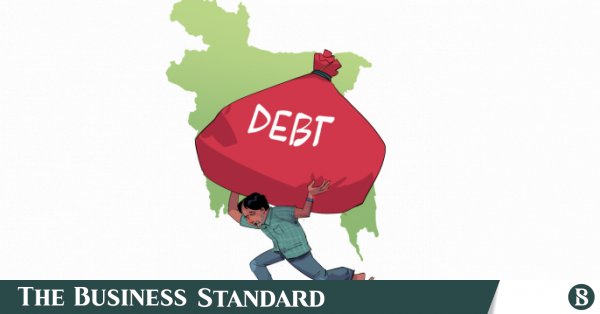
Although the debt is expected to remain within 39% of GDP due to an expanding economy, the ministry said the situation could still pose risks considering the tax-to-GDP ratio
Illustration: TBS
“>

Illustration: TBS
Highlights:
- Revenue shortfalls biggest domestic risk to Bangladesh’s economy
- Debt could exceed Tk33.78 lakh crore by 2029
- Development spending may decline Tk96,000 crore by 2029
- Private investment could fall Tk85,700 crore by 2029
- Increased borrowing may reduce growth to 6.45%
- Government plans tax reforms and broader tax collection
The finance ministry has identified revenue shortfall as the biggest domestic risk to Bangladesh economy, warning that persistent revenue gaps could push government debt up by more than Tk12 lakh crore over the next three fiscal years to Tk33.78 lakh crore.
Although the debt is expected to remain within 39% of GDP due to an expanding economy, the ministry said the situation could still pose risks considering the tax-to-GDP ratio.

In its Medium-Term Macroeconomic Policy Statement, the ministry said if the current trend of revenue shortfalls continues, development spending could decline by around Tk96,000 crore by 2029. Private investment could also fall short by about Tk85,700 crore.
Published with the budget documents, the policy statement said the government plans to introduce short-term Islamic Treasury Bills next fiscal year alongside Sukuk bonds to lengthen debt maturity and reduce refinancing risks.
Infograph: TBS
“>

Infograph: TBS
However, the report acknowledged that implementing the strategy would be challenging due to liquidity shortages in the financial sector. It also suggested attracting foreign investment into the domestic debt market to address the issue.
The government on Thursday announced a budget based on a revenue target of Tk6.95 lakh crore for the next fiscal year, a figure that has drawn scepticism among economists.
Centre for Policy Dialogue (CPD) distinguished fellow Debapriya Bhattacharya described the target as “unrealistic” in comments to The Business Standard.
CPD fellow Mustafizur Rahman said mobilising such a large volume of revenue within a single year would be extremely challenging.
He warned that if revenue collection falls short while public expenditure remains unchanged, pressure on both domestic and foreign borrowing would increase.
“In particular, higher external borrowing targets and repayment obligations could have adverse macroeconomic implications,” added Mustafizur.
Finance Minister Amir Khosru Mahmud Chowdhury at a post-budget press briefing yesterday said that reforms would be introduced in the National Board of Revenue, including its restructuring, staffing with competent officials, and digitisation.
He added that corruption would be curbed and businesses, including shops and restaurants across the country, would be brought under the tax network to boost revenue collection.
Finance Secretary Khairuzzaman Mozumder said the government would gradually move away from bank borrowing, with a focus on increasing public investment, which is expected to generate higher revenue over time.
Govt borrowing could drag down growth to 6.45%
The Fiscal Risk Assessment Statement chapter of policy statement said that in the past five years, revenue has fallen short of targets by an average of 16%. The gap has been widening and if this trend continues, the budget deficit could rise to nearly 5% of GDP.
The most concerning issue is that the government may need to rely more on borrowing to cover the revenue shortfall, which could in turn squeeze credit flow to the private sector.
According to the Finance Division, this could reduce private investment by around Tk85,700 crore by 2029, dragging down economic growth to 6.45% instead of the projected 7.5%.
To mitigate these risks, the report recommends expanding the tax net, rationalising tax exemptions, digitising tax administration, and strengthening accountability.
It also flags global energy price volatility, high inflation, financial weaknesses in state-owned enterprises, and climate-related disasters as key risks for the economy through 2029.
The economy may be able to absorb these risks individually, the chapter said. However, a combination of shocks could place pressure on growth, budget deficit, and debt situation.
The government plans to maintain its policy of keeping the budget deficit within around 5% of GDP in an effort to avoid excessive borrowing and preserve macroeconomic stability.
However, depreciation of the taka against the US dollar and rising global interest rates could increase the real cost of external debt, said the assessment.
Debt scenario
According to official data, external debt principal repayments stood at $2.61 billion in FY25 and are projected to rise to $3.20 billion in FY26. The finance ministry forecasts that this will further increase to $4.28 billion by FY29.
The repayment burden is expected to rise sharply as grace periods on loans expire, maturities are reached, and the impact of currency depreciation accumulates.
At present, around 91% of Bangladesh’s external debt is denominated in US dollars, Special Drawing Rights (SDR), and Japanese yen, with dollar- and SDR-based borrowing is 71%.
As a result, any depreciation of the taka against the dollar could significantly increase debt servicing costs. To address this risk, the finance ministry has indicated plans to explore hedging or exchange rate protection mechanisms in the future.
By 2029, 55.7% of total debt is projected to come from domestic sources, while 44.3% will be external. Although Bangladesh’s public debt remains within IMF-recommended safe thresholds, the low tax-to-GDP ratio is increasingly straining repayment capacity, prompting concerns among economists over potential debt vulnerability.
Government projections show the net fiscal deficit reaching Tk3.20 lakh crore by FY29, while remaining within 3.5%-3.7% of GDP.
A significant portion of this financing will come from domestic sources. Net domestic financing stood at Tk1.35 lakh crore in FY25 and is expected to rise to Tk1.84 lakh crore by FY29, though it is projected to remain near 2% of GDP.
Meanwhile, net external financing is projected to increase from Tk55,600 crore to Tk1.36 lakh crore over the same period, while remaining broadly stable at around 1.6% of GDP.
About The Author