Asaduzzaman highlights former Jamaat leader’s wartime position
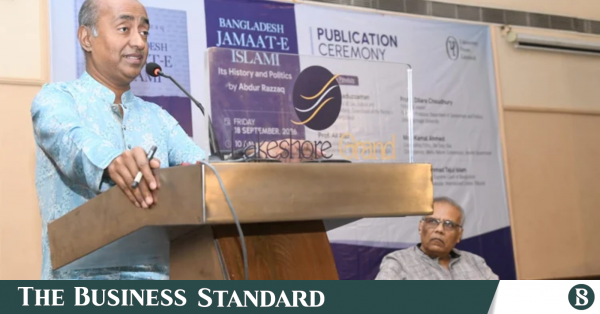
Law, Justice and Parliamentary Affairs Minister Md Asaduzzaman spoke as a distinguished panelist in an event at a hotel in Dhaka on 18 September 2026. Photo: BSS
“>

Law, Justice and Parliamentary Affairs Minister Md Asaduzzaman spoke as a distinguished panelist in an event at a hotel in Dhaka on 18 September 2026. Photo: BSS
Highlights:
- Earlier clarity could have resolved questions
- Book reflects Razzaq’s political thoughts and philosophy
- Asaduzzaman stresses accepting criticism in democracy
- Panel discusses Razzaq’s legacy and ideas
Law, Justice and Parliamentary Affairs Minister Md Asaduzzaman has said former Jamaat-e-Islami leader Barrister Abdur Razzaq’s position on the 1971 Liberation War and the political circumstances of that period was significant, suggesting that clearer articulation of that position earlier could have resolved many questions surrounding the issue.
The minister made the remarks today (18 September) while speaking as a distinguished panelist at the launch of Razzaq’s book Jamaat-e-Islami: Its History and Politics at a city hotel.

Highlighting Razzaq’s assessment of the Liberation War and the political context of the time, Asaduzzaman said his position and statements addressed to the nation deserved particular attention, reports BSS.
He observed that had the position been articulated clearly earlier, many of the questions surrounding the issue might have been resolved.
The minister said Razzaq’s book was not merely a literary or research work to him, but reflected the author’s life philosophy, thoughts, consciousness and experience of viewing society.
Razzaq’s political and organisational role
Asaduzzaman said Razzaq had carved out a distinct identity through his actions, thoughts, philosophy and ideals despite serving as assistant secretary general of Jamaat-e-Islami.
He said the respect Razzaq commanded in social and international circles went beyond his organisational position.
The minister also recalled Razzaq’s advocacy of international campaigns against fascism from a human rights perspective, saying he had used human rights issues as a platform to speak out against fascism.
Democracy, criticism and political change
Speaking more broadly about democratic society, Asaduzzaman said accepting differing opinions and criticism was essential.
“In a democratic society, it is not essential to agree with every statement made by an individual or a party. Similarly, it is not fair to reject any criticism simply because one dislikes it,” he said.
He also said an Islamic governance system should emerge from society rather than being imposed from above, describing governance based on Islamic values emerging from within society as the appropriate path to establishing such a system.
Referring to the new generation, he said society must adapt to change to move forward and that the July mass uprising had brought the generation’s aspirations for change to the forefront.
He said Razzaq’s book also contained significant perspectives on political thought and change.
Recalling his personal and professional relationship with Razzaq, Asaduzzaman said they would meet for tea or speak by phone whenever the former Jamaat leader visited London.
He said Razzaq, towards the end of his life while in hospital, had expressed a wish to be buried in Bangladesh.
The minister said that wish had been fulfilled and prayed for the eternal peace of Razzaq’s soul.
He also said people involved in politics should read the book.
Other panelists included Ali Riaz, Distinguished Professor in the Department of Politics and Government at Illinois State University, USA; John Danilovich, president of Washington DC-based Right to Freedom and a former US diplomat; Dilara Chowdhury, former professor of Government and Politics at Jahangirnagar University; and Kamal Ahmed, consulting editor of The Daily Star.
About The Author