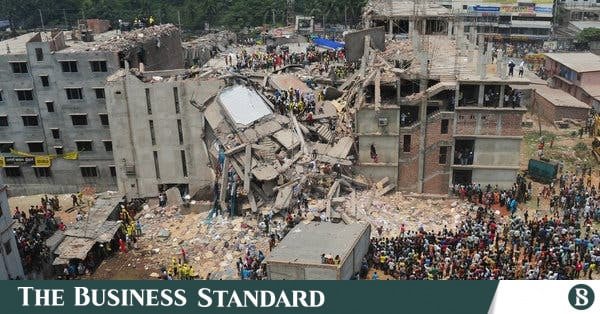
Thirteen years after the Rana Plaza collapse in Savar, near Dhaka, justice in the cases filed over one of the deadliest industrial disasters in history remains elusive. The building, which housed several garment factories, collapsed on April 24, 2013, killing 1,136 people and injuring around 1,500 others. Despite the magnitude of the tragedy, trials in five key cases are still ongoing, with no clear timeline for completion.
In total, six cases were filed following the collapse. These include a murder case for deaths caused by negligence, a case under the Building Construction Act filed by the Capital Development Authority (Rajuk), two corruption cases filed by the Anti-Corruption Commission (ACC), and two additional cases under the Arms Act and Special Powers Act. Of these, only one ACC case – related to concealment of assets – has been resolved so far.
The murder and building law cases were formally prepared for trial in 2016 and transferred to the Dhaka District and Sessions Judge Court. Charges were framed in the same year against dozens of accused, including Rana Plaza owner Sohel Rana. In the murder case, a total of 41 individuals were charged, while the case itself involves an extensive list of 594 witnesses.

Over the years, progress in the trial has been slow. So far, testimony from only 145 witnesses has been recorded in the murder case. The proceedings are currently in the final stages of witness examination, with the next hearing scheduled soon. Prosecutors say the pace has improved in the past year and a half, expressing hope that a verdict may be delivered within this year.
According to the prosecution, earlier delays were partly due to a lack of initiative from the state. However, recent efforts have focused on accelerating the process. “We are now in the final phase of recording testimonies. We hope to conclude the trial soon and ensure justice for the victims,” state lawyer Faisal Mahmud said.
Defence lawyers, however, have raised concerns about the prolonged nature of the trial. They argue that the case has dragged on for over a decade without resolution, leaving the accused – particularly Sohel Rana – in prolonged detention. Rana has been in custody since his arrest on April 29, 2013, while attempting to flee to India through Benapole.
The defence maintains that the trial should either be concluded quickly or that the accused should be granted bail. “The process cannot continue indefinitely. Witness examination is still incomplete, and there has been no conclusive proof presented so far,” a defence lawyer, Masud Khan Khokon, told TBS.
Beyond the murder case, other cases related to the collapse are also progressing slowly. The ACC’s corruption case concerning illegal construction – where the building was allegedly expanded from an approved six storeys to ten through corrupt practices – is currently at the stage of final arguments. Out of 20 witnesses in this case, testimony from 19 has already been recorded, and the court is expected to move toward concluding arguments soon.
Meanwhile, the two cases filed under the Arms Act and Special Powers Act, in which Sohel Rana is the sole accused, remain under trial. Witness examination in these cases has also been slow, with only a handful of testimonies recorded so far. Hearings are often delayed due to the absence of witnesses.
The case filed under the Building Construction Act has faced additional procedural complications. Although it was intended to be tried alongside the murder case for efficiency, it has yet to formally begin trial proceedings after being transferred between courts.
According to court sources, a total of 42 individuals are currently accused across the various cases, after accounting for overlapping names. Several accused remain absconding, while others are out on bail.
Legal experts say the prolonged delays highlight systemic challenges within the judicial process, particularly in handling complex, high-profile cases involving multiple defendants and hundreds of witnesses. Frequent adjournments, procedural hurdles, and the sheer scale of evidence have contributed to the slow pace of proceedings.
The Rana Plaza disaster remains a defining moment for Bangladesh’s industrial sector, drawing global attention to workplace safety and labour conditions in the garment industry. While significant reforms have been introduced in the years since, including improved factory inspections and compliance measures, the lack of timely justice in the legal cases continues to raise concerns.
For the families of the victims, the long wait for justice has been deeply painful. Many continue to struggle with the loss of loved ones and the economic hardship that followed the disaster. Survivors, including those left permanently disabled, also face ongoing challenges.
The only case that has reached a conclusion so far is the ACC’s asset concealment case against Sohel Rana. In 2017, he was sentenced to three years in prison and fined Tk50,000 in that case.
According to official records, 1,117 bodies were recovered from the rubble immediately after the collapse, with 19 more victims dying later in hospitals. A total of 2,438 people were rescued alive, of whom 1,524 were injured, including 78 who suffered permanent disabilities.
About The Author