A progressive society cannot be built without protecting people’s fundamental rights and freedoms, said Zahir Uddin Swapon, political adviser to the prime minister and Barishal-1 MP, today (31 August).
Stressing stronger collaboration among the government, civil society, and development partners to safeguard those rights, he also called for empowering young people to navigate rapid technological and artificial intelligence-driven changes responsibly and use innovation as a force for positive change.
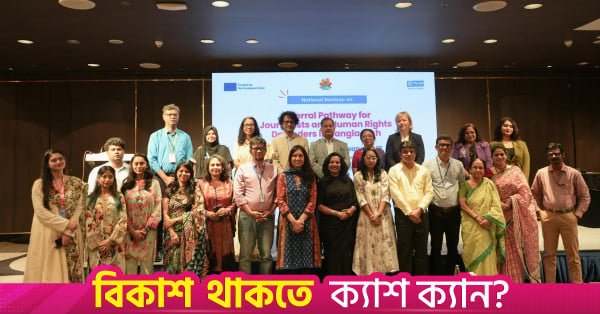
He made the remarks while addressing a seminar, titled “Referral Pathway for Journalists and Human Rights Defenders in Bangladesh”, organised at a hotel in Dhaka, according to a press release.

The seminar presented findings from a study on mapping support services and proposed a referral pathway for those facing legal, physical, digital, economic, and psychosocial risks.
The study was conducted under the Swadhinata: Freedom of Expression for Digital Democracy (FREEDOM) project, funded by the European Union, led by Plan International Bangladesh, and implemented by Manusher Jonno Foundation (MJF).
The study found that various support services, including legal and psychosocial assistance, emergency response, and digital security support, are available in Bangladesh. However, service providers often work separately, while access to specialised assistance remains uneven, particularly in districts, upazilas, and remote areas.
Baiba Zarina, deputy head of delegation and head of the Political, Economic, Trade, Press and Information Section of the EU Delegation to Bangladesh, said no journalist or human rights defender facing a threat should be left unsure about where to seek help.
“They should know exactly whom to contact, where to seek help and what support is available,” she said, adding that stronger coordination and clearer referral pathways are needed to ensure timely support.
Faruk Wasif, director general of the Press Institute Bangladesh, said social media has expanded opportunities for expression but has also increased misinformation, hate, online harassment, and misuse of artificial intelligence.
He stressed the need to protect not only journalists and human rights defenders but also ordinary social media users, while strengthening media literacy.
Kabita Bose, country director of Plan International Bangladesh, said digital democracy is not merely about access to mobile phones or the internet, but also about using technology safely and responsibly.
She stressed the need for timely legal measures and rapid responses to complaints.
Saying laws and policies alone were insufficient unless effectively implemented, MJF Executive Director Shaheen Anam called for greater public awareness and engagement of young people as agents of change amid rising misinformation, social media misuse, and digital harassment.
Conducted across all eight administrative divisions, the study involved 16 focus group and small-group discussions, 20 key informant interviews, eight divisional stakeholder consultation workshops, and a national validation workshop.
It identified legal and judicial harassment, digital threats and online violence, physical intimidation, economic insecurity, and psychosocial stress as interconnected risks.
About The Author