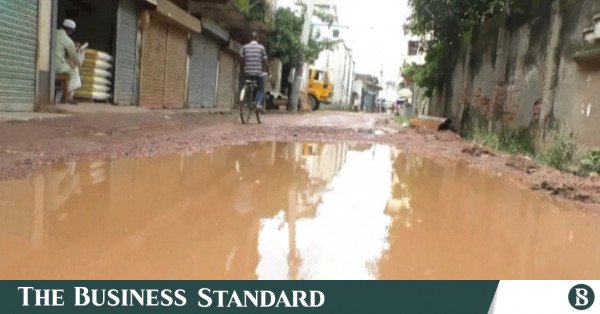
Potholes, damaged roads and knee-deep water after even light rain have turned daily travel into a struggle for residents of Naogaon town, with many roads remaining in poor condition for years.
On a number of roads, the asphalt wore away nearly a decade ago, and the underlying brick aggregate has also gradually eroded. Some roads are now covered with mud, while deep potholes filled with rainwater make it difficult to judge their depth.
Drivers of battery-powered rickshaws, CNG-run vehicles and rickshaws are often reluctant to ply the worst-affected roads. Even when passengers offer higher fares, residents often struggle to find a vehicle.

Patients, pregnant women, students and elderly people are among those facing the greatest hardship.
A recent visit to Tajer Mor, Kalitala, Palpara, Sultanpara, Gosthati Mor, Ukilpara, Chakbaria and Doyaler Mor showed the extent of the problem.
On some roads, the pavement has almost completely disappeared, while deep potholes have developed elsewhere. When rainwater accumulates, the hazards become difficult to see, forcing vehicles to move slowly and sometimes causing traffic congestion.
Nearly 80% of roads need repair
Sazzad Hossain, executive engineer of Naogaon Municipality, said the municipality was established in 1963, upgraded to a second-class municipality in 1980 and then to a first-class municipality in 1989. The municipality covers an area of 39 square kilometres and has a population of around 2 lakh.
The town has approximately 300 kilometres of roads, including 150 kilometres of paved roads, 50 kilometres of semi-paved roads and 100 kilometres of unpaved roads.
About 80% of these roads require repair, Sazzad said.
Difficulties in emergencies
The poor condition of the roads is affecting not only regular travel but also emergency transportation.
Residents said drivers are sometimes unwilling to take patients to hospitals through badly damaged roads. Transporting pregnant women becomes particularly risky. Vehicles frequently suffer damage after falling into potholes, while the condition of the roads increases the risk of accidents.
Omar Faruk, a resident of Chakbaria, said the situation becomes worse during the rainy season.
“The problem increases during the monsoon. Work has started on some roads, but travelling becomes difficult when it rains. Many places are flooded even after a little rain,” he said.
Abdul Jalil, a rickshaw puller from Gosthati Mor, said water-filled potholes make it impossible to determine how deep they are.
“Rickshaw wheels and other parts are damaged when they fall into the holes. It is also risky to carry passengers,” he said.
Students also suffer
The deteriorating roads have also made commuting to schools difficult. During the rainy season, mud and standing water force many students to leave home earlier. Wet roads and a shortage of vehicles often result in dirty or damaged uniforms and delays in reaching educational institutions.
Hossain Ali, a Class VI student at Prashika Bidyaniketan in the town, said travelling to school becomes difficult during rain.
“There is water and mud on the roads. My shoes and clothes often get dirty or damaged, and it is not easy to find a vehicle,” he said.
Khairun Nahar Khushi, a schoolteacher in the SIO Office area, said improvements are needed in both roads and drainage.
“During rain, the problems faced by students and ordinary residents become much worse,” she said.
A Kalitala resident, Akhil Kumar Sarker, said several important roads, including those in Tajer Mor, Kalitala, Palpara, Sultanpara, Gosthati Mor and Ukilpara, have remained in poor condition for a long time.
“Drainage and street lighting also need improvement,” he said.
Poor drainage adds to waterlogging
The town’s road problems are closely linked to inadequate drainage. In many areas, rainwater cannot drain away quickly, leaving roads submerged for extended periods.
Residents said waste accumulated in some drains further obstructs water flow. Persistent waterlogging has also contributed to foul odours and an increased presence of mosquitoes and flies.
Some residents called for improvements in waste management and mosquito-control activities. They also said several roads remain inadequately lit at night.
Higher taxes, demand for better services
Concerns over municipal services have also intensified following an increase in holding tax and water charges in Naogaon Municipality from 1 July 2025.
The increase has caused dissatisfaction among some residents, who say higher payments should be accompanied by visible improvements in essential services.
Social worker Nais Parvin said citizens expect better roads, drainage, water supply, waste management and street lighting in return for paying municipal taxes.
“People will have greater confidence in the municipality if they can see a clear improvement in services,” she said.
However, TMA Momin, deputy director of the Local Government Division and municipal administrator, said there was no basis for describing the tax increase as irregular.
He said taxes are reassessed every five years under municipal law and that the increase in holding tax and water charges was part of that process.
“Work to improve the town’s infrastructure is underway. Work on 11 roads has already begun, and the remaining roads will be repaired in phases,” Momin said.
About The Author