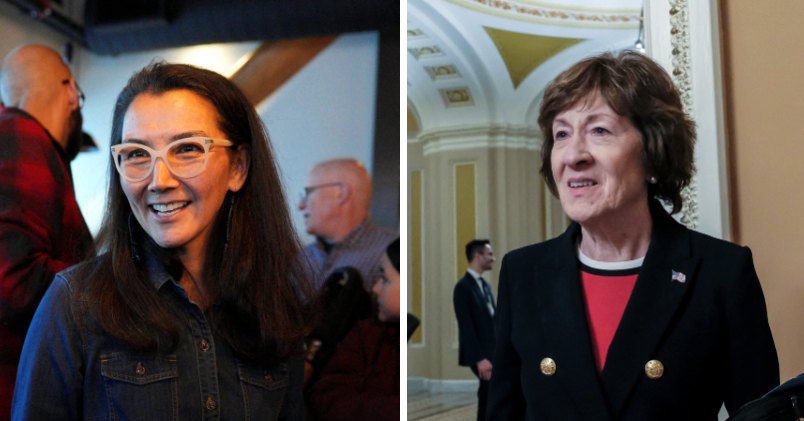
In this year’s most competitive Senate races, some candidates are winning over voters with strong platforms or personal appeal, while others are benefiting from voters’ disdain for the opposing party.
The latest New York Times/Siena polls of battleground Senate races asked voters to describe why they support their preferred candidate. They were also asked which party they wanted to control the Senate in the fall.
Comparing the answers to those questions can help us understand what makes a strong — or weak — candidate across states.
Some candidates are more popular than their parties
Across the six states polled — Alaska, Iowa, Maine, North Carolina, Ohio and Texas — 4 percent of voters supported a candidate who was not from the party they wanted to control the Senate. In exceedingly close races, that could be the difference between winning and losing.
In Alaska, for example, 41 percent of voters prefer Democratic control of the Senate, but 45 percent of voters said they planned to vote for Mary Peltola — a four-percentage-point overperformance by the Democratic candidate. That overperformance by the Democratic candidate held true in every state polled other than Maine, where the poll was conducted before Graham Platner withdrew from the race following a rape accusation.
In five of the six states we polled, the Democratic Senate candidate is outrunning the Senate control preference of voters.
Poll responses from voters in each state
Overperformance
Alaska
Peltola +4 pts.
Sullivan −1 pt.
Ohio
Brown +2
Husted −1
Texas
Talarico +2
Paxton −3
Iowa
Turek +1
Hinson −1
North Carolina
Cooper +1
Whatley −0.3
Maine
Platner −5
Collins +5
To win the chamber, Democrats would need to flip the Republican-held seats in four of these six states — five of which backed President Trump in 2024. If the election were held today, the polls found that Republicans would retain control.
However, the Democratic overperformance by candidates in several states could be a sign that some voters who don’t necessarily want Democrats running Congress are still open to backing the party’s candidate in their state. In North Carolina, Alaska and Ohio, for example, the Democratic nominees were boosted by positive views of the candidates.
Why voters are supporting the Democratic candidate for U.S. Senate
Poll responses from voters in each state
Cooper N.C.
57%
3%
25%
Peltola Alaska
53
30
10
Brown Ohio
48
12
28
Talarico Texas
39
29
18
Turek Iowa
36
23
27
Platner Maine
36
35
16
Republicans, meanwhile, have their own well-liked candidates in Maine and Alaska. But in some races, such as Iowa and Ohio, the Republican candidates’ support was more tied to party-line support and concerns about their Democratic opponents.
Why voters are supporting the Republican candidate for U.S. Senate
Poll responses from voters in each state
Collins Maine
59%
33%
7%
Sullivan Alaska
49
22
21
Hinson Iowa
37
7
35
Paxton Texas
34
30
21
Husted Ohio
28
28
26
Whatley N.C.
24
30
28
In their own words, here is a selection of responses from voters explaining their reasons for supporting their chosen candidates.
Candidates whose support is more about their personal appeal
Roy Cooper in North Carolina and Ms. Peltola in Alaska, both Democrats, and Susan Collins, the Republican incumbent in Maine, earned the highest shares of support driven by perceptions of their character, which was the top driver of support for each candidate. This may stem in part from the reputations they have built holding statewide office. They also garnered among the highest favorability numbers in the survey.
Thirty percent of the supporters of Ms. Peltola, the first Alaska Native elected to Congress, pointed to her character as their main reason for choosing her, compared with just 15 percent for her opponent, Dan Sullivan. Even so, she is still narrowly trailing him by two percentage points.
-
Alaska voter, supporting Mary Peltola
“I feel like she has more Alaskan values and represents Alaskans’ interests.”
Woman, 50s, Prefers Democratic Senate control
-
Alaska voter, supporting Mary Peltola
“She does things for Alaska.”
Man, 60s, Prefers Republican Senate control
In North Carolina, a state that Mr. Trump carried in each of the last three presidential elections, the poll found a seven-percentage-point lead for Mr. Cooper, the state’s former governor. Thirty-six percent of Mr. Cooper’s supporters pointed to his character as their reason for supporting him — the highest share of any candidate in the survey — while just 2 percent of his supporters cited dislike of Michael Whatley, the Republican nominee, as their main motivation.
Mr. Cooper, however, is outperforming preference for Democratic Senate control by just one percentage point. His lead may be a reflection of the state’s broader political environment being relatively beneficial to Democrats, as well as voters’ unfamiliarity with Mr. Whatley, whom more than 40 percent of likely voters either had not heard of him or said they did not know how they felt about him.
-
N.C. voter, supporting Roy Cooper
“He listens to and supports the community.”
Woman, 30s, Prefers Democratic Senate control
-
N.C. voter, supporting Roy Cooper
“Experience as governor.”
Man, 40s, Prefers Republican Senate control
About a third of Ms. Collins’s supporters cited her character as their reason for backing her — nearly 20 percentage points higher than the share of voters who said the same about the next-closest Republican nominee, Ashley Hinson of Iowa.
But a quarter of Ms. Collins’s supporters said they were motivated by dislike of Mr. Platner. The candidate chosen to replace Mr. Platner may be well positioned against Ms. Collins, given that the poll showed that Mr. Platner was leading the race before his exit. But Ms. Collins is seen as effective in bringing money and resources to the state and is not viewed as too extreme by most voters, according to the poll.
-
Maine voter, supporting Susan Collins
“Consistency, reliability and trustworthiness.”
Man, 40s, Prefers Republican Senate control
-
Maine voter, supporting Susan Collins
“She has a lot of influence now, and I think she’s done a good job.”
Woman, 90s, Prefers Democratic Senate control
Candidates whose support is more about their policies
For Mr. Sullivan and Mr. Platner, their backers were more likely to cite policy positions, rather than character, as the motivation behind their support.
One-third of voters supporting Mr. Sullivan said policy was their primary reason for backing him, the highest share of any candidate in the surveys and the single biggest factor contributing to his support. The share of Ms. Peltola’s supporters that was tied to policy was not far behind, at 23 percent, but still ran second to character.
-
Alaska voter, supporting Mary Peltola
“She wants to keep people from stock trading on the floor so that senators and representatives couldn’t do stock trades.”
Woman, 60s, Prefers Republican Senate control
-
Alaska voter, supporting Dan Sullivan
“He pays attention to our veterans, supports immigration laws and will stand behind the development of the natural gas line.”
Man, 50s, Prefers Republican Senate control
In Maine, roughly a quarter of supporters for both Mr. Platner and Ms. Collins cited their preferred candidate’s policy positions as their reason for voting for them. That was the top reason listed for Mr. Platner, but it was almost 10 percentage points behind the most cited reason for support of Ms. Collins: her character.
Mr. Platner was the only candidate in these polls to have a notable share of supporters cite change as their rationale, suggesting that a meaningful portion of his coalition was either looking to move on from Ms. Collins’s nearly 30-year Senate tenure or was motivated by dissatisfaction with the current Democratic establishment, rather than direct support of his platform or his character.
-
Maine voter, supporting Susan Collins
“Susan Collins is more of a moderate candidate and can break with her party when needed.”
Man, 40s, Prefers Democratic Senate control
-
Maine voter, supporting Graham Platner
“It’s time for a change, and Susan Collins lost me with Brett Kavanaugh.”
Man, 70s, Prefers Democratic Senate control
-
Maine voter, supporting Susan Collins
“Because she is not a socialist and doesn’t push that agenda.”
Woman, 50s, Prefers Republican Senate control
Polls were conducted before Platner withdrew from the Maine Senate race.
Candidates whose support is more about dislike of their opponent
The closest of the six races that were polled was in Texas, where James Talarico and Ken Paxton were tied, even as voters were six percentage points more likely to prefer that Republicans retain control in the Senate.
That difference is being driven, in part, by deep dislike for Mr. Paxton, whose personal controversies — including his wife’s decision to file for divorce on “biblical grounds” and past corruption charges — have made headlines in the state for years. Mr. Paxton was the least popular candidate across the six states polled, with voters more likely to have an unfavorable than a favorable view of him by more than 10 percentage points.
In total, 29 percent of Mr. Talarico’s supporters specifically listed something negative about Mr. Paxton as the main driver of their support for the Texas Democrat, with a vast majority of this group pointing specifically to concerns about Mr. Paxton’s character.
Even among Republicans, nearly a quarter said the scandals surrounding Mr. Paxton meant they could not support him or they were questioning their support.
To be sure, an equally large swath of Mr. Paxton’s supporters drew on dislike of Mr. Talarico as their main reason for support. Mr. Talarico has been tagged as too liberal and out of touch by Republicans. But the 39 percent of Mr. Talarico’s supporters who noted a positive reason for backing him, compared to the 34 percent of Mr. Paxton’s supporters who said the same, may be providing enough of a boost to make the race even.
-
Texas voter, supporting James Talarico
“Untrustworthiness and inconsistency. Ken Paxton is self-serving, I believe.”
Woman, 40s, Unsure who she prefers for Senate control
-
Texas voter, supporting Ken Paxton
“James Talarico is a heretic. He’s a liar. He’s a snoozer. He talks a good game, but there’s no truth at all.”
Woman, 60s, Prefers Republican Senate control
-
Texas voter, supporting James Talarico
“He’s the candidate besides Ken Paxton.”
Man, 40s, Prefers Republican Senate control
-
Texas voter, supporting Ken Paxton
“Probably because he’s a Republican.”
Man, 60s, Prefers Republican Senate control
Candidates whose support is more about party allegiances
The polls were intended to get a sense of what was driving the races five months out from the general election, and in some states the findings were that the candidates were not well known. In those circumstances, many voters default to voting based on party loyalty.
In Iowa more so than any other state, neither candidate was especially well known: 25 percent of voters there said they had not heard of Ms. Hinson, the Republican nominee, or said they could not give an opinion of her. Thirty-five percent said the same about Josh Turek, the Democrat.
Republicans have seized on that opportunity. Republican-aligned super PACs have dumped millions of dollars into the state to support Ms. Hinson, who has aligned herself closely with Mr. Trump. The top reason for her support — cited by nearly one-third of her backers — was purely to support the Republican Party.
Across the six states, Mr. Turek, a self-described “prairie populist,” was the Democrat with the most supporters who said they were backing him because of support for the party, though that reason still came in second to positive views of his policies.
The poll found that Ms. Hinson had a two-percentage-point edge, while voters preferred Republican control of the Senate by five percentage points, showing that candidate quality may still be playing a role.
Fourteen percent of Mr. Turek’s supporters said they were backing him because they had a negative view of Ms. Hinson’s character, compared with just 5 percent of Ms. Hinson’s supporters who said the same about Mr. Turek.
-
Iowa voter, supporting Josh Turek
“I feel that the Republican party has lost its way.”
Man, 40s, Prefers Democratic Senate control
-
Iowa voter, supporting Ashley Hinson
“I’m never going to vote for a Democrat again in my life.”
Man, 40s, Prefers Republican Senate control
-
Iowa voter, supporting Josh Turek
“I don’t trust a thing that Hinson does.”
Man, 70s, Prefers Democratic Senate control
-
Iowa voter, supporting Ashley Hinson
“Because everything Josh Turek says is a lie.”
Man, 40s, Prefers Republican Senate control
Mr. Whatley, the Republican candidate in North Carolina, was the least-known Senate candidate across the six states. The poll found that dislike of Mr. Cooper and support for the party were effectively tied as the top reasons for his support.
Results of New York Times/Siena polls of 3,659 likely voters in Alaska, Iowa, Maine, North Carolina, Ohio and Texas conducted June 15-29, 2026.
Respondents in each state were asked to describe in their own words “the main reason” they were supporting a Senate candidate, if they had said earlier in the poll that they were voting for or leaning toward voting for that candidate in November. The responses displayed have been lightly edited.
About The Author