Under a Tk5,258cr project, Rajuk plans to build modern housing, widen roads and keep open space in Old Dhaka.
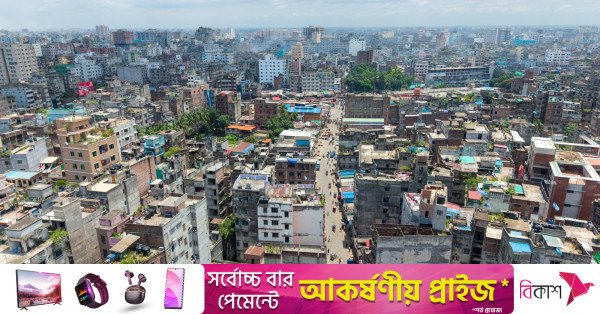
An aerial view shows dense buildings and narrow roads in Old Dhaka’s Bangshal area on 4 July 2026. File Photo: TBS
“>

An aerial view shows dense buildings and narrow roads in Old Dhaka’s Bangshal area on 4 July 2026. File Photo: TBS
Old Dhaka, the historic heart of the capital, could undergo its most ambitious transformation in decades under a government proposal to replace ageing buildings with modern housing and significantly expand open spaces. The multi-billion-taka initiative seeks to tackle chronic overcrowding, poor infrastructure, and disaster risks while preserving the area’s distinctive heritage.
The proposed Old Dhaka Revitalisation initiative will span approximately 6,500 acres, covering wards 24 to 61 of the Dhaka South City Corporation (DSCC) and part of ward 62.
Under the blueprint, dilapidated privately owned buildings will be redeveloped using a social housing model.

Crucially, 60% of the land will be preserved as open space, incorporating wider roads and green areas, communal parking and restored water bodies, an art museum and traditional food corners.
Infograph: TBS
“>

Infograph: TBS
Urban planning experts have welcomed the proposal in principle but warn that its ultimate success hinges on whether authorities can overcome the deep-seated legal and logistical hurdles that derailed previous attempts.
According to Rajdhani Unnayan Kartripakkha (Rajuk), the overall project is estimated to cost Tk5,258.40 crore. Of that amount, Tk36.85 crore has been allocated for an initial study and preparatory work, while the main infrastructure investment project is expected to require Tk5,221.55 crore.
A preliminary project titled “Integrated Project for Revitalisation of Old Dhaka” has since been sent to the Planning Commission for policy approval.
Once cleared, the proposal will be forwarded through the Economic Relations Division (ERD) to development partners for financing. Officials expect the study to be completed within three years of securing external funding. The project is scheduled to run from July 2027 to June 2030.
The initiative builds on a Rajuk survey of a 34-acre section of Islambag. The study revealed that nearly 48% of the buildings there are single-storey structures, mostly aged between 21 and 30 years. Rajuk projects that redevelopment under its Floor Area Ratio (FAR) guidelines could generate nearly four times more usable space than currently exists—a finding that encouraged the government to scale up the model across Old Dhaka.
New look, keeping old flavour
For Dhaka residents, Old Dhaka remains the living repository of the city’s origins, culture, and commerce. While the northern wings of the capital expand with glass-fronted towers and elevated expressways, the centuries-old neighbourhoods along the Buriganga River retain a rich Mughal and colonial legacy.
Its maze of capillary-like lanes, weathered buildings, bustling wholesale markets, traditional food and close-knit communities continues to define a part of the city where history and everyday life remain deeply intertwined.
Although long associated with traffic congestion, overcrowding and deteriorating infrastructure – and at times rightly so – Old Dhaka also preserves traditions, businesses and architectural heritage that have endured for generations.
Neighbourhoods including Bangshal, Chawkbazar, Islampur, Islambag, Shakhari Bazar, Tanti Bazar, Sutrapur, Wari, Lalbagh, Kotwali, Narinda, Gandaria and parts of Babubazar are generally regarded as part of Old Dhaka, with boundaries shaped more by history and urban character than by administrative divisions.
Rajuk officials said the original proposal combined the study and investment project under a single scheme. However, at a meeting chaired by Housing and Public Works Secretary Nazrul Islam on 11 May, it was decided that the study would be completed first before moving to the investment phase.
A Rajuk official, speaking on condition of anonymity, explained that restructuring the Preliminary Development Project Proposal (PDPP) to focus initially on the study improves the prospects of securing foreign financing. The meeting also resolved to launch a pilot project to build public confidence and facilitate temporary relocation strategies for residents.
Residents’ support and funding hurdles
Project officials concede that the redevelopment cannot move forward without the explicit backing of local property owners, who must agree to contribute their land to the pool. Extensive consultations with elected representatives and residents will be conducted during the study phase, and the investment phase will only proceed if sufficient public consent is achieved.
Rajuk officials said the main redevelopment project would require foreign financing. Potential development partners include the World Bank, the Japan International Cooperation Agency (Jica), the Asian Development Bank (ADB) and the Asian Infrastructure Investment Bank (AIIB).
They added that Korean and Chinese companies have also expressed interest in jointly investing in similar projects with Rajuk.
Decades of urban challenges
According to the project proposal, a detailed study and baseline surveys will be carried out that focus heavily on mitigating severe safety risks. Most buildings in Old Dhaka were constructed decades ago without modern safety codes, leaving them exceptionally vulnerable to earthquakes and fires.
Furthermore, the area’s notoriously narrow roads routinely hamper emergency services, while decaying drainage, sewerage, and waste management systems cause chronic waterlogging and public health risks.
Lessons from earlier attempts
Defending the scale of the project, Rajuk officials argued that past initiatives failed because they were too fragmented. Instead of wholesale demolition, they advocate for a balanced, phased approach combining selective redevelopment, infrastructure upgrades, and strict heritage conservation.
Md Musleh Uddin Hasan, Professor of Urban and Regional Planning at the Bangladesh University of Engineering and Technology (Buet), agreed that a phased rollout is critical but urged caution.
“A similar initiative was taken before,” Professor Hasan said. “The key question is whether the challenges that prevented the first attempt from succeeding can be addressed this time. If those problems still persist, they must be resolved first.”
He pointed out that land tenure is a massive roadblock in the historic quarters. “Many properties in Old Dhaka lack formal ownership documents because they have been inherited over generations without proper registration. That was a major obstacle previously.”
According to him, another important consideration is the scale of the project and a phased approach would be far more effective.
He recommended starting with a strictly limited pilot area. “If the project can first be implemented successfully on a small scale, it will build public confidence and encourage wider participation. Furthermore, since our institutional capacity for a project of this magnitude is still developing, engaging external experts in the initial stages will allow for a ‘learning by doing’ approach to train local professionals for later phases.”
About The Author