Today, buyers are increasingly skipping traditional haats and heading straight to modern agro farms, where they can pre-book curated livestock promoted through sophisticated social media marketing campaigns.
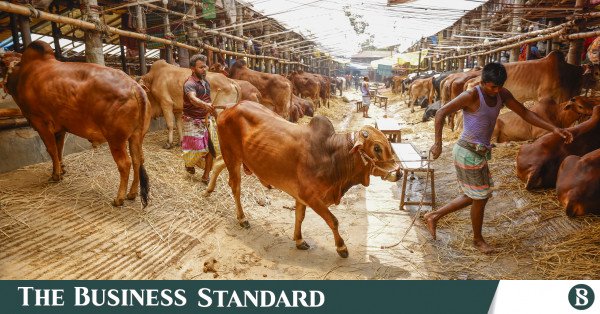
Traders tend to cattle ahead of Eid-ul-Adha at the Gabtoli cattle market, the capital’s largest hub for sacrificial animals, where preparations are gathering pace for the festive rush. The photo was taken on Wednesday. Photo: Rajib Dhar
“>

Traders tend to cattle ahead of Eid-ul-Adha at the Gabtoli cattle market, the capital’s largest hub for sacrificial animals, where preparations are gathering pace for the festive rush. The photo was taken on Wednesday. Photo: Rajib Dhar
The scene at Chattogram’s sacrificial animal market this Eid-ul-Adha looks nothing like it did a decade ago. The chaotic bargaining, mud-slicked haats, and middlemen that once defined the city’s Qurbani cattle trade are steadily giving way to a more organised and profitable system.
Today, buyers are increasingly skipping traditional haats and heading straight to modern agro farms, where they can pre-book curated livestock promoted through sophisticated social media marketing campaigns.
Farms selling out livestock early

With eight days still to go before Eid, major cattle farms in Chattogram have already sold 60%-80% of their stock, signalling a clear structural shift in buying patterns.
Mustafizur Rahman, senior executive at Nahar Cattle Farm, said around 400 cattle were prepared this season. “We have already sold around 80%,” he said. “People are coming early to inspect and book in advance.”
At Asian Agro Farm, owner Alif Chowdhury reported similar demand: of 250 cattle, nearly 60% sold before Eid. Premium breeds such as Shahiwal, Holstein Friesian, Brahma, and Angus remain in strong demand.
Farm owners say small and medium cattle are selling fastest, while rising feed costs have pushed prices above last year’s. Across Chattogram, cattle now sell between Tk1.5 lakh and Tk15 lakh, though some farms still offer animals from Tk50,000.
According to the District Livestock Office, Eid demand stands at 818,681 animals, while local supply is about 783,151 – leaving a gap of roughly 35,000 expected to be met by incoming cattle from nearby districts.
Buyers steadily moving away from haats
The shift from open cattle markets to farms reflects changing buyer priorities: convenience, transparency, and family comfort.
Suleiman Chowdhury, who bought from Asian Agro, said, “Going to the haat is too much of a hassle. You can’t take your family – it’s muddy, crowded, and full of waste. So I went to the farm instead.”
Another buyer, Md Hasibul Islam, added, “Here you get hand-picked cattle. You can check properly, take your time and decide.”
Many farms now offer pre-booking systems, allowing buyers to reserve cattle with a deposit and keep them at the farm until Eid, avoiding the additional burden of housing them at home.
From corporate farms to digital cattle trade
Since 2015, Chattogram’s cattle sector has shifted from passion-driven farms to corporate-style agro enterprises.
A “corporate cowboy” culture has emerged, with former corporate professionals now managing operations, nutrition, and marketing. Modern farms increasingly run on data and systems – with individual feeding plans, biosecurity protocols, and sensor-based tracking of weight and feed intake. In-house feed production and corn silage systems add further control and efficiency.
This professionalisation has merged directly with digital marketing. Cattle are now branded products – named, video-featured, and promoted online, with some becoming “celebrity bulls” ahead of Eid.
The shift accelerated after COVID-19. Facebook Live sales, video marketing, and online booking have become standard, gradually replacing the traditional haat with a digital livestock marketplace.
Challenges remain
The District Livestock Department estimates Chattogram had around 12,500 farms eighteen months ago. Since then, rising feed costs, production pressure, and market volatility have pushed many small operators out, concentrating the sector in larger, more resilient farms.
Despite these challenges, analysts say the industry is becoming more structured and forward-looking, with improved breeds, technology, and stronger veterinary access helping position Chattogram as a growing livestock hub. The traditional haat has not vanished — but the centre of gravity is steadily shifting toward more efficient, well-managed modern farms, signalling an evolving and increasingly sustainable market.
About The Author