Highlights
- Probe urged 30-plus reforms after Milestone air crash
- Most safety, zoning recommendations remain unimplemented a year later
- School seeks approval for new building despite unresolved concerns
The official investigation into last year’s Milestone School air crash recommended more than 30 reforms aimed at preventing another disaster, including enforcing stricter building controls, moving military flight training outside Dhaka and relocating educational institutions from airport approach zones in the long run. Yet, a year later, hardly any progress has been made in implementing those recommendations, according to documents reviewed by The Business Standard.
According to the investigation commission, the disaster exposed deep-rooted failures in urban planning, regulatory oversight, aviation safety, and building compliance that had created the conditions for catastrophe long before the aircraft lost control.

An analysis of the 185-page investigation report, obtained by The Business Standard, shows that the commission identified a series of institutional failures involving multiple government agencies, including the Civil Aviation Authority of Bangladesh (CAAB), Rajdhani Unnayan Kartripakkha (Rajuk), and the educational institution itself.
Despite more than 30 recommendations issued after the tragedy, many remain unimplemented. Milestone School has even applied to Rajuk this month for permission to construct another seven-storey academic building on its Diabari campus, while construction of another approved 10-storey building is already underway.
Crash revealed broader governance failures
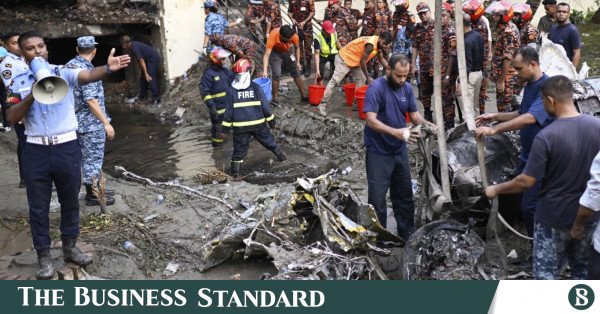
The accident occurred on 21 July, 2025, when a Bangladesh Air Force FT-7 BGI training aircraft lost altitude during its second circuit and crashed into the Haider Ali building of Milestone School and College. The crash triggered a massive explosion and fire that killed 35 people, including students, teachers, guardians and the pilot, Flight Lieutenant Towkir Islam.
The commission concluded that while the immediate cause was pilot error, the scale of the tragedy resulted from a combination of regulatory negligence, unsafe construction practices, inadequate emergency preparedness and poor land-use planning around Hazrat Shahjalal International Airport.
The interim government formed a nine-member commission led by former secretary AKM Jafar Ullah Khan to investigate responsibility, damages and institutional failures, alongside a separate technical committee headed by then Principal Staff Officer Lieutenant General SM Kamrul Hasan.
Although both reports were submitted in November 2025, neither has been officially published.
Unsafe buildings, poor evacuation
One of the investigation’s most alarming findings concerns the school’s infrastructure.
At the time of the crash, hundreds of students were attending regular, improvement and extra classes inside the three-storey building. Yet the structure had only one staircase for evacuation.
According to the Fire Service, a building of that size and occupancy should have had at least three emergency exits.
Fire safety experts told the commission that multiple escape routes could have significantly reduced casualties during the fire.
The commission also found that Milestone authorities failed to produce valid construction approval documents for the building. Although the institution claimed it had obtained permission from the local Union Parishad when the building was constructed, no documentary evidence was provided.
Investigators found that only seven of the campus’s 17 buildings had proper approval. The remaining structures had either been built or were being used without authorisation.
The report further noted that Rajuk had taken no effective action despite being aware of these irregularities.
New building application raises questions
Documents obtained by TBS show that on 6 July this year, Milestone College Principal Ziaul Alam submitted an application to Rajuk’s Uttara office seeking permission to construct a seven-storey building on the Diabari campus.
The application included land ownership documents and tax records.
When contacted, Ziaul Alam said all necessary approvals had been obtained before applying to Rajuk, but requested written questions. Despite being sent detailed questions via WhatsApp, he did not respond over the following three days.
During a visit to the campus, TBS found normal academic activities continuing, with little indication that one of Bangladesh’s deadliest aviation disasters had occurred there only a year earlier.
Meanwhile, Milestone founder and adviser Colonel (Retd.) Nurunnabi denied that any new application had been submitted.
Rajuk officials, however, confirmed that the application had been received.
MM Ehsanul Imam, authorised officer at Rajuk’s Uttara office, told TBS that any building near the airport requires prior clearance from CAAB before Rajuk can consider approval.
“The latest application does not include CAAB clearance. We are now verifying the documents,” he said.
Airport safety rules ignored
The Diabari campus falls within the airport’s Obstacle Limitation Surface (OLS), a protected airspace designed to ensure safe aircraft operations.
CAAB regulations restrict both building height and land use within these zones.
According to CAAB documents, Milestone is located within the airport’s Inner Horizontal Surface and Inner Approach area, where buildings cannot exceed 150 feet.
Professor Adilur Rahman Khan, Executive Director of the Institute for Planning and Development (IPD), said allowing additional construction in an area already identified as high-risk contradicts the commission’s recommendations.
“Following such disasters, authorities often become active for a while, but implementation eventually stalls,” he said.
The report also reveals that between 2015 and 2025, CAAB repeatedly informed Rajuk about 630 buildings violating airport height restrictions. Investigators found no evidence that effective enforcement followed.
Sweeping recommendations largely ignored
The commission recommended far-reaching reforms extending well beyond aviation.
It proposed relocating schools, hospitals and other high-occupancy facilities away from airport approach zones over the long term, while prohibiting new such developments in the highest-risk areas.
It also called for stricter enforcement of land-use controls, stronger coordination between Rajuk and CAAB, tighter implementation of international aviation safety standards, and stronger legal safeguards against uncontrolled urban development.
The report further recommended establishing a new international airport outside densely populated areas around Dhaka.
A separate technical committee also proposed ending solo fighter jet training over Dhaka, relocating fighter squadrons outside the capital, expanding military aviation facilities elsewhere, and moving flight training operations away from congested urban areas.
Families still await justice
Following the crash, the interim government announced compensation of Tk20 lakh for each deceased victim’s family and Tk5 lakh for each injured survivor.
Many affected families rejected the offer.
The investigation commission instead recommended compensation of Tk10 million for each deceased child and Tk8 million for each deceased adult, along with substantially higher financial support for burn victims requiring long-term treatment.
A commission member, speaking on condition of anonymity, said the recommended compensation could never fully address the trauma suffered by victims and survivors, adding that successive governments had failed to act on the recommendations.
Habibur Rahman, father of seventh-grade student Jabir Farhan, who died in the crash, said neither the interim administration nor the current government had adequately responded to victims’ concerns.
“I’ve heard Milestone plans to build another building,” he said. “Why doesn’t the administration stop this? Schools should be relocated from this area before another tragedy happens.”
About The Author