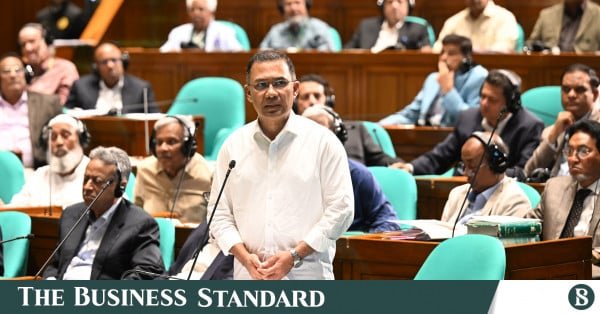
Criticising the opposition’s vehicular long march amid the energy crisis, Prime Minister Tarique Rahman said if a long march by vehicles could solve gas and electricity problems, his government would have organised one first.
He said the gas and electricity crisis did not emerge overnight, attributing the current situation to several factors, including the failure to explore domestic gas resources for a long period, an import-dependent energy system, and disruptions to oil and gas imports caused by the recent war in the Middle East. He said the government is working to resolve the problems.
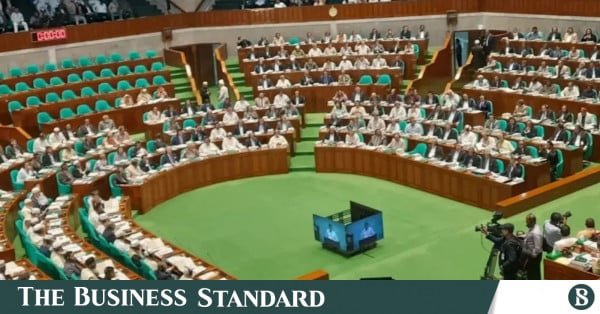
He made the remarks in his concluding speech at the third session of the National Parliament today (10 September). Speaker Hafiz Uddin Ahmed presided over the proceedings.

No gas exploration in Bay under ‘invisible signals’
Explaining the reasons behind the gas crisis, the prime minister said no meaningful effort had been made for more than a decade under the fascist regime to extract gas from domestic sources. Meanwhile, neighbouring countries on both sides of Bangladesh’s maritime boundary in the Bay of Bengal have been extracting gas from offshore fields.
He said gas wells had not been drilled in Bangladesh’s portion of the Bay of Bengal for a long time due to “an invisible signal”.
“Many say that gas wells were not drilled in Bangladesh’s part of the Bay of Bengal so that a particular country could continue taking gas without any hindrance,” he said.
In contrast, he alleged, Bangladesh was made dependent on imported energy by making the Middle East its main source of gas imports.
Middle East war, LNG terminal accident
The prime minister said the war in the Middle East began within 10 to 12 days of the current government taking office, disrupting supplies of oil and gas imported from the region.
At the same time, an accident at one of the country’s two LNG terminals rendered it completely unable to supply gas, he said.
The prime minister said these factors had compounded the difficulties faced by people over gas and electricity supplies.
Govt initiatives to resolve gas, power crisis
The prime minister said the government had already taken several measures to address the gas and electricity crisis.
“We are firmly hopeful that, InshaAllah, over time we will be able to resolve the problems we are facing with gas and electricity,” he said.
He said the government would work together with opposition lawmakers to bring the country and its people out of the crisis.
PM criticises quick-rental plants, stresses solar power
Criticising the installation of quick-rental power plants in the past to address electricity shortages, the prime minister alleged that the state had been burdened with debt while certain people benefited, without providing a lasting solution to the electricity and energy problems.
The prime minister also outlined plans to place greater emphasis on solar power generation in the future.
‘Mountain of corruption, irregularities’
Speaking about the banking sector, the prime minister said the current government had inherited a fragile situation in various sectors, including education, health, banking, insurance, financial institutions, administration and law enforcement agencies.
He said there was also a “mountain” of corruption and irregularities across these sectors.
The prime minister also highlighted the burden of foreign debt, saying that although many of those who had burdened the country with debt had fled the country, the people were still having to repay those loans.
The current government has paid a record $2.0476 billion in foreign loan principal and interest over the past five months, he said.
‘Freedom of speech must not cross into abuse’
Calling for decency in political discourse, the prime minister said Bangladesh currently has a democratic environment and freedom of speech.
However, he urged everyone to ensure that freedom of speech does not cross the limits of abusive language.
Calling for an end to the culture of verbal abuse in politics, he said no conscientious or patriotic politician wanted the country’s political culture to descend into abusive language.
‘Differences of opinion must not turn into hostility’
Tarique Rahman said differences of opinion and political competition were natural in a democratic system and part of democratic practice.
However, he urged everyone to ensure that differences of opinion did not turn into hostility.
He said both the government and the opposition had been elected by the people’s votes and therefore both sides had a responsibility to work for the welfare of the country and its people.
He warned that divisions and conflicts among democratic forces could ultimately create an opportunity for the ousted fascist forces to revive.
About The Author