The sewing machines were running, but something felt off.
Bulbuli’s hands slowed. The numbers didn’t add up. Where she would usually complete up to 250 pieces an hour, that morning she struggled to reach even 50. Then the power went out.
“There was a delay in starting the generator,” she recalled. “Just before 9am, it had only just been switched on when we heard a loud cracking sound. Suddenly, everything went dark.”

Moments later, the building collapsed.
People rescue garment workers trapped under rubble at the Rana Plaza building after it collapsed, in Savar, Bangladesh, 24 April 2013. File Photo: Reuters
“>

People rescue garment workers trapped under rubble at the Rana Plaza building after it collapsed, in Savar, Bangladesh, 24 April 2013. File Photo: Reuters
Thirteen years after the Rana Plaza collapse, survivors like Bulbuli are still living with its consequences – physical pain, trauma, and an enduring struggle for justice.
On 24 April 2013, more than 1,100 garment workers were killed and over 1,500 injured when the nine-storey commercial building in Savar crumbled, marking one of the deadliest industrial disasters in history.
More than a decade on, many survivors say their lives never truly recovered.
Bulbuli, now 38, had moved from Bogura to Savar at the age of 20 in search of a better future. That future was buried under concrete that day.
She now suffers from multiple injuries, including fractures in her spine and arm, and is unable to work. She depends on her husband’s modest income as a van driver.
Thirteen years have passed. I received only Tk95,000 in two instalments.
Bulbuli, Rana Plaza tragedy victim
“Thirteen years have passed. I received only Tk95,000 in two instalments. That was all,” she said. “I live in constant pain. Those responsible have not been punished.”
Her story is echoed by many.
Nilufa Begum, another survivor, faces an even harsher reality. After undergoing 11 surgeries on her right leg, she still requires further treatment costing up to Tk8 lakh, far beyond her means.
And with no family support, she now works intermittently at a small roadside eatery, earning around Tk200 a day when she can.
“I can only work 10 to 12 days a month,” she said. “This is how I survive.”
Each year on this day, survivors, families, and labour rights groups gather at the site, not only to remember, but to demand what they say remains unfulfilled – justice, compensation, and rehabilitation.
And for families of the missing, the grief remains unresolved.
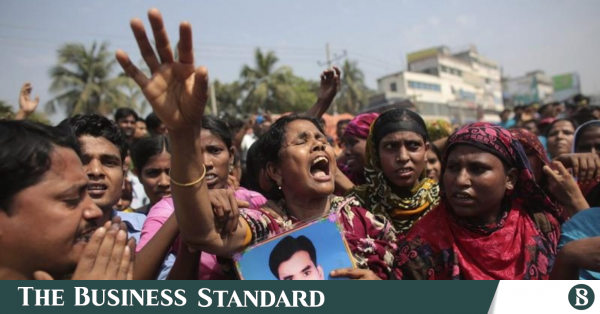
Ferdousi Begum stood at the site holding a photograph of her son, Nahidul Islam, who never returned home after entering the factory that day. His body was never recovered.
“Sometimes I come here and feel like he is still around,” she said quietly.
Nahid left behind a wife and a child. The family is now somehow surviving on his wife’s income.
Nearby, Rasheda Begum clutched the image of her 14-year-old daughter, Rina Akter, who had joined the garment sector to support her family.
“My child went to work so young for us. We sent her to her death,” she said. “Those responsible still walk free.”
Khayrul Mamun Mintoo, general secretary of the Bangladesh Garment and Sweater Workers Trade Union Centre, told The Business Standard that although the demands have changed somewhat over time, fundamentally the same demands are being raised every year at this gathering.
Rescue workers attempt to rescue garment workers from the rubble of the collapsed Rana Plaza building, in Savar, 28 April 2013. File Photo: Reuters
“>

Rescue workers attempt to rescue garment workers from the rubble of the collapsed Rana Plaza building, in Savar, 28 April 2013. File Photo: Reuters
About The Author