Zaffar Abbas, editor of the Pakistani newspaper Dawn, noted that the crisis facing media freedom is a shared struggle across South Asia
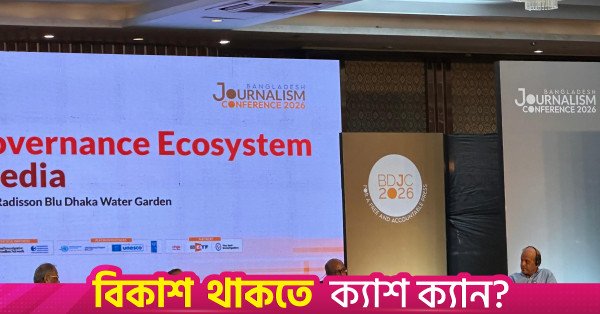
The Business Standard Executive Editor Shakhawat Liton, is moderating a plenary session highlighting Bangladesh’s poor standing in global press freedom rankings. Photo: TBS
“>

The Business Standard Executive Editor Shakhawat Liton, is moderating a plenary session highlighting Bangladesh’s poor standing in global press freedom rankings. Photo: TBS
Political control over state institutions, the growing influence of business in politics, and the rise of majoritarianism are weakening press freedom and democratic accountability in Bangladesh and across South Asia, veteran journalists and speakers warned today (9 May).
The observations were made during a plenary session titled “Politico-Governance Ecosystem and Free Media” on the second day of the Bangladesh Journalism Conference 2026.
Journalists, editors, and governance experts gathered to discuss how political systems and state structures shape the environment for media freedom.

Countries like Bangladesh, which remain near the bottom in press freedom, also tend to rank poorly in corruption indicators, rule of law rankings, and economic freedom
Shakhawat Liton, executive editor of The Business Standard
Shakhawat Liton, executive editor of The Business Standard, moderated the session and highlighted Bangladesh’s poor standing in global press freedom rankings.
He noted that while Scandinavian and Western democracies consistently score above 90 out of 100, Bangladesh struggles to score around 33.
‘Aladdin’s magic lamp’
“We have seen extensive coverage in newspapers about the Press Freedom Index. At the top of the index are countries like Sweden, Norway, and Switzerland – countries that consistently score 85, 90, or even above 90.
“Meanwhile, we consistently score around 33 or even below that. In other words, we barely scrape by,” Shakhawat Liton said.
“Countries like Bangladesh, which remain near the bottom in press freedom, also tend to rank poorly in corruption indicators, rule of law rankings, and economic freedom,” he said, questioning whether top-ranking countries possess a different political planet or an “Aladdin’s magic lamp” that remains out of reach for others.

Iftekharuzzaman, executive director of Transparency International Bangladesh (TIB), argued that political commitments to media freedom are not reflected in reality.
He described the current political order as one shaped by “money, muscle, religion, patriarchy, and media,” wherein a “winner takes all” game allows political forces to control institutions of accountability.
Politics as an investment
The TIB chief specifically pointed to the “exponential rise” of business interests in governance.
While he noted he had no issue with businesspeople entering politics, he warned of the consequences “when business intrudes into politics and politics itself becomes an investment.”

“When parliament began, the percentage of independent members whose primary occupation was business was 17.5. In the incumbent parliament, it is 16.9. This reflects the exponential rise of business in politics,” he clarified.
Meanwhile, Kamal Ahmed, consulting editor of The Daily Star, cautioned against the rise of majoritarianism in the name of democracy, which he said often marginalises dissenting voices.
Shared South Asian struggle
Zaffar Abbas, editor of the Pakistani newspaper Dawn, noted that the crisis facing media freedom is a shared struggle across South Asia.
He called for societies in the region to examine why they have failed to evolve in a way that inspires good governance and press freedom that society can relate to.
The session examined how laws, political systems, and governance structures influence press freedom, and discussed the balance between state oversight and the role of independent journalism in ensuring democratic accountability.
About The Author