The party rejected claims that BPC is inefficient or loss-making, saying it made Tk3,943 crore in profit in fiscal 2023-24 and Tk2,050 crore in 2024-25.
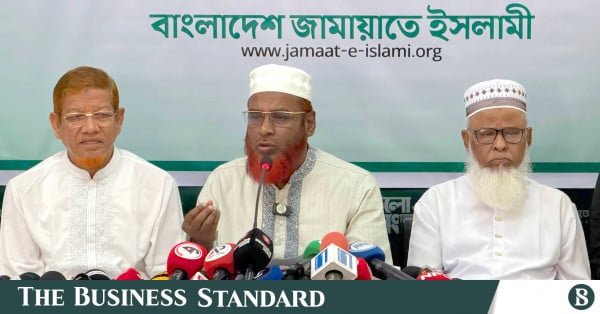
Bangladesh Jamaat-e-Islami holds a press briefing today (8 August) at its party office in the capital’s Moghbazar. Photo: Jamaat-e-Islami Facebook Page
“>

Bangladesh Jamaat-e-Islami holds a press briefing today (8 August) at its party office in the capital’s Moghbazar. Photo: Jamaat-e-Islami Facebook Page
Bangladesh Jamaat-e-Islami has demanded an immediate suspension of the government’s initiative to allow the private sector to import, store, transport, distribute and market refined petroleum products.
At a press briefing today (8 August), the party described the move as “a transfer, not reform”, warning that it could create private monopolies. It alleged that a new policy is being drafted to open refined fuel imports and marketing to private companies.
The initiative gained momentum after the appointment of a new Bangladesh Petroleum Corporation (BPC) chairman, who was instructed to prepare a draft policy for private-sector involvement in refined fuel import, storage, transportation, distribution and marketing just four days after taking office.

Jamaat said the move could concentrate the fuel market in the hands of a few business groups rather than increase competition.
It argued that fuel imports require deep-sea ports, the Single Point Mooring, large tank terminals, pipelines and bank financing worth hundreds of millions of dollars – facilities and financial capacity available to only three or four groups in Bangladesh.
The party rejected claims that BPC is inefficient or loss-making, saying it made Tk3,943 crore in profit in fiscal 2023-24 and Tk2,050 crore in 2024-25.
Jamaat also alleged that the ongoing fuel crisis was being used as a pretext for privatisation. Referring to a 28 July decision of the Cabinet Committee on Economic Affairs, it claimed the government was seeking to cut the tender period for international procurement of refined fuel for September-December 2026 from 42 days to 10 days, potentially limiting participation by major international suppliers.
The party raised energy-security concerns, saying petroleum products are vital for defence, agriculture, power, transport and aviation. Greater private-sector control, it argued, could weaken the state’s ability to ensure direct control and supply during war or disasters.
Jamaat further alleged that moves were underway to curtail legal protections for leaders of fuel-sector workers’ organisations in an effort to silence opposition to privatisation.
The party asked whether a draft policy on private-sector fuel imports and marketing was being processed by the relevant ministry, what study supported the decision, which companies had submitted applications or proposals, and whether the draft and related documents would be made public.
It also questioned whether retail prices would be set by the Bangladesh Energy Regulatory Commission (BERC) or private companies.
Saying it was not opposed to a market economy or private investment, Jamaat called for six measures: halting privatisation; publishing all relevant documents and allowing at least 60 days for public consultation; and holding an open parliamentary hearing involving opposition parties, the Consumers Association of Bangladesh, the Centre for Policy Dialogue, university energy experts, labour federations and consumers.
It also demanded BPC reforms through independent audits, professional board appointments, mandatory e-GP and quarterly disclosure of import prices and volumes; a firm timeline for implementing Eastern Refinery’s second unit (ERL-2) and expanding strategic fuel storage; and withdrawal of recommendations curtailing fuel workers’ legal protections.
About The Author