The party calls for a 90-day review involving the government, opposition, energy agencies, businesses and independent experts.
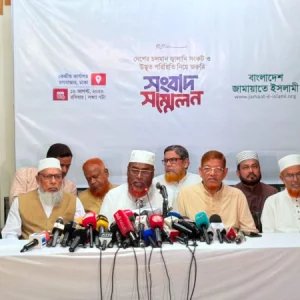
Jamaat Secretary General Mia Golam Porwar speaks at a press conference at the party’s central office in Dhaka on 16 August 2026. Photo: Collected
“>

Jamaat Secretary General Mia Golam Porwar speaks at a press conference at the party’s central office in Dhaka on 16 August 2026. Photo: Collected
The Bangladesh Jamaat-e-Islami has put forward its previously submitted 10-point recommendations to address the country’s ongoing electricity, gas and fuel crisis, in response to the prime minister’s call for opposition parties to present effective plans to tackle the situation.
The party said it had submitted the recommendations in writing to the parliamentary special committee on the energy crisis on 21 May and that the government had been in possession of the proposals for the past three months.
Jamaat Secretary General Mia Golam Porwar made the remarks at a press conference at the party’s central office today (16 August).

He called on the government to explain how many of the recommendations had been implemented, which ones were under way and which had yet to be acted upon.
“Let the government, opposition parties, Petrobangla, Bapex, BPDB, engineers, businesses and independent energy experts regularly review the situation. After 90 days, present a progress report in parliament,” Porwar said.
He said the report should show how much gas production had increased, how much system loss had been reduced and how many illegal connections had been disconnected.
The party’s draft proposal also calls for a special committee, including opposition members, to regularly review progress and for a report to be placed before parliament after 90 days.
Four administrative reforms proposed
Jamaat has proposed four administrative measures to address the energy crisis.
These include forming a “National Emergency Energy Cell” with representatives from all relevant stakeholders and considering giving Petrobangla and Bapex boards authority to approve emergency workover and rehabilitation projects within specified financial limits.
The party also called for the government to publicly disclose when the Rooppur baseload power plant is expected to begin generation and what its tariff will be.
Other proposals include establishing a permanent mechanism for evaluating emergency tenders, introducing single-point oversight for priority projects and regularly publishing information on how long files have remained pending and where they are stalled.
Focus on domestic gas production
Increasing domestic gas production is one of Jamaat’s key recommendations.
The party proposed carrying out workovers on gas wells capable of producing results quickly, bringing gas from Bhola, Jamalpur and Zakiganj into the national grid, and intensifying exploration for new gas reserves both onshore and offshore.
It also called for strengthening Bapex’s capacity.
Jamaat said six visible measures could be taken within 90 days, including workovers at high-potential gas wells and publishing lists of closed and low-producing wells.
It also proposed expanding interim transportation facilities to utilise Bhola’s gas, taking action against system losses and illegal connections, announcing supply schedules for the industrial, power, fertiliser and residential sectors, and quickly introducing digital monitoring of the Single Point Mooring (SPM) system and fuel supplies.
Porwar said the crisis could not be resolved merely by introducing new plans and stressed the need to reduce administrative complications and quickly utilise existing infrastructure and gas wells.
About The Author