Some students now question the value of higher education after seeing people reach leadership positions without pursuing formal studies, he said. Political influence, excessive social media use, and unfamiliar question patterns have also affected their preparation.
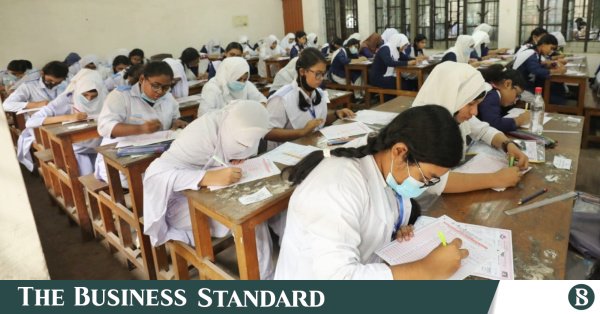
Students at a classroom giving the HSC exams: Rajib Dhar/TBS
“>

Students at a classroom giving the HSC exams: Rajib Dhar/TBS
The strain in student-teacher relations since the July 2024 Uprising has come under renewed scrutiny following the sharp decline in this year’s Higher Secondary Certificate (HSC) and equivalent examination pass rates.
Teachers describe a changing classroom environment marked by declining student attention, growing indiscipline and, in some cases, a reluctance among teachers to speak freely. They question whether eroding trust between students and teachers has contributed to the poor results.
The concerns have emerged alongside prolonged learning losses from Covid-19, political upheaval, and longstanding weaknesses in the education system, which educationists say have compounded the challenges facing both students and teachers.

A changing classroom after July
The mass uprising appears to have altered classroom dynamics across institutions. Reports of teachers being harassed, changes in students’ behaviour, and teachers becoming increasingly cautious have raised concerns about the learning environment.
Mohammad Arifur Rahman, an English teacher at Dhaka Residential Model College, said students sat for the full syllabus this year under fairer examination conditions than in previous years. The absence of unfair advantages previously available to examinees also contributed to the lower results, he said.
But the disruption went beyond examinations. The July Uprising and subsequent election interrupted studies, while students’ general interest in learning has declined, according to Arifur.
Infographic: TBS
“>

Infographic: TBS
Some students now question the value of higher education after seeing people reach leadership positions without pursuing formal studies, he said. Political influence, excessive social media use, and unfamiliar question patterns have also affected their preparation.
The picture, however, is not uniform. Arnab, an HSC student who secured a GPA-5 from St Gregory’s School, said students continue to value their teachers’ guidance and recognise their contribution to academic success. “We respect our teachers. We owe this success to their efforts,” he said.
Yet teachers’ accounts suggest that maintaining such relationships has become increasingly difficult in some institutions.
Anjan Chakraborty, a teacher at Abhaynagar Adarsha High School in Jashore, said some students even leave classrooms mid-lessons and behave disrespectfully towards teachers. Many have yet to regain their concentration since the pandemic, he added.
Some students were also used for political purposes after the uprising, while a tendency to achieve objectives through force has emerged. Drug abuse and online gambling are further aggravating behavioural problems, he said.
Teachers feel increasingly constrained
The strain is not limited to students’ conduct. Teachers themselves say they have become more guarded in the classroom following incidents of harassment at educational institutions after the mass uprising.
A teacher at a reputed Dhaka institution, speaking on condition of anonymity, said relations had deteriorated since 2024, leaving teachers uncertain about how students might respond to certain discussions.
“Not all students are alike. There are good and well-mannered students, too. But most students now display a certain degree of arrogance. I believe this has affected our spontaneity in teaching,” the teacher said.
Beyond student behaviour: a systemic failure
Educationists caution that the crisis cannot be explained by student behaviour or strained teacher-student relations alone. They point to accumulated learning gaps, political and social disruption, and an education system that has struggled to respond.
Professor Mohammad Mojibor Rahman of Dhaka University’s Institute of Education and Research said students entered higher secondary education carrying substantial learning deficits from the Covid period, some dating back to primary school. Political turmoil following the July Uprising compounded those gaps.
“But blaming students alone would simply be an attempt to evade responsibility. The social, cultural and political environment is also responsible. After the uprising, we failed to bring them back to their study desks,” he said.
He criticised the lack of systematic curriculum development and an effective education policy, comparing the country’s haphazard educational progress to unplanned urbanisation.
Educationist Professor Manzoor Ahmed said deteriorating student-teacher relations had affected learning, but students’ lack of concentration was only part of a wider problem. Teaching methods and structural weaknesses also required scrutiny, he said.
He argued that teachers and education officials often blamed students while overlooking the systemic nature of the crisis. Highly centralised class routines and periods lasting just 30-40 minutes, he added, may not give teachers enough time to complete the higher secondary curriculum effectively.
Restoring students’ engagement, educationists say, will require rebuilding trust, supporting teachers and addressing institutional weaknesses that continue to undermine the learning environment.
About The Author