Since eight years ago when President Trump pulled out of a nuclear deal with Tehran, Iran has accumulated 22,000 pounds, or 11 tons, of enriched uranium. But the fate of Iran’s stockpile remains a mystery, two months after the United States began a war meant to prevent Iran from ever building an atomic bomb.
Uranium can light cities or destroy them. Low concentrations can power nuclear reactors. Higher concentrations, from a process called enrichment, can make nuclear bombs.
Concentrations in Iran’s stockpile
Uranium enrichment gets increasingly easy and fast as concentrations rise. It’s much harder to get to 20 percent from 0 percent than to 60 percent from 20 percent, or even to 90 percent — the preferred level for making nuclear arms.
Iran began enriching uranium on an industrial scale in 2006, describing its aims as peaceful. Reports from the International Atomic Energy Agency showed the stockpile growing over the next few years.
Chart shows the increasing stockpile of uranium enriched up to 5 percent, in light purple, from 2008 to 2010.
In 2010, Iran said it would begin enriching uranium up to 20 percent — ostensibly to make fuel for a research reactor. This level is the official dividing line between civilian and military uses.
Chart shows the increasing stockpile of uranium enriched up to 5 percent, in light purple, from 2008 to 2013, when it reaches about 20,000 pounds. A new area on the chart, in medium purple and indicating 20 percent enrichment, grows from 2010 onward.
The 20 percent level was alarming because it was about 80 percent of the way to bomb-grade fuel.
Chart zooms in into the area of uranium enriched to 20 percent.
As the stockpile kept growing, the Obama administration began talks to curb it.
In 2015, Iran and six nations led by the United States reached an accord that limited the purity of its enriched uranium to 3.67 percent and the size of its stockpile until 2030.
Chart extends to show the increasing stockpile of uranium enriched to 5 percent, in light purple, from 2008 to 2015. The area of enriched to 20 percent is visible from 2010 to 2014.
Under the deal, Tehran shipped 25,000 pounds of enriched uranium, or 12.5 tons, and restricted the size of its stockpile to under 660 pounds.
Chart extends to show the stockpile of uranium enriched up to 2018, with the limit on its size imposed by the 2015 deal marked with a red line. The chart also shows a huge drop in the levels of enriched uranium after 2016.
Iran lacked a single bomb’s worth of uranium in 2018, when Mr. Trump withdrew the United States from the pact and reimposed a series of tough economic sanctions.
Then Iran began to enrich above the deal’s limit, first at low enrichment levels to pressure the West and then up to 20 percent in early 2021, just before Mr. Trump left office.
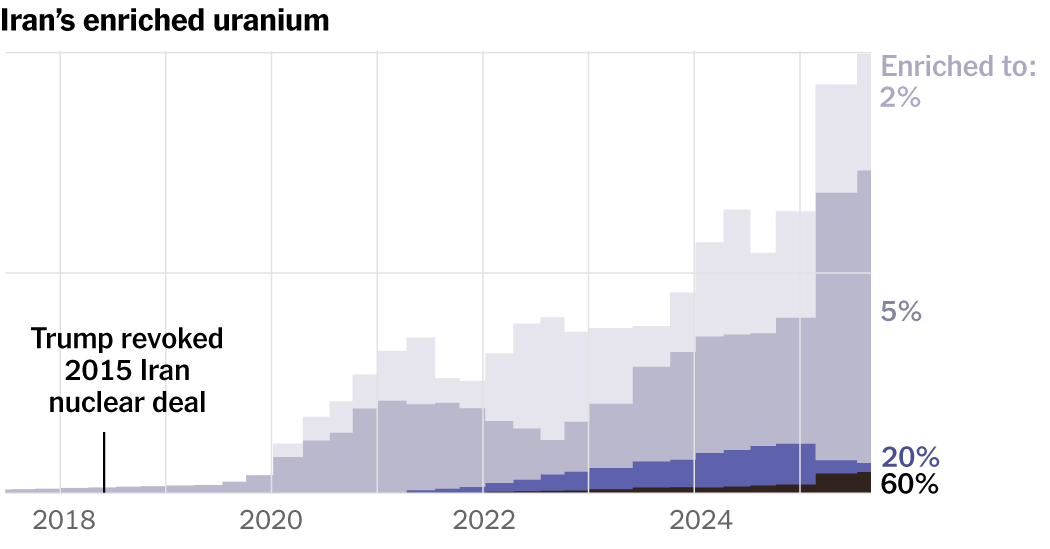
Chart shows the stockpile of uranium enriched from 2016 to 2022, and highlights May 2018, when Trump revoked the Iran nuclear deal.
The Biden administration tried, unsuccessfully, to restore aspects of the abandoned deal. Throughout the negotiations, Iran enriched uranium to an unprecedented level of up to 60 percent — a hairsbreadth away from the preferred grade for atom bombs.
Chart shows the stockpile of uranium enriched from 2019 to 2025, with all levels of enrichment increasing. Enrichment to 60 percent is also visible in dark colors from 2021 to 2025.
With Mr. Trump again in office in 2025, Iran’s stockpile of enriched uranium grew at the fastest rate since the International Atomic Energy Agency started reporting.
Chart zooms out to see the entire extent of the timeline, from 2006 to 2025.
In June 2025, during the 12-day war, the United States bombed Iran’s enrichment plants at Natanz and Fordow, as well as its uranium storage tunnels at Isfahan. One month later, Iran suspended cooperation with the I.A.E.A., ending the monitoring of the nation’s enrichment sites.
In the absence of on-site inspections and despite satellite monitoring, the location of the 11-ton stockpile remains uncertain.
Radioactive and chemically hazardous, parts of the stockpile remain hidden or buried under wartime rubble, making them difficult targets to access or destroy. It’s even a challenge to confirm they exist.
Even if Iran were to dig out the uranium, experts said, it would take many months — perhaps more than a year — to turn it into a warhead. Experts said that Iran, when the war started, posed no imminent threat, as it was up to years away from making a nuclear weapon.
The Trump administration has argued that U.S. satellites are monitoring the deeply buried uranium and that the cache is of little or no use to Iran because of the wide destruction of its nuclear sites and know-how.
Analysts question these assertions. They say Iran last year may have set up an enrichment plant in the mountain tunnels that adjoin its Isfahan site, where Tehran is also seen as storing the bulk of its uranium stockpile. If so, they say, that raises the possibility that Iran has a covert site where it might conduct new rounds of fuel enrichment to make fuel for an atomic bomb.
Methodology
To extract enrichment figures, The New York Times reviewed reports published quarterly by the International Atomic Energy Agency from 2003 to 2025. The agency started to report enrichment figures in February 2008. In 2016, it reported that the stockpile did not exceed 300 kilograms, or 660 pounds, of 3.67 percent enriched uranium, without providing exact figures.
About The Author