Throughout April, a similar picture has emerged in mango-growing areas, where both small and mature fruits are seen scattered beneath trees.
Heatwave and drought trigger premature mango drop, raising production concerns among Rajshahi growers this season. Photo: BSS
“>

Heatwave and drought trigger premature mango drop, raising production concerns among Rajshahi growers this season. Photo: BSS
The ongoing heatwave and prolonged dry spell are adversely affecting mango orchards in Rajshahi, raising concerns among growers over potential production losses this season.
With soil moisture levels falling due to the lack of rainfall, raw mangoes are dropping prematurely from trees across the region.
In some orchards, farmers are also reporting signs of rot and pest infestations, compounding their worries.

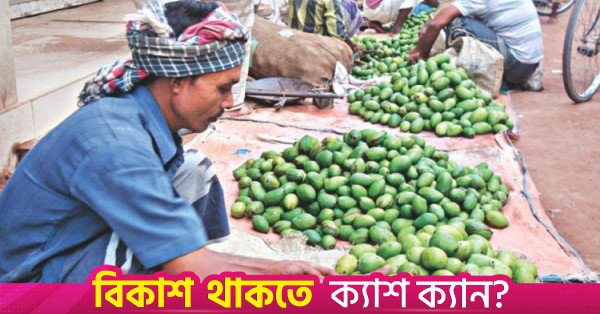
Throughout April, a similar picture has emerged in mango-growing areas, where both small and mature fruits are seen scattered beneath trees.
While some have spoiled, others remain intact but have not ripened. Many growers fear that more fruit could drop if the current weather persists.
According to the Rajshahi Weather Office, the region has received almost no rainfall in recent weeks. Only 1.4 mm of rain was recorded on 7 April and 9.2 mm on 28 March.
Temperatures began rising sharply from mid-March, intensifying into a severe heatwave in April.
During a visit to an orchard in the Budhpara area, fallen mangoes were seen covering the ground.
Orchard owner Shahin said drought conditions have weakened the trees’ ability to retain fruit. He said that if the situation continues, up to half of the mangoes could be lost.
Mahbub Islam, a grower from Puthia upazila, said the season had started with promise, as favourable weather led to abundant blossoms and good fruit setting.
However, continuous high temperatures have reversed that outlook.
“It’s difficult for trees to hold onto mangoes at 40øC,” he said, adding that irrigation could have reduced losses. He estimated that about 30% of his mangoes have already dropped.
Monir Hossain, a farmer from Parila village in Paba upazila with 300 trees, echoed similar concerns.
“We were advised to irrigate, but there is a water shortage here. Rain would have helped a lot,” he said.
However, some growers have managed to limit losses through regular irrigation.
Hanif Mondal of Charghat, who has around 500 trees of different varieties, said timely watering helped him protect his crop.
“I irrigated three times during the dry spell, so the mangoes are holding. Otherwise, the situation would have been the same,” he said.
The Department of Agricultural Extension (DAE) in Rajshahi said mango cultivation has expanded to 19,062 hectares this year, with a production target of 244,000 tonnes.
Shafiqul Islam, Principal Scientific Officer at the Rajshahi Fruit Research Station, said fruit drop can occur naturally when trees bear excessive loads. However, he noted that water scarcity is a key factor this season.
“Due to drought, soil moisture has declined, limiting nutrient supply to the trees. This leads to fruit drop. Adequate irrigation could reduce the losses significantly,” he said.
Meanwhile, Mohammad Nasir Uddin, Deputy Director of the DAE in Rajshahi, said there is no shortage of fuel and that farmers are being supported with fuel access cards.
“Some fruit drop is normal under these conditions and would have occurred anyway. Even if one mango develops per blossom, it still indicates a strong yield,” he added.
About The Author