The decisions were taken at an inter-ministerial meeting chaired by Home Minister Salahuddin Ahmed on 15 September, attended by representatives of relevant agencies.
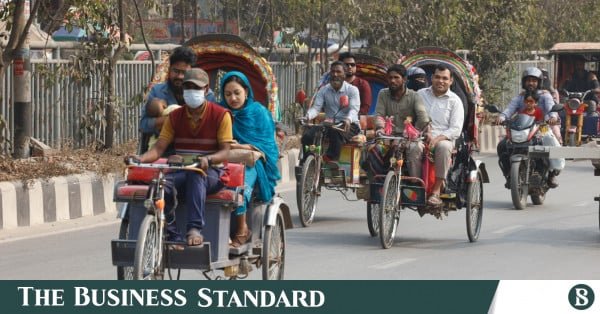
Battery-run rickshaws on a Dhaka street. File photo: Syed Zakir Hossain/TBS
“>

Battery-run rickshaws on a Dhaka street. File photo: Syed Zakir Hossain/TBS
The government has ordered authorities to identify and shut down illegal charging points through regular drives to ease Dhaka’s traffic congestion, while making traffic approval mandatory before roadwork and imposing penalties for delays in completing development projects.
The decisions were taken at an inter-ministerial meeting chaired by Home Minister Salahuddin Ahmed on 15 September, attended by representatives of relevant agencies.
The Power Division has been instructed to act against charging points illegally drawing electricity by hooking into power lines and report the measures to the home ministry. The Power Division, Dhaka Metropolitan Police (DMP) and city corporations will jointly identify illegally operated factories and establishments and take legal action against them.

Authorities were also directed to quickly remove soil and construction materials dumped beside roads near the Dhaka Airport Flyover and make the roads suitable for traffic. They must also identify roads that have remained closed for long periods and take steps to reopen them for public movement.
Traffic approval before roadwork, penalties for delays
Traffic department approval will be mandatory before development work begins in DMP areas, as agencies often notify traffic officials only two or three days before work or start excavation without permission, causing congestion.
Under the new rules, city corporations, the Roads and Highways Department (RHD) and other agencies must obtain the traffic department’s opinion before seeking road excavation permits and submit a traffic management plan (TMP), work schedule and safety information. A joint site inspection with the relevant traffic division’s deputy commissioner will also be required.
For major roads, DMP traffic must be informed after DTCA approval. The same rules apply to branch roads, though closure may be allowed where alternative routes exist.
Construction must be carried out from 10pm to 6am on working days. Agencies have also been advised to use additional manpower and equipment for 24-hour work on Fridays and Saturdays to speed up completion and reduce disruption.
Development agencies must meet declared deadlines and follow approved schedules. Contractors missing deadlines will face legal action and fines, with the action reported to the DMP traffic division. DMP reports will receive priority in future contractor evaluations.
Under the DTCA Act 2012, a traffic impact assessment (TIA) is mandatory before any development project that could affect traffic movement. DTCA will give final project approval based on recommendations from the DMP traffic division.
The TIA must assess the project’s impact on the entire Dhaka road network, using recognised traffic modelling methods to develop and compare multiple traffic-management scenarios before selecting the most effective option. A traffic management and diversion plan based on the selected scenario must then be submitted to DTCA for approval. Failure to properly implement an approved TIA or TMP will result in fines and legal action.
Safety measures at construction sites
Development agencies must deploy adequate numbers of trained traffic signalmen at every construction site, working directly under the relevant traffic division. Agencies will be responsible for their training.
Small potholes on alternative roads affected by construction must be repaired quickly. Construction materials, sand and equipment cannot be placed on usable traffic lanes or footpaths.
Construction sites must be enclosed on both sides with concrete or steel barriers at least 5–6 feet high to prevent accidents. Sites must also have adequate water tanks and fire extinguishers, along with signboards displaying emergency numbers for the Fire Service and police.
Residents in surrounding areas must be informed about construction before work begins through public announcements or other publicity. Necessary fill plates must also be installed over footpaths or drains to maintain movement of motorcycles and other small vehicles.
Monthly review of development work
Monthly joint review meetings will be mandatory to assess road development and construction work in Dhaka and address temporary public suffering caused by such projects.
The DMP additional police commissioner (traffic) will chair at least one meeting each month with development agencies and contractors to review progress, schedules and public impact. The DMP traffic division will present illustrated reports on congestion, safety risks and other problems, with agencies required to resolve them and report progress.
Special measures will be taken to maintain normal traffic near schools during public examinations and ensure uninterrupted emergency patient transport around hospitals. Dust control, water spraying and compliance with noise pollution laws will also be mandatory.
A coordination committee headed by DTCA will include representatives from the Ministry of Railways, Bangladesh Bridge Authority, DMP, Dhaka WASA, Titas Gas, Dhaka Mass Transit Company Limited (DMTCL), Bangladesh Telecommunications Company Limited (BTCL), Rajuk and other relevant agencies.
The committee must prepare a detailed action plan within 10 days and submit it to the Home Ministry, covering development-work coordination, traffic management and reduction of public suffering.
A review meeting chaired by Home Minister Salahuddin Ahmed will be held at 3pm on 1 October.
About The Author